Search


引用和文献 (17)
Invitrogen™
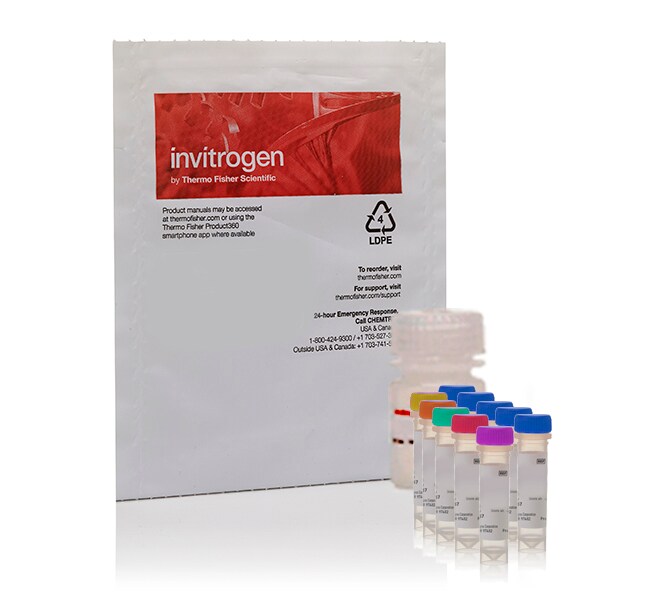
Amplex™ Red 磷脂酶 D 检测试剂盒
Amplex™ Red 磷脂酶 D 检测试剂盒为检测磷脂酶 D (PLD) 活性提供了一种灵敏而简单的方法,可使用荧光微孔板读数仪或荧光计进行检测。查看我们完整的荧光微孔板检测产品线。•检测到低至了解更多信息
| 货号 | 数量 |
|---|---|
| A12219 | 500 Assays |
货号 A12219
价格(CNY)
5,921.00
Each
数量:
500 Assays
价格(CNY)
5,921.00
Each
Amplex™ Red 磷脂酶 D 检测试剂盒为检测磷脂酶 D (PLD) 活性提供了一种灵敏而简单的方法,可使用荧光微孔板读数仪或荧光计进行检测。
查看我们完整的荧光微孔板检测产品线。
•检测到低至 10 U/mL 的磷脂酶 D 活性水平
• 产品规格允许在多个时间点测量
• 设计用于尽可能减少自发荧光干扰
PLD 活性可以使用 10-乙酰基-3,7-二羟基吩嗪(Amplex™ Red 试剂)进行间接监测,这是一种针对过氧化氢的灵敏荧光探针。PLD 将磷脂酰胆碱(卵磷脂)转化为胆碱,后者然后被胆碱氧化酶氧化为甜菜碱和过氧化氢。在存在辣根过氧化物酶的情况下,过氧化氢与 Amplex™ Red 试剂以 1:1 的化学计量比发生反应,生成具有强烈荧光的产物试卤灵。
因为试卤灵的最大吸收和荧光发射波长分别约为 571 nm 和 585 nm,所以大多数生物样品的自发荧光对其几乎没有干扰。
Amplex™ Red 测定试剂盒可用于广泛的研究范围
可提供一系列经过验证的 Amplex™ Red 测定试剂盒进行细胞信号转导和脂质、神经生物学、炎症和免疫功能以及代谢方面的研究。我们还提供具有更高灵敏度和更明亮荧光的第二代试剂——Amplex™ UltraRed 试剂(货号 A36006)—具有更高灵敏度和更明亮荧光的第二代试剂以及 Amplex™ Red/UltraRed 终止试剂(货号:A33855)。Amplex™ Red/UltraRed 终止试剂允许使用者在确定的时间点轻松控制和终止荧光信号生成反应。加入终止试剂之后,荧光信号能够保持稳定状态至少 3 个小时。还提供定制检测设计和包装。
查看我们完整的荧光微孔板检测产品线。
•检测到低至 10 U/mL 的磷脂酶 D 活性水平
• 产品规格允许在多个时间点测量
• 设计用于尽可能减少自发荧光干扰
PLD 活性可以使用 10-乙酰基-3,7-二羟基吩嗪(Amplex™ Red 试剂)进行间接监测,这是一种针对过氧化氢的灵敏荧光探针。PLD 将磷脂酰胆碱(卵磷脂)转化为胆碱,后者然后被胆碱氧化酶氧化为甜菜碱和过氧化氢。在存在辣根过氧化物酶的情况下,过氧化氢与 Amplex™ Red 试剂以 1:1 的化学计量比发生反应,生成具有强烈荧光的产物试卤灵。
因为试卤灵的最大吸收和荧光发射波长分别约为 571 nm 和 585 nm,所以大多数生物样品的自发荧光对其几乎没有干扰。
Amplex™ Red 测定试剂盒可用于广泛的研究范围
可提供一系列经过验证的 Amplex™ Red 测定试剂盒进行细胞信号转导和脂质、神经生物学、炎症和免疫功能以及代谢方面的研究。我们还提供具有更高灵敏度和更明亮荧光的第二代试剂——Amplex™ UltraRed 试剂(货号 A36006)—具有更高灵敏度和更明亮荧光的第二代试剂以及 Amplex™ Red/UltraRed 终止试剂(货号:A33855)。Amplex™ Red/UltraRed 终止试剂允许使用者在确定的时间点轻松控制和终止荧光信号生成反应。加入终止试剂之后,荧光信号能够保持稳定状态至少 3 个小时。还提供定制检测设计和包装。
仅供科研使用。不可用于诊断程序。
规格
检测方法荧光强度
染料类型Amplex Red
数量500 Assays
运输条件室温
底物属性基于脂质的底物、化学底物
底物类型磷脂酶底物
目标酶磷脂酶
发射波长范围585 nm
Excitation Wavelength Range571 nm
适用于(应用)Enzyme and Metabolic Activity
适用于(设备)Microplate Reader
产品线Amplex
产品类型磷脂酶检测
Unit SizeEach
内容与储存
在冷冻冰箱(-5°C 至 -30°C)中避光储存。
常见问题解答 (FAQ)
I'm using an Amplex Red kit, the reagent changes color to pink almost immediately in my own Krebs-Ringer buffer but not in HBSS. Why is this?
Can Amplex Red Assays be performed using cell lysates?
引用和文献 (17)
引用和文献
Abstract
Phospholipase D1 production of phosphatidic acid at the plasma membrane promotes exocytosis of large dense-core granules at a late stage.
Journal:J Biol Chem
PubMed ID:17540765
'Substantial efforts have recently been made to demonstrate the importance of lipids and lipid-modifying enzymes in various membrane trafficking processes, including calcium-regulated exocytosis of hormones and neurotransmitters. Among bioactive lipids, phosphatidic acid (PA) is an attractive candidate to promote membrane fusion through its ability to change membrane topology. To date,
Cholesterol distribution in the Golgi complex of DITNC1 astrocytes is differentially altered by fresh and aged amyloid beta-peptide-(1-42).
Journal:J Biol Chem
PubMed ID:12584199
'The Golgi complex plays an important role in cholesterol trafficking in cells, and amyloid beta-peptides (Abetas) alter cholesterol trafficking. The hypothesis was tested that fresh and aged Abeta-(1-42) would differentially modify Golgi cholesterol content in DINTC1 astrocytes and that the effects of Abeta-(1-42) would be associated with the region of
The antisignaling agent SC-alpha alpha delta 9, 4-(benzyl-(2-[(2,5-diphenyloxazole-4-carbonyl)amino]ethyl)carbamoyl)- 2-decanoylaminobutyric acid, is a structurally unique phospholipid analogue with phospholipase C inhibitory activity.
Journal:Mol Cancer Ther
PubMed ID:12481409
'Phospholipids and lipid second messengers mediate mitogenic signal transduction and oncogenesis, but there have been few successful examples of small molecules that affect biologically important phospholipid metabolism. Here we investigated the actions of a previously described antitumor agent, 4-(benzyl-(2-[(2,5-diphenyloxazole-4-carbonyl)amino]ethyl)carbamoyl)- 2-decanoylaminobutyric acid (SC-alpha alpha delta 9), which has antisignaling properties, on
Interfacial sensing by alveolar type II cells: a new concept in lung physiology?
Journal:Am J Physiol Cell Physiol
PubMed ID:21270294
'Alveolar type II (AT II) cells are in close contact with an air-liquid interface (I(AL)). This contact may be of considerable physiological relevance; however, no data exist to provide a satisfying description of this specific microenvironment. This is mainly due to the experimental difficulty to manipulate and analyze cell-air contacts
Loss of the ceramide transfer protein augments EGF receptor signaling in breast cancer.
Journal:Cancer Res
PubMed ID:22472120
'Triple-negative breast cancers (TNBC) are especially refractory to treatment due to their negative hormone receptor and ErbB2/HER2 status. Therefore, the identification of cancer-associated deregulated signaling pathways is necessary to develop improved targeted therapies. Here, we show that expression of the ceramide transfer protein CERT is reduced in TNBCs. CERT transfers