Search


引用和文献 (12)
Invitrogen™
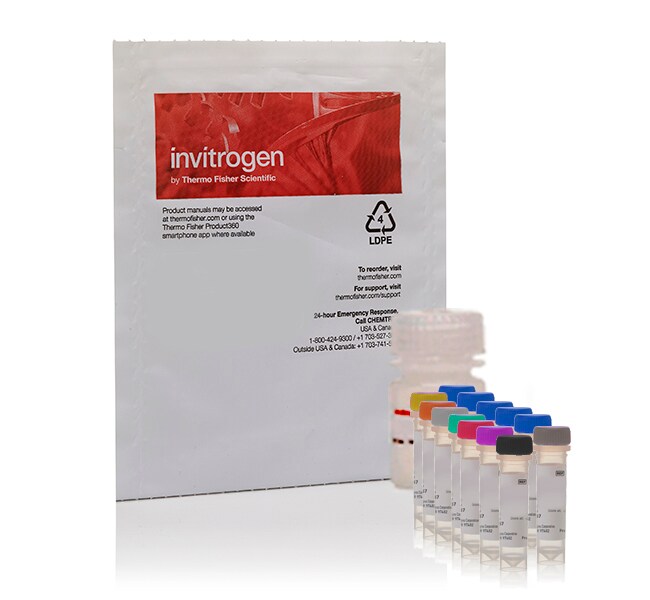
Amplex™ Red 鞘磷脂酶检测试剂盒
Amplex™ Red 鞘磷脂酶检测试剂盒为检测极低浓度的鞘磷脂酶提供了一种灵敏、快速且简单的荧光测定方法,可使用荧光微孔板读数仪或荧光计进行检测。查看我们完整的荧光微孔板检测产品线。•在 200 µL 测定试剂盒容积中检测到低至 80了解更多信息
| 货号 | 数量 |
|---|---|
| A12220 | 500 Assays |
货号 A12220
价格(CNY)
5,823.00
Each
数量:
500 Assays
价格(CNY)
5,823.00
Each
Amplex™ Red 鞘磷脂酶检测试剂盒为检测极低浓度的鞘磷脂酶提供了一种灵敏、快速且简单的荧光测定方法,可使用荧光微孔板读数仪或荧光计进行检测。
查看我们完整的荧光微孔板检测产品线。
•在 200 µL 测定试剂盒容积中检测到低至 80 µU/mL 的鞘磷脂酶活性水平
• 产品规格允许在多个时间点测量
• 设计用于尽可能减少自发荧光干扰
在这种酶偶联测定试剂盒中,鞘磷脂酶活性可以使用 10-乙酰基-3,7-二羟基吩嗪(Amplex™ Red 试剂)进行间接监测,这是一种针对过氧化氢的灵敏荧光探针。鞘磷脂酶可水解鞘磷脂以产生神经酰胺和磷酸胆碱。加入碱性磷酸酶,其水解磷酸胆碱形成胆碱。胆碱随后被胆碱氧化酶氧化形成甜菜碱和过氧化氢。在存在辣根过氧化物酶的情况下,过氧化氢与 Amplex™Red 试剂以 1:1 的化学计量比发生反应,生成具有强烈荧光的产物试卤灵。
因为试卤灵的最大吸收和荧光发射波长分别约为 571 nm 和 585 nm,所以大多数生物样品的自发荧光对其几乎没有干扰。
Amplex™ Red 测定试剂盒可用于广泛的研究范围
可提供一系列经过验证的 Amplex™ Red 测定试剂盒进行细胞信号转导和脂质、神经生物学、炎症和免疫功能以及代谢方面的研究。我们还提供具有更高灵敏度和更明亮荧光的第二代试剂——Amplex™ UltraRed 试剂(货号 A36006)—具有更高灵敏度和更明亮荧光的第二代试剂以及 Amplex™ Red/UltraRed 终止试剂(货号:A33855)。Amplex™ Red/UltraRed 终止试剂允许使用者在确定的时间点轻松控制和终止荧光信号生成反应。加入终止试剂之后,荧光信号能够保持稳定状态至少 3 个小时。还提供定制检测设计和包装。
查看我们完整的荧光微孔板检测产品线。
•在 200 µL 测定试剂盒容积中检测到低至 80 µU/mL 的鞘磷脂酶活性水平
• 产品规格允许在多个时间点测量
• 设计用于尽可能减少自发荧光干扰
在这种酶偶联测定试剂盒中,鞘磷脂酶活性可以使用 10-乙酰基-3,7-二羟基吩嗪(Amplex™ Red 试剂)进行间接监测,这是一种针对过氧化氢的灵敏荧光探针。鞘磷脂酶可水解鞘磷脂以产生神经酰胺和磷酸胆碱。加入碱性磷酸酶,其水解磷酸胆碱形成胆碱。胆碱随后被胆碱氧化酶氧化形成甜菜碱和过氧化氢。在存在辣根过氧化物酶的情况下,过氧化氢与 Amplex™Red 试剂以 1:1 的化学计量比发生反应,生成具有强烈荧光的产物试卤灵。
因为试卤灵的最大吸收和荧光发射波长分别约为 571 nm 和 585 nm,所以大多数生物样品的自发荧光对其几乎没有干扰。
Amplex™ Red 测定试剂盒可用于广泛的研究范围
可提供一系列经过验证的 Amplex™ Red 测定试剂盒进行细胞信号转导和脂质、神经生物学、炎症和免疫功能以及代谢方面的研究。我们还提供具有更高灵敏度和更明亮荧光的第二代试剂——Amplex™ UltraRed 试剂(货号 A36006)—具有更高灵敏度和更明亮荧光的第二代试剂以及 Amplex™ Red/UltraRed 终止试剂(货号:A33855)。Amplex™ Red/UltraRed 终止试剂允许使用者在确定的时间点轻松控制和终止荧光信号生成反应。加入终止试剂之后,荧光信号能够保持稳定状态至少 3 个小时。还提供定制检测设计和包装。
仅供科研使用。不可用于诊断程序。
规格
检测方法荧光
染料类型其他标记或染料
产品规格96 孔板
数量500 Assays
运输条件湿冰
适用于(应用)鞘磷脂酶测定试剂盒
适用于(设备)荧光计, 微孔板读数仪
产品线Amplex
产品类型红色鞘磷脂酶测定试剂盒
Unit SizeEach
内容与储存
在冷冻冰箱(-5°C 至 -30°C)中避光储存。
常见问题解答 (FAQ)
I'm using an Amplex Red kit, the reagent changes color to pink almost immediately in my own Krebs-Ringer buffer but not in HBSS. Why is this?
Can Amplex Red Assays be performed using cell lysates?
引用和文献 (12)
引用和文献
Abstract
Involvement of the acid sphingomyelinase pathway in uva-induced apoptosis.
Journal:J Biol Chem
PubMed ID:11278294
'The sphingomyelin-ceramide pathway is an evolutionarily conserved ubiquitous signal transduction system that regulates many cell functions including apoptosis. Sphingomyelin (SM) is hydrolyzed to ceramide by different sphingomyelinases. Ceramide serves as a second messenger in mediating cellular effects of cytokines and stress. In this study, we find that acid sphingomyelinase (SMase)
Combination brain and systemic injections of AAV provide maximal functional and survival benefits in the Niemann-Pick mouse.
Journal:Proc Natl Acad Sci U S A
PubMed ID:17517638
'Niemann-Pick disease (NPD) is caused by the loss of acid sphingomyelinase (ASM) activity, which results in widespread accumulation of undegraded lipids in cells of the viscera and CNS. In this study, we tested the effect of combination brain and systemic injections of recombinant adeno-associated viral vectors encoding human ASM (hASM)
Protection from high fat diet-induced increase in ceramide in mice lacking plasminogen activator inhibitor 1.
Journal:J Biol Chem
PubMed ID:18359942
'Obesity increases the risk for metabolic and cardiovascular disease, and adipose tissue plays a central role in this process. Ceramide, the key intermediate of sphingolipid metabolism, also contributes to obesity-related disorders. We show that a high fat diet increased ceramide levels in the adipose tissues and plasma in C57BL/6J mice
Counteracting suppression of CFTR and voltage-gated K+ channels by a bacterial pathogenic factor with the natural product tannic acid.
Journal:
PubMed ID:25313718
'Mutations in the cystic fibrosis transmembrane conductance regulator (CFTR) cause recurring bacterial infection in CF patients'' lungs. However, the severity of CF lung disease correlates poorly with genotype. Antibiotic treatment helps dramatically prolong patients'' life. The lung disease generally determines prognosis and causes most morbidity and mortality; early control of
Ceramide upregulation causes pulmonary cell apoptosis and emphysema-like disease in mice.
Journal:Nat Med
PubMed ID:15852018
'Alveolar cell apoptosis is involved in the pathogenesis of emphysema, a prevalent disease primarily caused by cigarette smoking. We report that ceramide, a second messenger lipid, is a crucial mediator of alveolar destruction in emphysema. Inhibition of enzymes controlling de novo ceramide synthesis prevented alveolar cell apoptosis, oxidative stress and