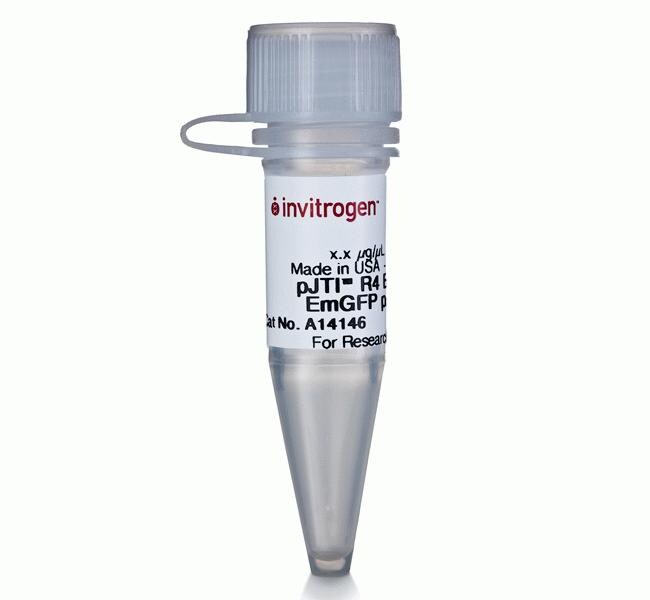
pJTI™ R4 Exp CMV EmGFP pA 载体

pJTI™ R4 Exp CMV EmGFP pA 载体

The pJTI™ R4 Exp CMV EmGFP pA vector is a positive control vector for assessing the success of a retargeting了解更多信息
Have Questions?
货号数量
A14146100 μg
货号 A14146
价格(CNY)
3,554.00
Each
添加至购物车
数量:
100 μg
价格(CNY)
3,554.00
Each
添加至购物车
The pJTI™ R4 Exp CMV EmGFP pA vector is a positive control vector for assessing the success of a retargeting reaction with a Jump-In™ parental cell line. When co-transfected with the integrase vector (pJTI™ R4 Int vector) included in the Jump-In™ parental kits, the EmGFP will be expressed and positive cells will fluoresce green.

Ensure the Success of Your Jump-In™ Retargeting Reactions
Successful retargeting of Jump-In™ parental cell lines like the the Jump-In™ GripTite™ HEK293 kit (A14150) is dependent on a variety of factors such as:

Transfection efficiency

• Cell confluency
• Antibiotic selection conditions
• Quality and concentration of DNA
• Retargeting vector to integrase vector ratio

We strongly recommend including a retargeting reaction with the pJTI™ R4 Exp CMV EmGFP pA vector in your Jump-In™ experiment along with negative controls (no plasmid DNA, no integrase vector) so you can easily visualize the results and optimize the retargeting conditions.

For Research Use Only. Not intended for any animal or human therapeutic or diagnostic use.
仅供科研使用。不可用于诊断程序。
规格
构成或诱导系统组成型
输送类型转染
适用于(应用)稳定的细胞系开发、靶向整合
产品规格液体
产品类型哺乳动物表达载体
数量100 μg
选择试剂(真核生物)
运输条件干冰
载体Jump-In 载体
克隆方法Gateway™
产品线Jump-In
促进剂CMV
蛋白标记未标记
Unit SizeEach
内容与储存
接收后立即将载体储存于 -20°C 下

常见问题解答 (FAQ)

你们是否提供表达GFP的哺乳动物载体,这样我就可将其作为参照来监测我的转染和表达情况?

我们提供pJTI R4 Exp CMV EmGFP pA载体,货号A14146,您可使用这一产品来监控转染和表达情况。

Do you offer a GFP-expressing mammalian expression vector that I can use as a control to monitor my transfection and expression?

We offer pJTI R4 Exp CMV EmGFP pA Vector, Cat. No. A14146, which you can use to monitor your transfection and expression.

When should I consider reversible integration (Flp-In system) vs irreversible integration (Jump-In system)?

Use irreversible integration (Jump-In system) if the transgene should be sustained in the mammalian genome for a long time. Use reversible integration such as Flp-In system if the transgene needs to be replaced with another gene of interest after a short period of time.

What controls do I need in the Jump-In system to check for the successful retargeting of the platform line?

The second step in targeted integration is the retargeting event mediated by the R4 integrase where the genetic elements of interest are site-specifically transferred from the retargeting expression construct (created using the MultiSite Gateway Pro module) onto the genome of the platform line. This integration event also positions the EF1alpha promoter upstream of the blasticidin, neomycin, or eosin resistance gene (i.e., "promoterless" selection marker), thus allowing the selection of transformants that are successfully "retargeted" using the appropriate selection agent. Although you select from successfully retargeted clones using the blasticidin, Geneticin, or Zeocin antibiotic, you may also perform a nested PCR to amplify the region from the EF1alpha promoter to the appropriate resistance gene. You can amplify the hygromycin resistance gene as a positive control. Similar to the platform line creation, you may also perform a Southern blot analysis with a probe designed for your gene of interest.

What controls do I need in the Jump-In system to check for the presence of the R4 target site after the creation of the platform cell line?

A platform cell line is created when the R4 attP retargeting sequences are site-specifically inserted into the mammalian genome via PhiC31 Int-mediated recombination. In addition to the R4 retargeting sequences, this integration event introduces the hygromycin resistance gene under the control of the HSV TK promoter and the promoterless Bsd, Neo, or Zeo resistance marker, depending on the platform vector used (i.e., pJTI/Bsd, pJTI/Neo, or pJTI/Zeo). Although you select for transformants carrying the R4 retargeting sequences by their resistance to hygromycin, you may perform PCR analysis to check the integrity of the R4 attP retargeting sequences. For this, we recommend amplifying the region from the R4 attP sequence to the appropriate resistance marker (depending on the platform line used) using the genomic DNA from the platform line. A nested PCR is recommended to reduce the high background you may observe with only primary PCR. Alternatively, you may create a labeled DNA probe by PCR amplifying an approximately 1.5 kb region covering the retargeting sequences, and then perform a Southern blot analysis. The Southern blot will also act as an additional check to verify that only a single copy of the retargeting sequence is integrated into the genome.