Search


引用和文献 (39)
Invitrogen™
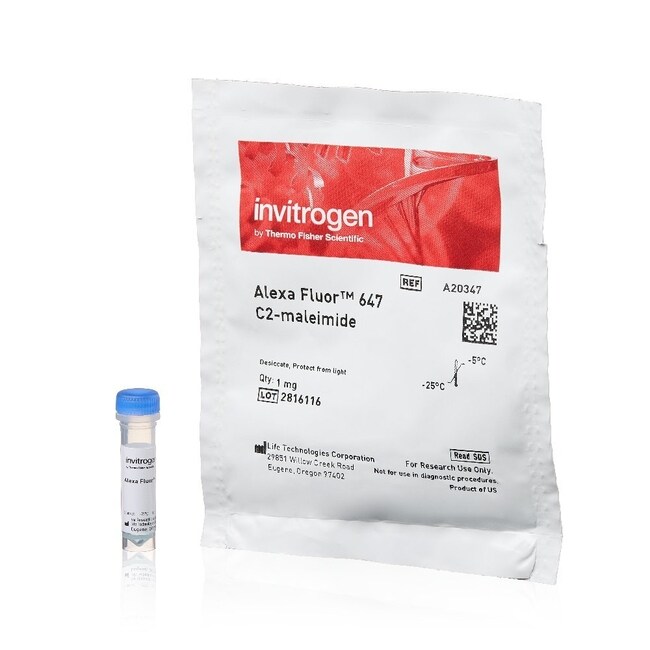
Alexa Fluor™ 647 C2 马来酰亚胺
Alexa Fluor™ 647 是一种明亮的远红外荧光染料,其激发光谱非常适合于 594 nm 或 633 nm 激光谱线了解更多信息
| 货号 | 数量 |
|---|---|
| A20347 | 1 mg |
货号 A20347
价格(CNY)
5,939.00
Each
数量:
1 mg
价格(CNY)
5,939.00
Each
Alexa Fluor™ 647 是一种明亮的远红外荧光染料,其激发光谱非常适合于 594 nm 或 633 nm 激光谱线。Alexa Fluor™ 647 染料用于成像和流式细胞分析中稳定信号的生成,具有水溶性和 pH 值不敏感性 (pH 4 - pH 10)。除反应性染料制剂外,我们还提供可与多种抗体、肽、蛋白、示踪剂和扩增底物偶联并且针对细胞标记和检测进行优化的 Alexa Fluor™ 647 染料(了解更多信息)。
Alexa Fluor™ 647 的马来酰亚胺衍生物是将该染料与蛋白、寡核苷酸硫代磷酸盐或低分子量配体上的硫醇基团偶联的较常用工具。所得 Alexa Fluor™ 647 偶联物显示出比其他光谱相似荧光基团的偶联物更亮的荧光和更高的光稳定性。
关于该 AlexaFluor™ 马来酰亚胺的详细信息:
荧光基团标记:Alexa Fluor™ 647 染料
反应性基团:马来酰亚胺
反应性:蛋白质和配基上的硫醇基团、寡核苷酸硫代磷酸盐
偶联物的 Ex/Em:651/671 nm
消光系数:265,000 cm-1M-1
光谱类似染料:Cy5
分子量:∼1250
典型偶联反应
在适当的缓冲液(10-100 mM 磷酸盐、Tris 或 HEPES)中,在 pH 值为 7.0-7.5 的环境下该蛋白的溶解浓度应为 50-100 µM。在此 pH 值范围内,蛋白硫醇基团亲核性强,在存在不计其数的蛋白胺(这些蛋白胺经过质子化,并且相对不具反应性)时,几乎仅与试剂反应。我们建议此时使用达到 DTT 或 TCEP 等还原剂摩尔量10倍的浓度还原所有二硫键。必须通过透析去除过量的 DTT,应在无氧条件下进行后续硫醇修饰,以防止二硫键再形成;在马来酰亚胺偶联之前使用 TCEP 时,无需采取这些预防措施。
Alexa Fluor™ 马来酰亚胺通常在即将使用前溶于高质量无水二甲亚砜 (DMSO) 中,浓度为1-10 mM,储备液应尽可能避光储存。通常,将这种储备液逐滴加入蛋白溶液中,同时搅拌,产生大约10-20摩尔试剂/摩尔蛋白,反应在室温下进行2小时,或在 4°C 下过夜避光进行。通过添加过量的谷胱甘肽、巯基乙醇或其他可溶性低分子量硫醇,可以消耗任何未反应的硫醇反应性试剂。
偶联物纯化
通常使用凝胶过滤柱(如 Sephadex™ G-25、BioGel™ P-30 或等效物)将标记抗体与游离 Alexa Fluor™ 染料分离。对于更大或更小的蛋白,选择具有适当分子量滤除点的凝胶过滤介质或通过透析纯化。我们提供了多种优化的纯化试剂盒,可用于不同量抗体偶联物:
0.5-1 mg 用抗体偶联物纯化试剂盒 (A33086)
20-50 µg 用抗体偶联物纯化试剂盒 (A33087)
50-100 µg 用抗体偶联物纯化试剂盒 (A33088)
了解关于蛋白和抗体标记的更多信息
我们提供一系列 Molecular Probes™ 抗体和蛋白标记试剂盒,旨在满足您的起始材料和实验设置需求。参见我们的抗体标记试剂盒或使用我们的标记化学选择工具进行其他选择。欲了解有关我们标记试剂盒的更多信息,请参阅 Molecular Probes™ 手册中第 1.2 节—蛋白和核酸标记试剂盒。
我们还’可为您定制偶联物
如果您’无法在我们的在线目录中找到’想要的产品,我们还’可为您定制抗体或蛋白偶联物。我们的定制偶联服务是高效和保密的,我们保证我们的工作质量。我们经过ISO 9001:2000认证。
Alexa Fluor™ 647 的马来酰亚胺衍生物是将该染料与蛋白、寡核苷酸硫代磷酸盐或低分子量配体上的硫醇基团偶联的较常用工具。所得 Alexa Fluor™ 647 偶联物显示出比其他光谱相似荧光基团的偶联物更亮的荧光和更高的光稳定性。
关于该 AlexaFluor™ 马来酰亚胺的详细信息:
荧光基团标记:Alexa Fluor™ 647 染料
反应性基团:马来酰亚胺
反应性:蛋白质和配基上的硫醇基团、寡核苷酸硫代磷酸盐
偶联物的 Ex/Em:651/671 nm
消光系数:265,000 cm-1M-1
光谱类似染料:Cy5
分子量:∼1250
典型偶联反应
在适当的缓冲液(10-100 mM 磷酸盐、Tris 或 HEPES)中,在 pH 值为 7.0-7.5 的环境下该蛋白的溶解浓度应为 50-100 µM。在此 pH 值范围内,蛋白硫醇基团亲核性强,在存在不计其数的蛋白胺(这些蛋白胺经过质子化,并且相对不具反应性)时,几乎仅与试剂反应。我们建议此时使用达到 DTT 或 TCEP 等还原剂摩尔量10倍的浓度还原所有二硫键。必须通过透析去除过量的 DTT,应在无氧条件下进行后续硫醇修饰,以防止二硫键再形成;在马来酰亚胺偶联之前使用 TCEP 时,无需采取这些预防措施。
Alexa Fluor™ 马来酰亚胺通常在即将使用前溶于高质量无水二甲亚砜 (DMSO) 中,浓度为1-10 mM,储备液应尽可能避光储存。通常,将这种储备液逐滴加入蛋白溶液中,同时搅拌,产生大约10-20摩尔试剂/摩尔蛋白,反应在室温下进行2小时,或在 4°C 下过夜避光进行。通过添加过量的谷胱甘肽、巯基乙醇或其他可溶性低分子量硫醇,可以消耗任何未反应的硫醇反应性试剂。
偶联物纯化
通常使用凝胶过滤柱(如 Sephadex™ G-25、BioGel™ P-30 或等效物)将标记抗体与游离 Alexa Fluor™ 染料分离。对于更大或更小的蛋白,选择具有适当分子量滤除点的凝胶过滤介质或通过透析纯化。我们提供了多种优化的纯化试剂盒,可用于不同量抗体偶联物:
0.5-1 mg 用抗体偶联物纯化试剂盒 (A33086)
20-50 µg 用抗体偶联物纯化试剂盒 (A33087)
50-100 µg 用抗体偶联物纯化试剂盒 (A33088)
了解关于蛋白和抗体标记的更多信息
我们提供一系列 Molecular Probes™ 抗体和蛋白标记试剂盒,旨在满足您的起始材料和实验设置需求。参见我们的抗体标记试剂盒或使用我们的标记化学选择工具进行其他选择。欲了解有关我们标记试剂盒的更多信息,请参阅 Molecular Probes™ 手册中第 1.2 节—蛋白和核酸标记试剂盒。
我们还’可为您定制偶联物
如果您’无法在我们的在线目录中找到’想要的产品,我们还’可为您定制抗体或蛋白偶联物。我们的定制偶联服务是高效和保密的,我们保证我们的工作质量。我们经过ISO 9001:2000认证。
仅供科研使用。不可用于诊断程序。
规格
化学反应性硫醇
发射671 nm
激发651 nm
标签或染料Alexa Fluor™ 647
产品类型染料
数量1 mg
反应一部分马来酰亚胺
运输条件室温
标签类型Alexa Fluor 染料
产品线Alexa Fluor
Unit SizeEach
内容与储存
储存在冰箱(-5 至 -30°C)中并避光。
引用和文献 (39)
引用和文献
Abstract
Membrane protein stoichiometry determined from the step-wise photobleaching of dye-labelled subunits.
Journal:Chembiochem
PubMed ID:17503420
Reversible transition between the surface trimer and membrane-inserted monomer of annexin 12.
Journal:Biochemistry
PubMed ID:15736950
'Under mildly acidic conditions, annexin 12 (ANX) inserts into lipid membranes to form a transbilayer pore [Langen, R., et al. (1998) Proc. Natl. Acad. Sci. U.S.A. 95, 14060]. In this study, we have addressed the question of the oligomeric state of ANX in this transbilayer conformation by means of Forster-type
Single-molecule studies of synaptotagmin and complexin binding to the SNARE complex.
Journal:Biophys J
PubMed ID:15821166
'The assembly of multiprotein complexes at the membrane interface governs many signaling processes in cells. However, very few methods exist for obtaining biophysical information about protein complex formation at the membrane. We used single molecule fluorescence resonance energy transfer to study complexin and synaptotagmin interactions with the SNARE complex in
Chaperoning of insertion of membrane proteins into lipid bilayers by hemifluorinated surfactants: application to diphtheria toxin.
Journal:Biochemistry
PubMed ID:16489756
'Hemifluorinated compounds, such as HF-TAC, make up a novel class of nondetergent surfactants designed to keep membrane proteins soluble under nondissociating conditions [Breyton, C., et al. (2004) FEBS Lett. 564, 312]. Because fluorinated and hydrogenated chains do not mix well, supramicellar concentrations of these surfactants can coexist with intact lipid
Multicolor single-molecule FRET to explore protein folding and binding.
Journal:Mol Biosyst
PubMed ID:20601974
'Proper protein function in cells, tissues and organisms depends critically on correct protein folding or interaction with partners. Over the last decade, single-molecule FRET (smFRET) has emerged as a powerful tool to probe complex distributions, dynamics, pathways and landscapes in protein folding and binding reactions, leveraging its ability to avoid