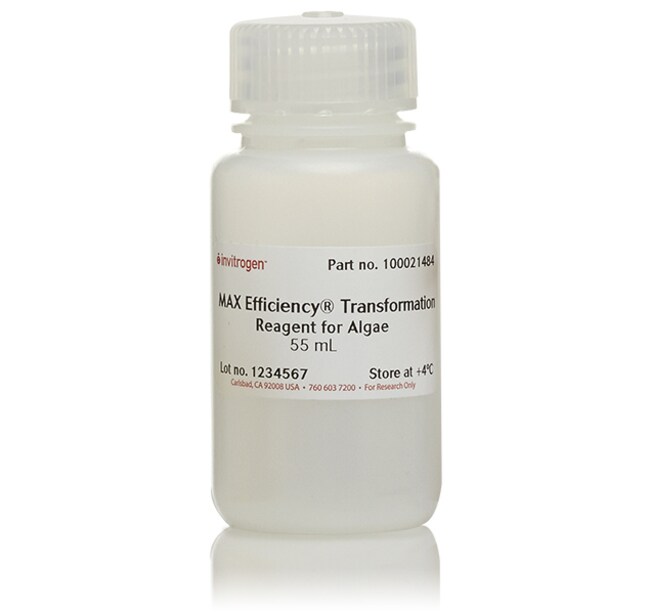
我正在使用藻类MAX Efficiency转化试剂转化衣藻。但是,转化效率非常低。如何能够对此进行改善?
请查看以下建议:
1. 为得到最佳结果,藻类细胞浓度应在1 x 10⁶至2 x 10⁶细胞/mL之间(OD范围为0.3-0.5)。细胞浓度不可超过3 x 106细胞/mL。可通过OD750检测细胞生长,线性范围将在0.2-1.2(在1 cm光路中)之间。如果OD值超出线性范围,请稀释并再次检测以获得准确读数。
公式为:细胞数= (OD750 – 0.088)/ 9 × 10⁶ /mL
2. 线性DNA转化比环状DNA转化的效率高很多(有效率约高出70%)。
3. DNA的质量和浓度对于转化效率至关重要。您将需要使用PureLink HQ、PureLink HiPure或相同质量的质粒纯化试剂盒进行DNA纯化。使用小体积的浓缩纯化DNA要比使用大体积的低浓度DNA更好。(如果您在转化线性质粒,则在线性化之后,您将需要在转化前使用凝胶提取或PCR净化试剂盒对质粒进行纯化处理。)我们建议每次电穿孔使用2 µg的线性质粒DNA。
4. 质粒DNA是随机插入到基因组的。通常,只有20%的转化株会明显表达目的基因。我们建议首先通过菌落PCR对菌落进行筛选,确保启动子和目的基因的完全整合,随后通过筛选多个阳性克隆,挑选出表达水平最高的克隆。
5. 由于C. reinhardtii基因组具有非常高的GC含量(约62% GC),如果目的基因适应了高表达C. reinhardtii基因的密码子使用偏好,则重组基因的表达水平会明显改善。
6. 由于转化效率取决于构建体向基因组的随机整合,电穿孔结果将取决于目的基因的性质。您可尝试转化试剂盒中的对照载体,从而确认试剂盒及其电穿孔方法是有效的。
我该使用哪种试剂对Chlamydomonas进行转化?
我们提供用于藻类的MAX Efficiency转化试剂(货号A24229)。8种不同的Chlamydomonas reinhardtii株——CC1690、CC2935、CC1009、CC4414、CC118、CC536、WT137c和CC3395 wall(-)——均使用藻类MAX Efficiency转化试剂及通过电穿孔用TAP/蔗糖试剂进行转化。以下数据显示,与使用TAP/蔗糖培养基相比,使用藻类MAX Efficiency转化试剂对C. reinhardtii WT137c进行培养可获得1000倍以上的克隆数(右)。
I am using the MAX Efficiency Transformation Reagent for Algae to transform Chlamydomonas. However, my efficiency is very low. Any suggestions on how to improve this?
Please see the following suggestions:
1. For best results, the algae need to be between 1 x 10e6 and 2 x 10e6 cells/mL (thus, an OD of 0.3-0.5). The concentration of the cells should not exceed 3 x 10⁶ cells/mL. Cell growth can be measured by OD750 and the linear range will be between 0.2 and 1.2 (in 1 cm lightpass). If the OD is out of the linear range, please dilute the cells and measure again to get an accurate reading.
The formula is: cell number = (OD750 - 0.088)/9 million/mL
2. Transformation of linearized DNA is much more efficient (~70% more efficient) than transformation of circular DNA.
3. The quality and concentration of the DNA are critical to the transformation efficiency. You will want to use PureLink HQ, PureLink HiPure, or equivalent plasmid purification kits for pure DNA. It is better to have a small volume of concentrated pure DNA than a large volume of DNA of low concentration. (If you are transforming linearized plasmid, then after the linearization you will need to clean the plasmid up using either gel extraction or a PCR cleanup kit prior to transformation.) We recommend using 2 µg of linearized plasmid DNA per electroporation.
4. Insertion of the plasmid DNA into the genome occurs randomly. On average, only 20% of transformants will express the gene of interest at appreciable levels. We recommend first screening the colonies by colony PCR to ensure full integration of the promoter and gene of interest, followed by the screening of several positive clones for the expression of the gene of interest to pick the highest expressing clone.
5. Because the C. reinhardtii genome has a very high GC content (~62% GC), the expression levels of recombinant genes are significantly improved if the gene of interest is adapted to the preferred codon usage of highly expressed C. reinhardtii genes.
6. Since the transformation efficiency depends on the random integration of the construct into the genome, the results of the electroporation will depend on the nature of the gene of interest. You can try to transform the control vector that comes with the kit to confirm that the kit and their electroporation method are working correctly.
Find additional tips, troubleshooting help, and resources within our Protein Expression Support Center.
What reagent should I use for transformation of Chlamydomonas?
We offer our MAX Efficiency Transformation Reagent for Algae (Cat. No. A24229). Eight different strains of Chlamydomonas reinhardtii, CC1690, CC2935, CC1009, CC4414, CC118, CC536, WT137c, and CC3395 wall(-), were transformed using MAX Efficiency Transformation Reagent for Algae and with TAP/sucrose reagent by electroporation with higher transformation efficiency resulting from use of MAX Efficiency Transformation Reagent for Algae.
Find additional tips, troubleshooting help, and resources within our Protein Expression Support Center.
What type of algae can the MAX Efficiency Transformation Reagent for Algae be used for?
The MAX Efficiency Transformation Reagent for Algae was developed for transforming the pChlamy_4 vector into the Chlamydomonas reinhardtii 137c cells by electroporation.
Find additional tips, troubleshooting help, and resources within our Protein Expression Support Center.