Search


引用和文献 (10)
Gibco™
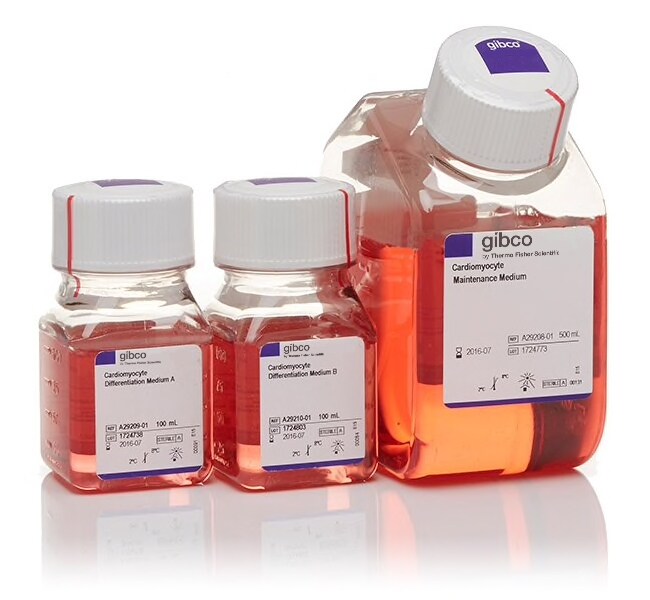
PSC 心肌细胞分化试剂盒
Gibco™ PSC 心肌细胞分化试剂盒由一组无血清和无异源培养基组成,能够在短短8天内有效地将人多能干细胞 (PSC) 分化为收缩的心肌细胞。与需要多种组分和更长测定持续时间的其他方法不同,PSC 心肌细胞分化试剂盒能够以即用型培养基形式在更短时间内从多能干细胞中生成心肌细胞。由三种不需要解冻或混合的 1X 培养基组成,依次使用每种培养基总共14天,从而得到能够表达相关生理标记物并可在培养中收缩的功能性心肌细胞,随后可以在培养中维持了解更多信息
| 货号 | 数量 |
|---|---|
| A2921201 | 1 kit |
货号 A2921201
价格(CNY)
7,350.00
飞享价
Ends: 31-Dec-2026
9,555.00共减 2,205.00 (23%)
Each
数量:
1 kit
价格(CNY)
7,350.00
飞享价
Ends: 31-Dec-2026
9,555.00共减 2,205.00 (23%)
Each
Gibco™ PSC 心肌细胞分化试剂盒由一组无血清和无异源培养基组成,能够在短短8天内有效地将人多能干细胞 (PSC) 分化为收缩的心肌细胞。与需要多种组分和更长测定持续时间的其他方法不同,PSC 心肌细胞分化试剂盒能够以即用型培养基形式在更短时间内从多能干细胞中生成心肌细胞。
由三种不需要解冻或混合的 1X 培养基组成,依次使用每种培养基总共14天,从而得到能够表达相关生理标记物并可在培养中收缩的功能性心肌细胞,随后可以在培养中维持 >15天。维持培养基也可单独购买(货号 A2920801)。
无需解冻或混合
PSC 心肌细胞分化试剂盒由无需冷冻储存的 1X 培养基组成,因此无需解冻或混合试剂。只需加温培养基,加入 PSC 培养物即可。
心肌细胞的迅速生产
PSC 心肌细胞分化试剂盒能够在短短8天内产生具有收缩性的心肌细胞。分化的心肌细胞随后可在培养中维持 >15 天。
高质量心肌细胞的生成
使用 PSC 心肌细胞分化试剂盒生成的心肌细胞具有功能相关性,可表达关键标记物如 TNNT2、Nkx2.5、MYH6 和 α-肌动蛋白;并且可以在培养中收缩。
由三种不需要解冻或混合的 1X 培养基组成,依次使用每种培养基总共14天,从而得到能够表达相关生理标记物并可在培养中收缩的功能性心肌细胞,随后可以在培养中维持 >15天。维持培养基也可单独购买(货号 A2920801)。
无需解冻或混合
PSC 心肌细胞分化试剂盒由无需冷冻储存的 1X 培养基组成,因此无需解冻或混合试剂。只需加温培养基,加入 PSC 培养物即可。
心肌细胞的迅速生产
PSC 心肌细胞分化试剂盒能够在短短8天内产生具有收缩性的心肌细胞。分化的心肌细胞随后可在培养中维持 >15 天。
高质量心肌细胞的生成
使用 PSC 心肌细胞分化试剂盒生成的心肌细胞具有功能相关性,可表达关键标记物如 TNNT2、Nkx2.5、MYH6 和 α-肌动蛋白;并且可以在培养中收缩。
仅供科研使用。不可用于诊断程序。
规格
细胞类型Cardiomyocytes
数量1 kit
运输条件室温
产品类型PSC 心肌细胞分化试剂盒
Unit SizeEach
内容与储存
• 500 mL 心肌细胞维持培养基
• 100 mL 心肌细胞分化培养基 A
• 100 mL 心肌细胞分化培养基 B
在 2–8° 条件下避光保存。
• 100 mL 心肌细胞分化培养基 A
• 100 mL 心肌细胞分化培养基 B
在 2–8° 条件下避光保存。
常见问题解答 (FAQ)
我在使用Gibco PSC心肌细胞分化试剂盒的过程中发现我的iPSC细胞系未发生良好的分化。我该如何处理?
我正在计划使用PSC心肌细胞分化试剂盒。我获得的分化细胞预期能够表达哪些标志物?
使用Gibco PSC心肌细胞分化试剂盒,我可以将分化后的细胞维持培养多久?
使用PSC心肌细胞分化试剂盒所生成的心肌细胞群体的组成是怎样的?
在PSCs向心肌细胞分化的过程中,您推荐使用何种解离试剂进行传代?
引用和文献 (10)
引用和文献
Abstract
Cardiac disease modeling using induced pluripotent stem cell-derived human cardiomyocytes.
Journal:
PubMed ID:25815118
Causative mutations and variants associated with cardiac diseases have been found in genes encoding cardiac ion channels, accessory proteins, cytoskeletal components, junctional proteins, and signaling molecules. In most cases the functional evaluation of the genetic alteration has been carried out by expressing the mutated proteins in in-vitro heterologous systems. While
Generation of the human induced pluripotent stem cell (hiPSC) line PSMi004-A from a carrier of the KCNQ1-R594Q mutation.
Journal:Stem Cell Res
PubMed ID:30974404
'We generated human induced pluripotent stem cells (hiPSCs) from dermal fibroblasts of a male carrier of the heterozygous mutation c.1781?G?>?A p.R594Q on the KCNQ1 gene. hiPSCs, generated using four retroviruses each encoding for OCT4, SOX2, KLF4 and cMYC, display pluripotent stem cell characteristics, and can be differentiated into spontaneously beating
Reprogramming of Urine-Derived Renal Epithelial Cells into iPSCs Using srRNA and Consecutive Differentiation into Beating Cardiomyocytes.
Journal:Mol Ther Nucleic Acids
PubMed ID:31476669
'The generation of induced pluripotent stem cells (iPSCs) from patient''s somatic cells and the subsequent differentiation into desired cell types opens up numerous possibilities in regenerative medicine and tissue engineering. Adult cardiomyocytes have limited self-renewal capacity; thus, the efficient, safe, and clinically applicable generation of autologous cardiomyocytes is of great
Targeting RyR Activity Boosts Antisense Exon 44 and 45 Skipping in Human DMD Skeletal or Cardiac Muscle Culture Models.
Journal:Mol Ther Nucleic Acids
PubMed ID:31678734
Systemic delivery of antisense oligonucleotides (AO) for DMD exon skipping has proven effective for reframing DMD mRNA, rescuing dystrophin expression, and slowing disease progression in animal models. In humans with Duchenne muscular dystrophy treated with AOs, low levels of dystrophin have been induced, and modest slowing of disease progression has
Generation of the human induced pluripotent stem cell (hiPSC) line PSMi005-A from a patient carrying the KCNQ1-R190W mutation.
Journal:Stem Cell Res
PubMed ID:31009818
We generated human induced pluripotent stem cells (hiPSCs) from dermal fibroblasts of a woman carrier of the heterozygous mutation c.568C?>?T p.R190W on the KCNQ1 gene. hiPSCs, obtained using four retroviruses enconding the reprogramming factors OCT4, SOX2, cMYC and KLF4, display pluripotent stem cell characteristics, and can be differentiated into spontaneously