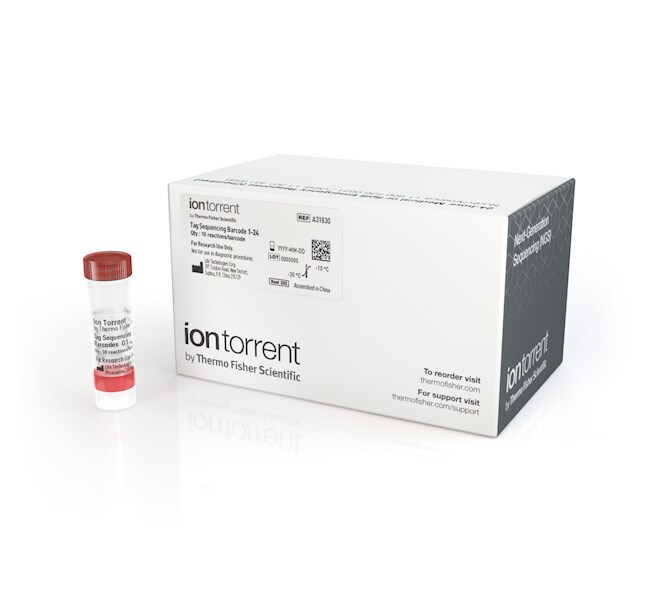
What are the differences between the Tag Sequencing Barcode Set 1-24 (Cat. No. A31830) and the Ion Xpress Barcode Adapters (Cat. No. 4474517)?
The TAG Sequencing Barcode Set contains adapters designed for Oncomine workflows using AmpliSeq HD technology and they can be used only with those library kits. This type of chemistry uses a molecular tag in order to track polymerase errors and increase the assay sensitivity. The Ion Xpress Barcode Adapters are not an alternative of the TAG Sequencing Barcode Set and vice versa. The list of the barcodes set compatible with a library kit is specified in the library manual.
Find additional tips, troubleshooting help, and resources within our Next-Generation Sequencing Support Center.
For the Oncomine Lung Cell-Free Total Nucleic Acid Research Assay, what are the analysis workflows in Ion Reporter Software?
There are two analysis workflows available:
1. Oncomine TagSeq Lung v2 Liquid Biopsy - w2.0 - Single Sample: Detects and annotates low-frequency variants including SNPs/Indels (down to 0.1% limit of detection), Fusions, and CNVs from targeted nucleic acid libraries (DNA & RNA) from the Oncomine Lung Cell‑Free Total Nucleic Acid Research Assay. This is compatible with DNA & RNA purified from cell-free total nucleic acids.
2. Oncomine TagSeq Lung v2 Tumor - w2.0 - Single Sample: Detects and annotates low-frequency variants including SNPs/Indels (down to 0.5% limit of detection), fusions, and CNVs from targeted nucleic acid libraries (DNA & RNA) from the Oncomine Lung Cell-Free Total Nucleic Acid Research Assay. Due to deamination events caused by the FFPE process, the minimum alternative allele frequency is set to 0.3%. This makes it compatible with DNA & RNA purified from FFPE tumor tissue as well as fresh frozen tumor tissue.
Are there any BED files for the Oncomine Lung Cell-Free Total Nucleic Acid Research Assay?
Yes, there is a specific BED file and Hotspot file for the Oncomine Lung Cell-Free Total Nucleic Acid Research Assay. Please contact your local Field Application Specialist (FAS) or Clinical Application Consultant (CAC) to request the BED files.
What is the LOD (limit of detection) for the Oncomine Lung Cell-Free Total Nucleic Acid (cfNA) Research Assay?
Through the use of Tag Sequencing technology, low limits of detection (LOD) can be achieved for different variant types*:
- For SNVs/short indels, an LOD of 0.1% can be achieved with sensitivity of ˜90% and specificity of >99%
- For fusions & MET exon skipping, an LOD of 1% can be achieved with sensitivity of >90% and specificity of >99%
- For MET CNV target, detection as low as 1.2-fold amplification can be achieved with sensitivity of >90% and specificity of >99%
*Sensitivity and specificity for each variant type were determined using a collection of contrived positive samples and cfNA isolated from normal healthy donors.
Does the Oncomine Lung Cell-Free Total Nucleic Acid Research Assay use AmpliSeq technology?
No, this assay uses Tag Sequencing technology. Cell-free DNA (cfDNA) and cell-free RNA (cfRNA) are found at extremely low concentrations in the plasma fraction of whole blood. Because of this low prevalence, Taq Sequencing technology is utilized in this assay. The technology attaches unique molecular tags to the gene-specific primers. After amplification, the tagged molecules are grouped based on the tags. Groups containing the same mutant variant 80% of the time or greater will be called positive. Using the Tag technology, groups that contain random errors generated through the library construction/sequencing process are removed.