Search


引用和文献 (4)
Thermo Scientific™
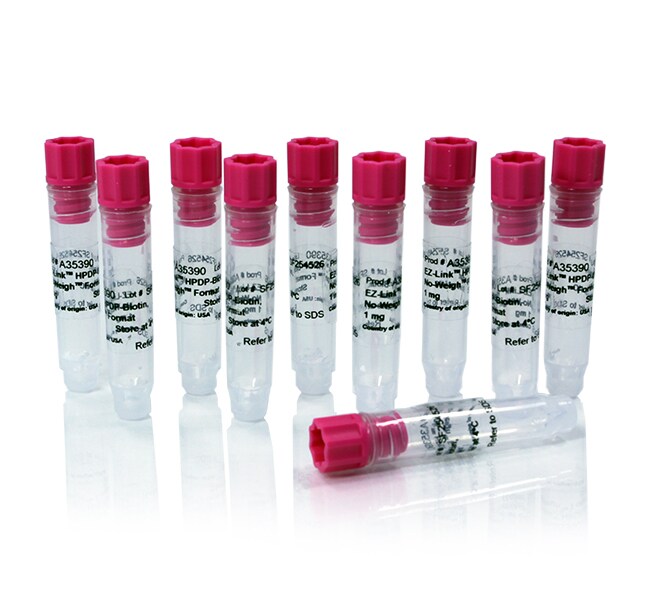
EZ-Link™ HPDP-生物素,No-Weigh™ 规格
Thermo Scientific EZ-Link HPDP-生物素是一种具有膜可穿透性的生物素标记试剂,可与巯基 (-SH) 基团反应。可通过还原剂裂解靶标巯基分子与生物素基团之间产生的二硫键,以释放生物素基团并再生原始未修饰型蛋白(或肽)。使用固定化亲和素了解更多信息
Have Questions?
更改视图

| 货号 | 数量 |
|---|---|
| A35390 | 10 x 1 mg |
| 21341 | 50 mg |
货号 A35390
价格(CNY)
2,482.00
Online exclusive
Ends: 31-Dec-2026
3,597.00共减 1,115.00 (31%)
Each
数量:
10 x 1 mg
价格(CNY)
2,482.00
Online exclusive
Ends: 31-Dec-2026
3,597.00共减 1,115.00 (31%)
Each
Thermo Scientific EZ-Link HPDP-生物素是一种具有膜可穿透性的生物素标记试剂,可与巯基 (-SH) 基团反应。可通过还原剂裂解靶标巯基分子与生物素基团之间产生的二硫键,以释放生物素基团并再生原始未修饰型蛋白(或肽)。使用固定化亲和素、链霉素亲和素或 Thermo Scientific NeutrAvidin 蛋白时,使用 HPDP-生物素进行的标记便于纯化靶标分子,以用于还原 SDS PAGE 或质量分析;捕获的生物素化分子可通过二硫苏糖醇 (DTT) 或其他还原剂切断二硫键而从载体上高效洗脱出来,而不是试图使用强酸或变性剂解离亲和素与生物素之间的高亲和力相互作用。
Thermo Scientific No-Weigh 产品是可提供预等分规格的特殊试剂。预称重的包装可避免重复开瓶和关盖,从而防止随时间推移导致的试剂反应性的降低和污染。对于这种规格,可每次使用一小瓶新鲜试剂,避免了对少量试剂进行称重的麻烦,并减少了对试剂稳定性的担忧。
EZ-Link HPDP-生物素的特点:
•蛋白标记—生物素化抗体或用于蛋白方法的其他蛋白
• 硫醇反应性—与巯基 (-SH)(如半胱氨酸 (C) 侧链)反应
• 吡啶基二硫基活化—在 PBS 等缓冲液中于 6.5 至 7.5 pH 值下进行反应
• 可逆性—可形成二硫键,可使用 DTT 或其他还原剂裂解该键
• 溶解度—必须溶于 DMSO 或 DMF 中,然后在缓冲溶液中进一步稀释
• 中等长度—间隔臂(添加至靶标的总长度)为 29.2 埃
HPDP-生物素是一种可结合标记蛋白半胱氨酸和含有巯基基团的其他分子的吡啶基二硫基-生物素化合物。该试剂可在近中性缓冲液中与还原硫醇 (-SH) 进行特异性反应,形成可逆的二硫键。HPDP-生物素用于需要回收原始、未修饰分子的标记和亲和纯化应用。例如,蛋白可以被生物素化,允许结合其相互作用体,然后被捕获到链霉素亲和素色谱柱上,最终通过二硫苏糖醇还原二硫键来洗脱和回收。
我们生产生物素试剂,以确保尽可能使预期研究应用的总体产品完整性、一致性和性能达到较高水平。
生物素化试剂在反应性、长度、溶解度、细胞渗透性和可裂解性方面不同。三种 巯基反应性化合物可用:马来酰亚胺基、碘乙酰和吡啶基二硫基。吡啶基二硫基试剂可在近中性缓冲液中与巯基基团 (-SH) 进行特异性反应,形成可逆的二硫键。
在蛋白中,巯基存在于有半胱氨酸 (C) 残基的位置。胱氨酸二硫键必须还原以便获得可进行标记的巯基基团。抗体的铰链区二硫键可以选择性地还原,从而形成可标记的功能性半抗体。
应用:
•检索细胞表面受体,并将生物素从固定化亲和素柱上裂解下来
Thermo Scientific No-Weigh 产品是可提供预等分规格的特殊试剂。预称重的包装可避免重复开瓶和关盖,从而防止随时间推移导致的试剂反应性的降低和污染。对于这种规格,可每次使用一小瓶新鲜试剂,避免了对少量试剂进行称重的麻烦,并减少了对试剂稳定性的担忧。
EZ-Link HPDP-生物素的特点:
•蛋白标记—生物素化抗体或用于蛋白方法的其他蛋白
• 硫醇反应性—与巯基 (-SH)(如半胱氨酸 (C) 侧链)反应
• 吡啶基二硫基活化—在 PBS 等缓冲液中于 6.5 至 7.5 pH 值下进行反应
• 可逆性—可形成二硫键,可使用 DTT 或其他还原剂裂解该键
• 溶解度—必须溶于 DMSO 或 DMF 中,然后在缓冲溶液中进一步稀释
• 中等长度—间隔臂(添加至靶标的总长度)为 29.2 埃
HPDP-生物素是一种可结合标记蛋白半胱氨酸和含有巯基基团的其他分子的吡啶基二硫基-生物素化合物。该试剂可在近中性缓冲液中与还原硫醇 (-SH) 进行特异性反应,形成可逆的二硫键。HPDP-生物素用于需要回收原始、未修饰分子的标记和亲和纯化应用。例如,蛋白可以被生物素化,允许结合其相互作用体,然后被捕获到链霉素亲和素色谱柱上,最终通过二硫苏糖醇还原二硫键来洗脱和回收。
我们生产生物素试剂,以确保尽可能使预期研究应用的总体产品完整性、一致性和性能达到较高水平。
生物素化试剂在反应性、长度、溶解度、细胞渗透性和可裂解性方面不同。三种 巯基反应性化合物可用:马来酰亚胺基、碘乙酰和吡啶基二硫基。吡啶基二硫基试剂可在近中性缓冲液中与巯基基团 (-SH) 进行特异性反应,形成可逆的二硫键。
在蛋白中,巯基存在于有半胱氨酸 (C) 残基的位置。胱氨酸二硫键必须还原以便获得可进行标记的巯基基团。抗体的铰链区二硫键可以选择性地还原,从而形成可标记的功能性半抗体。
应用:
•检索细胞表面受体,并将生物素从固定化亲和素柱上裂解下来
仅供科研使用。不可用于诊断程序。
规格
产品规格实心
标签类型生物素& 类似物
产品线EZ-Link, No-Weigh
数量10 x 1 mg
运输条件室温
溶解度DMF(二甲基甲酰胺), DMSO(二甲亚砜)
Unit SizeEach
内容与储存
储存在冰箱 (2–8°C) 中。
常见问题解答 (FAQ)
What is the advantage of using EZ-Link HPDP-Biotin over maleimide- or iodoacetyl-containing biotinylation reagents?
Is it possible that HPDP-biotin (Cat. No. 21341) can also react with non-reduced sulfur?
引用和文献 (4)
引用和文献
Abstract
A variant NuRD complex containing PWWP2A/B excludes MBD2/3 to regulate transcription at active genes.
Journal:Nat Commun
PubMed ID:30228260
'Transcriptional regulation by chromatin is a highly dynamic process directed through the recruitment and coordinated action of epigenetic modifiers and readers of these modifications. Using an unbiased proteomic approach to find interactors of H3K36me3, a modification enriched on active chromatin, here we identify PWWP2A and HDAC2 among the top interactors.
Splicing of long non-coding RNAs primarily depends on polypyrimidine tract and 5' splice-site sequences due to weak interactions with SR proteins.
Journal:Nucleic Acids Res
PubMed ID:30445574
'Many nascent long non-coding RNAs (lncRNAs) undergo the same maturation steps as pre-mRNAs of protein-coding genes (PCGs), but they are often poorly spliced. To identify the underlying mechanisms for this phenomenon, we searched for putative splicing inhibitory sequences using the ncRNA-a2 as a model. Genome-wide analyses of intergenic lncRNAs (lincRNAs)
The Implication of Early Chromatin Changes in X Chromosome Inactivation.
Journal:Cell
PubMed ID:30595450
'During development, the precise relationships between transcription and chromatin modifications often remain unclear. We use the X chromosome inactivation (XCI) paradigm to explore the implication of chromatin changes in gene silencing. Using female mouse embryonic stem cells, we initiate XCI by inducing Xist and then monitor the temporal changes in
Bioconjugation strategy for cell surface labelling with gold nanostructures designed for highly localized pH measurement.
Journal:Nat Commun
PubMed ID:30538244
Regulation of intracellular pH is critically important for many cellular functions. The quantification of proton extrusion in different types of cells and physiological conditions is pivotal to fully elucidate the mechanisms of pH homeostasis. Here we show the use of gold nanoparticles (AuNP) to create a high spatial resolution sensor