Search


引用和文献 (4)
Thermo Scientific™
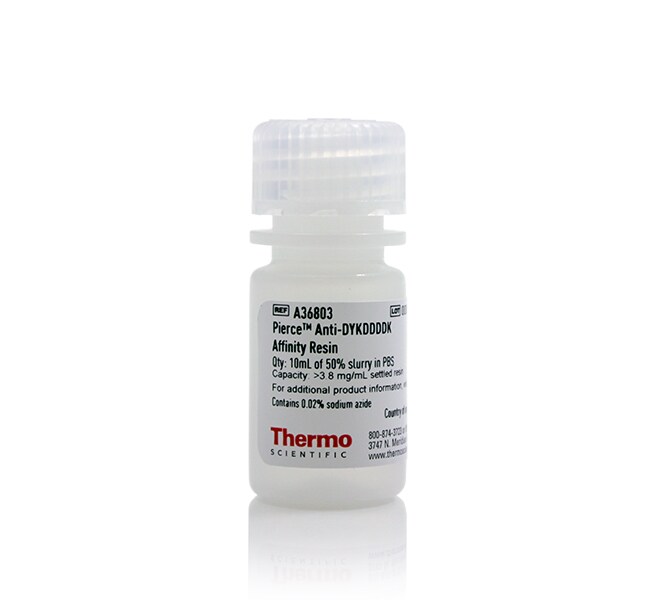
Pierce™ 抗-DYKDDDDK 亲和树脂
Thermo Scientific Pierce 抗-DYKDDDDK 亲和树脂是一种对体外蛋白表达系统、细菌、酵母菌和哺乳动物细胞中表达的 DYKDDDDK 标签蛋白进行纯化和免疫沉淀 (IP)了解更多信息
Have Questions?
更改视图

| 货号 | 数量 |
|---|---|
| A36803 | 10 mL |
| A36801 | 2 mL |
| A36804 | 100 mL |
| A40004562 | 5 Columns |
货号 A36803
价格(CNY)
16,544.00
Each
数量:
10 mL
价格(CNY)
16,544.00
Each
Thermo Scientific Pierce 抗-DYKDDDDK 亲和树脂是一种对体外蛋白表达系统、细菌、酵母菌和哺乳动物细胞中表达的 DYKDDDDK 标签蛋白进行纯化和免疫沉淀 (IP) 的快速、便捷方法。氨基酸序列 DYKDDDDK(通常称为 FLAG)被高亲和力大鼠单克隆抗体(克隆 L5)识别,该抗体与 UltraLink Biosupport 共价连接。UltraLink Biosupport 是一种刚性、亲水性、高度交联、共聚和多孔树脂,具有高偶联能力。树脂的孔隙度、刚性和耐久性使其适用于涉及大样品体积的中等压力、快速流动技术。
对于蛋白纯化或 IP,将树脂添加到含有 DYKDDDDK 标签蛋白的样品中,其中标签位于 N 或 C 端。捕获 DYKDDDDK 标签蛋白后,洗去非特异性结合蛋白,然后用洗脱缓冲液分离结合的靶蛋白。Pierce 抗-DYKDDDDK 亲和树脂推荐用于离心纯化柱或 FPLC 仪器的纯化柱。
特点包括:
•特异性 — 独特的碱基微珠和高特异性抗体可较大限度地减少脱靶结合(低非特异性结合)
•高纯度 — 优化的结合-洗涤-洗脱方案可以实现高纯度
•高得率 — 特殊抗体偶联方法可实现高得率
•快速 — 整个纯化方案通常只需不到40分钟
•经济 — 纯化方案能够多次重复使用
•通用—可用于基于离心、重力或 FPLC 的纯化和富集方法
•可扩展—以 1 mL、5 mL 和 50 mL 沉淀树脂包装规格提供,可用于较小规模免疫沉淀或较大规模纯化
Pierce 抗 DYKDDDDK 亲和树脂特性:
组成:抗 DYKDDDDK 抗体与 UltraLink Biosupport(高度交联的刚性载体)共价连接
粒径:50–80 µm
pH 值稳定:1–13
推荐的线性速度:<150 cm/小时
工作温度:2–30⁰C;切勿冷冻
粒子浓度:50% 浆(溶于磷酸盐缓冲盐水)、0.02% 叠氮化钠,pH 值为7.5
结合能力:≥3.0 mg DYKDDDDK-tGFP-His 蛋白 (∼32 kDa)/mL 沉淀树脂
对于蛋白纯化或 IP,将树脂添加到含有 DYKDDDDK 标签蛋白的样品中,其中标签位于 N 或 C 端。捕获 DYKDDDDK 标签蛋白后,洗去非特异性结合蛋白,然后用洗脱缓冲液分离结合的靶蛋白。Pierce 抗-DYKDDDDK 亲和树脂推荐用于离心纯化柱或 FPLC 仪器的纯化柱。
特点包括:
•特异性 — 独特的碱基微珠和高特异性抗体可较大限度地减少脱靶结合(低非特异性结合)
•高纯度 — 优化的结合-洗涤-洗脱方案可以实现高纯度
•高得率 — 特殊抗体偶联方法可实现高得率
•快速 — 整个纯化方案通常只需不到40分钟
•经济 — 纯化方案能够多次重复使用
•通用—可用于基于离心、重力或 FPLC 的纯化和富集方法
•可扩展—以 1 mL、5 mL 和 50 mL 沉淀树脂包装规格提供,可用于较小规模免疫沉淀或较大规模纯化
Pierce 抗 DYKDDDDK 亲和树脂特性:
组成:抗 DYKDDDDK 抗体与 UltraLink Biosupport(高度交联的刚性载体)共价连接
粒径:50–80 µm
pH 值稳定:1–13
推荐的线性速度:<150 cm/小时
工作温度:2–30⁰C;切勿冷冻
粒子浓度:50% 浆(溶于磷酸盐缓冲盐水)、0.02% 叠氮化钠,pH 值为7.5
结合能力:≥3.0 mg DYKDDDDK-tGFP-His 蛋白 (∼32 kDa)/mL 沉淀树脂
仅供科研使用。不可用于诊断程序。
规格
形式液体
产品规格液体
配方50% suspension in PBS containing 0.02% Sodium azide
产品线Pierce
产品类型亲和树脂
数量10 mL
运输条件湿冰
固定相抗-DYKDDDDK 单克隆抗体
基质Affinity Resin
Unit SizeEach
内容与储存
5 mL 沉淀树脂。10 mL,以 50% 浆液(溶于含 0.02% 叠氮化钠的 PBS)形式提供。2–8°C 储存。
常见问题解答 (FAQ)
What is the slurry/suspension percentage for your anti-DYKDDDDK ("FLAG") products?
What is the binding capacity for your Anti-DYKDDDDH Affinity Resin?
Can I use your UltraLink-based Anti-DYKDDDDH ("FLAG") Affinity Resin for FPLC purification?
How do I cleave off the DYKDDDDK ("FLAG") tag after purification?
引用和文献 (4)
引用和文献
Abstract
Structural insights into Ubr1-mediated N-degron polyubiquitination.
Journal:Nature
PubMed ID:34789879
The N-degron pathway targets proteins that bear a destabilizing residue at the N terminus for proteasome-dependent degradation(1). In yeast, Ubr1-a single-subunit E3 ligase-is responsible for the Arg/N-degron pathway(2). How Ubr1 mediates the initiation of ubiquitination and the elongation of the ubiquitin chain in a linkage-specific manner through a single E2
FKBP10 promotes clear cell renal cell carcinoma progression and regulates sensitivity to the HIF2α blockade by facilitating LDHA phosphorylation.
Journal:Cell death & disease
PubMed ID:38233415
Renal cell carcinoma (RCC) is one of the three major malignant tumors of the urinary system and originates from proximal tubular epithelial cells. Clear cell renal cell carcinoma (ccRCC) accounts for approximately 80% of RCC cases and is recognized as a metabolic disease driven by genetic mutations and epigenetic alterations.
Increased levels of eIF2A inhibit translation by sequestering 40S ribosomal subunits.
Journal:Nucleic acids research
PubMed ID:37602404
eIF2A was the first eukaryotic initiator tRNA carrier discovered but its exact function has remained enigmatic. Uncharacteristic of translation initiation factors, eIF2A is reported to be non-cytosolic in multiple human cancer cell lines. Attempts to study eIF2A mechanistically have been limited by the inability to achieve high yield of soluble
Brain-enriched RagB isoforms regulate the dynamics of mTORC1 activity through GATOR1 inhibition.
Journal:Nature cell biology
PubMed ID:36097071
Mechanistic target of rapamycin complex 1 (mTORC1) senses nutrient availability to appropriately regulate cellular anabolism and catabolism. During nutrient restriction, different organs in an animal do not respond equally, with vital organs being relatively spared. This raises the possibility that mTORC1 is differentially regulated in different cell types, yet little