Search

Ion Torrent™
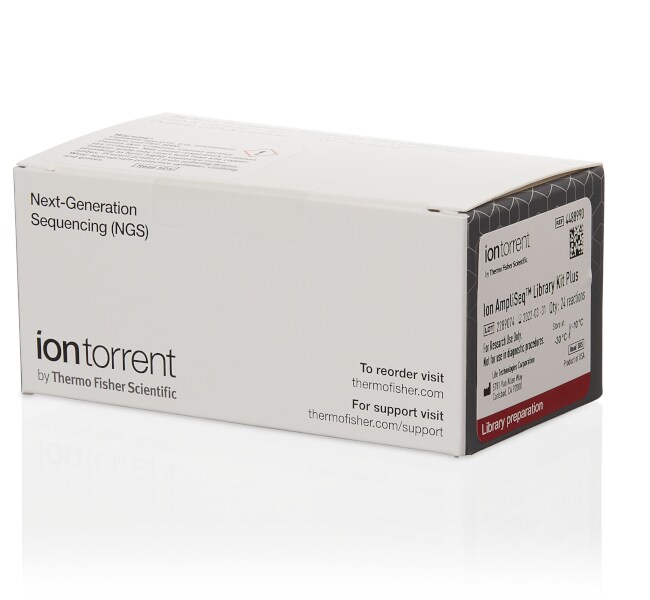
Ion AmpliSeq™ 文库试剂盒 Plus
The Ion AmpliSeq Library Kit Plus is designed for rapid preparation of amplicon libraries using Ion AmpliSeq panels.
Have Questions?
更改视图

| 货号 | 反应次数 |
|---|---|
| A38875 | 384 Reactions |
| 4488990 | 24 Reactions |
| A35907 | 96 Reactions |
货号 A38875
价格(CNY)
345,956.00
Each
反应次数:
384 Reactions
价格(CNY)
345,956.00
Each
The Ion AmpliSeq Library Kit Plus is designed for rapid preparation of amplicon libraries using Ion AmpliSeq panels. Ion AmpliSeq technology enables scalable, multiplex polymerase chain reactions (PCR) from 12- to 24,000-plex in a single well. Next-generation sequencing (NGS) libraries can be prepared using as little as 1 ng of starting material.
Ion AmpliSeq 文库试剂盒 Plus 设计用于使用 Ion AmpliSeq panel快速制备扩增子文库。Ion AmpliSeq 技术可在单孔中实现从 12 至 24,000 重的可扩展、多重聚合酶链式反应 (PCR)。下一代测序 (NGS) 文库可以使用低至 1 ng 的起始材料制备。
主要产品特点:
•可扩展且高效的文库制备
•简单、稳健的方案
•条形码样品多重检测
可扩展且高效的文库制备
只需低至 1 ng 起始材料、高度多重 PCR 扩增数千种基因组靶标区域,无需专门的微流 PCR 平台,即可获得卓越覆盖均匀性和特异性。引物含专有修饰,使得在文库制备过程中能够去除引物序列,从而能够在测序过程中进行有效的靶向评估。
简单、稳健的方案
Ion AmpliSeq 文库试剂盒 Plus 使用基于板的形式,可更轻松地处理和追踪样品,适用于自动化和高通量实验室兼容。方案简单易用,可实现高产量和均匀性、可靠且可重复。所得文库即可用于模板制备,采用自动 Ion Chef 系统(也可选择使用用于 Chef DL8 的 Ion AmpliSeq 试剂盒进行自动文库制备)或 Ion OneTouch 2 系统进行下游模板制备。直观的 Torrent Suite 软件和可选 Ion Reporter 软件可实现数据分析自动化。
条形码样品多重检测
Ion AmpliSeq 文库试剂盒 Plus 包括使用 Ion AmpliSeq 引物生成扩增子以及使用所得扩增子制备文库的试剂。该试剂盒可使用 Ion Xpress 条形码接头 1-96 试剂盒或 IonCode 条形码接头 1-384 试剂盒制备条形码文库。条形码文库可结合并加载到单张Ion芯片上,从而较大限度地缩短测序运行时间并降低成本,并可实现样品间的准确比较。
主要产品特点:
•可扩展且高效的文库制备
•简单、稳健的方案
•条形码样品多重检测
可扩展且高效的文库制备
只需低至 1 ng 起始材料、高度多重 PCR 扩增数千种基因组靶标区域,无需专门的微流 PCR 平台,即可获得卓越覆盖均匀性和特异性。引物含专有修饰,使得在文库制备过程中能够去除引物序列,从而能够在测序过程中进行有效的靶向评估。
简单、稳健的方案
Ion AmpliSeq 文库试剂盒 Plus 使用基于板的形式,可更轻松地处理和追踪样品,适用于自动化和高通量实验室兼容。方案简单易用,可实现高产量和均匀性、可靠且可重复。所得文库即可用于模板制备,采用自动 Ion Chef 系统(也可选择使用用于 Chef DL8 的 Ion AmpliSeq 试剂盒进行自动文库制备)或 Ion OneTouch 2 系统进行下游模板制备。直观的 Torrent Suite 软件和可选 Ion Reporter 软件可实现数据分析自动化。
条形码样品多重检测
Ion AmpliSeq 文库试剂盒 Plus 包括使用 Ion AmpliSeq 引物生成扩增子以及使用所得扩增子制备文库的试剂。该试剂盒可使用 Ion Xpress 条形码接头 1-96 试剂盒或 IonCode 条形码接头 1-384 试剂盒制备条形码文库。条形码文库可结合并加载到单张Ion芯片上,从而较大限度地缩短测序运行时间并降低成本,并可实现样品间的准确比较。
仅供科研使用。不可用于诊断程序。
规格
适用于(应用)测序
适用于(设备)Ion GeneStudio S5 系统、Ion GeneStudio™ S5 系统、Ion PGM™ 系统、Ion Proton™ 系统、Ion S5™ XL 系统、Ion OneTouch™ 2 系统、Ion Chef™ 系统
库靶向测序库
反应次数384 Reactions
产品线Ion AmpliSeq
产品类型文库试剂盒 Plus
数量384 reactions
样品类型DNA
运输条件经批准可置于湿冰或干冰上运输
工作流程步骤文库生成
产品规格试剂盒
测序类型基因组和 DNA 测序
Unit SizeEach
内容与储存
该 384-rxn 规模试剂盒由 4 个 96-rxn 规模试剂盒(货号 A35907)组成。
96-rxn 规模试剂盒包含:
6 个管,在 -5 至 -30°C 下储存。
1 管低 TE 缓冲液,在室温下储存
96-rxn 规模试剂盒包含:
6 个管,在 -5 至 -30°C 下储存。
1 管低 TE 缓冲液,在室温下储存