Search

Gibco™
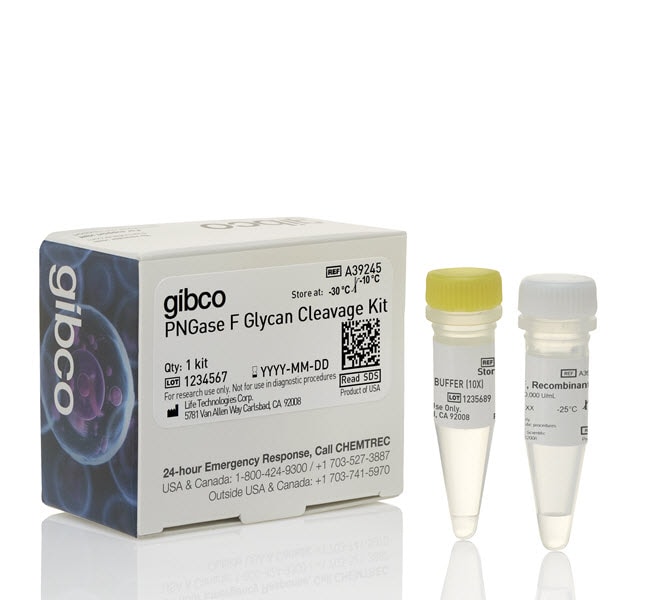
PNGase F 聚糖切割试剂盒
PNGase F 聚糖切割试剂盒包括从糖蛋白中酶去除几乎所有 N-连接低聚糖所必需的所有组分。该试剂盒包括 PNGase F 酶,它可以在高甘露糖、混合型和复杂低聚糖的最内端 GlcNAc了解更多信息
| 货号 | 数量 |
|---|---|
| A39245 | 1 kit |
货号 A39245
价格(CNY)
3,680.00
Online exclusive
Ends: 31-Dec-2026
4,296.00共减 616.00 (14%)
Each
数量:
1 kit
价格(CNY)
3,680.00
Online exclusive
Ends: 31-Dec-2026
4,296.00共减 616.00 (14%)
Each
PNGase F 聚糖切割试剂盒包括从糖蛋白中酶去除几乎所有 N-连接低聚糖所必需的所有组分。该试剂盒包括 PNGase F 酶,它可以在高甘露糖、混合型和复杂低聚糖的最内端 GlcNAc 和天冬酰胺残基处切割 N-聚糖链。
PNGase F 聚糖切割试剂盒的特点包括:
•≥ 95% 纯度
•无糖苷内切酶 F1、F2 或 F3 的重组 PNGase F 酶
•酶切割 N-聚糖核心低聚糖完整且适用于下游分析
•适于在天然或变性条件下使用
PNGase F 聚糖切割试剂盒中包括的组分为:30,000 单位 PNGase F(500,000 单位/mL)和 1 mL PNGase F 10X 缓冲液。
PNGase F 聚糖切割试剂盒的特点包括:
•≥ 95% 纯度
•无糖苷内切酶 F1、F2 或 F3 的重组 PNGase F 酶
•酶切割 N-聚糖核心低聚糖完整且适用于下游分析
•适于在天然或变性条件下使用
PNGase F 聚糖切割试剂盒中包括的组分为:30,000 单位 PNGase F(500,000 单位/mL)和 1 mL PNGase F 10X 缓冲液。
仅供科研使用。不可用于诊断程序。
规格
形式液体
数量1 kit
运输条件湿冰
产品类型PNGase F 聚糖切割试剂盒
Unit SizeEach
内容与储存
•30,000 单位 PNGase F 重组酶(500,000 单位/mL),在 -20°C 下储存
•1 mL PNGase F 10X 缓冲液,在 -20°C 下储存
•1 mL PNGase F 10X 缓冲液,在 -20°C 下储存