Search


引用和文献 (6)
Thermo Scientific™
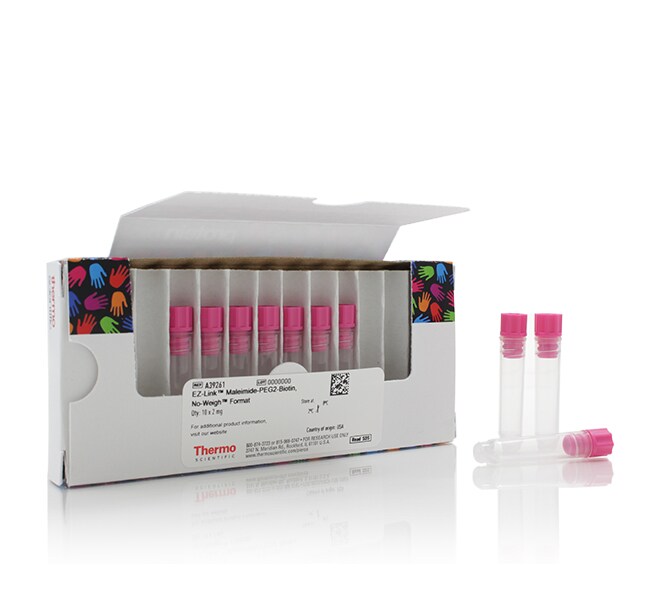
EZ-Link™ 马来酰亚胺-PEG2-生物素,No-Weigh™ 规格
Thermo Scientific EZ-Link 马来酰亚胺-PEG2-生物素是一种中等长度、马来酰亚胺活化的巯基反应性生物素化试剂,其间隔臂中含有 2 单位乙二醇,可提高水溶性特性。EZ-Link 马来酰亚胺-PEG2-生物素的特点:•蛋白标记—生物素化抗体或用于蛋白方法的其他蛋白• 硫醇反应性—与巯基了解更多信息
Have Questions?
更改视图

| 货号 | 数量 |
|---|---|
| A39261 | 10 x 2 mg |
| 21901BID | 50 mg |
货号 A39261
价格(CNY)
2,264.00
飞享价
Ends: 31-Dec-2026
3,280.00共减 1,016.00 (31%)
Each
数量:
10 x 2 mg
价格(CNY)
2,264.00
飞享价
Ends: 31-Dec-2026
3,280.00共减 1,016.00 (31%)
Each
Thermo Scientific EZ-Link 马来酰亚胺-PEG2-生物素是一种中等长度、马来酰亚胺活化的巯基反应性生物素化试剂,其间隔臂中含有 2 单位乙二醇,可提高水溶性特性。
EZ-Link 马来酰亚胺-PEG2-生物素的特点:
•蛋白标记—生物素化抗体或用于蛋白方法的其他蛋白
• 硫醇反应性—与巯基 (-SH)(如半胱氨酸 (C) 侧链)反应
• 马来酰亚胺活化—在 PBS 等缓冲液中于 6.5 至 7.5 pH 值下进行反应
• 聚乙二醇化—间隔臂含有一个亲水性 2 单位聚乙二醇 (PEG) 基团
• 增强溶解度—聚乙二醇化使生物素化分子具有水溶性,有助于防止储存在溶液中的生物素化抗体的聚集
• 不可逆—可形成永久性硫醚键;间隔臂不能被裂解
• 溶解度—可直接溶于水性缓冲液中进行标记反应
• 中等长度—间隔臂(添加至靶标的总长度)为 29.1 埃
马来酰亚胺-PEG2-生物素可对抗体、含半胱氨酸的肽类和其他含巯基的分子进行简单、高效的生物素化。在 pH 值 6.5 至 7.5 的条件下,马来酰亚胺基团与还原硫醇(巯基基团,—SH)发生特异性高效反应,形成稳定的硫醚键。亲水 2 单位聚乙二醇 (PEG) 间隔臂可将水溶性转移到生物素化分子,从而减少储存在溶液中的标记蛋白聚集。PEG 段可向间隔臂增加长度和灵活性,以尽可能减少与亲和素分子结合所涉及的空间位阻。
我们生产生物素试剂,以确保尽可能使预期研究应用的总体产品完整性、一致性和性能达到较高水平。
生物素化试剂在反应性、长度、溶解度、细胞渗透性和可裂解性方面不同。三种 巯基反应性化合物可用:马来酰亚胺基、碘乙酰和吡啶基二硫基。马来酰亚胺试剂可在近中性缓冲液中与巯基基团 (-SH) 进行特异性反应,形成永久的硫醚键。
在蛋白中,巯基存在于有半胱氨酸 (C) 残基的位置。胱氨酸二硫键必须还原以便获得可进行标记的巯基基团。抗体的铰链区二硫键可以选择性地还原,从而形成可标记的功能性半抗体。
EZ-Link 马来酰亚胺-PEG2-生物素的特点:
•蛋白标记—生物素化抗体或用于蛋白方法的其他蛋白
• 硫醇反应性—与巯基 (-SH)(如半胱氨酸 (C) 侧链)反应
• 马来酰亚胺活化—在 PBS 等缓冲液中于 6.5 至 7.5 pH 值下进行反应
• 聚乙二醇化—间隔臂含有一个亲水性 2 单位聚乙二醇 (PEG) 基团
• 增强溶解度—聚乙二醇化使生物素化分子具有水溶性,有助于防止储存在溶液中的生物素化抗体的聚集
• 不可逆—可形成永久性硫醚键;间隔臂不能被裂解
• 溶解度—可直接溶于水性缓冲液中进行标记反应
• 中等长度—间隔臂(添加至靶标的总长度)为 29.1 埃
马来酰亚胺-PEG2-生物素可对抗体、含半胱氨酸的肽类和其他含巯基的分子进行简单、高效的生物素化。在 pH 值 6.5 至 7.5 的条件下,马来酰亚胺基团与还原硫醇(巯基基团,—SH)发生特异性高效反应,形成稳定的硫醚键。亲水 2 单位聚乙二醇 (PEG) 间隔臂可将水溶性转移到生物素化分子,从而减少储存在溶液中的标记蛋白聚集。PEG 段可向间隔臂增加长度和灵活性,以尽可能减少与亲和素分子结合所涉及的空间位阻。
我们生产生物素试剂,以确保尽可能使预期研究应用的总体产品完整性、一致性和性能达到较高水平。
生物素化试剂在反应性、长度、溶解度、细胞渗透性和可裂解性方面不同。三种 巯基反应性化合物可用:马来酰亚胺基、碘乙酰和吡啶基二硫基。马来酰亚胺试剂可在近中性缓冲液中与巯基基团 (-SH) 进行特异性反应,形成永久的硫醚键。
在蛋白中,巯基存在于有半胱氨酸 (C) 残基的位置。胱氨酸二硫键必须还原以便获得可进行标记的巯基基团。抗体的铰链区二硫键可以选择性地还原,从而形成可标记的功能性半抗体。
仅供科研使用。不可用于诊断程序。
规格
细胞渗透性细胞不可透过性
标记方法化学标记
产品线EZ-Link
产品类型马来酰亚胺-PEG2-生物素
数量10 x 2 mg
反应一部分马来酰亚胺
运输条件经检验可环境温度或湿冰运输
化学反应性硫醇
标签或染料生物素
溶解度DMF(二甲基甲酰胺), DMSO(二甲亚砜), 水
间隔子聚乙二醇化,29.1 Å
Unit SizeEach
内容与储存
在 4°C 下干燥储存。
常见问题解答 (FAQ)
How does a product with "No-Weigh" format reduce my concern over reagent stability?
引用和文献 (6)
引用和文献
Abstract
Detection and quantification of free sulfhydryls in monoclonal antibodies using maleimide labeling and mass spectrometry.
Journal:
PubMed ID:30894096
The detection of free sulfhydryls in proteins can reveal incomplete disulfide bond formation, indicate cysteine residues available for conjugation, and offer insights into protein stability and structure. Traditional spectroscopic methods of free sulfhydryl detection, such as Ellman's reagent, generally require a relatively large amount of sample, preventing their use for
Regulating G protein-coupled receptors by topological inversion.
Journal:Elife
PubMed ID:30835201
'G protein-coupled receptors (GPCRs) are a family of proteins containing seven transmembrane helices, with the N- and C-terminus of the protein located at the extracellular space and cytosol, respectively. Here, we report that ceramide or related sphingolipids might invert the topology of many GPCRs that contain a GXXXN motif in
Transducin activates cGMP phosphodiesterase by trapping inhibitory ? subunit freed reversibly from the catalytic subunit in solution.
Journal:Sci Rep
PubMed ID:31076603
'Activation of cGMP phosphodiesterase (PDE) by activated transducin a subunit (Ta*) is a necessary step to generate a light response in vertebrate photoreceptors. PDE in rods is a heterotetramer composed of two catalytic subunits, PDEa and PDEß, and two inhibitory PDE? subunits, each binding to PDEa or PDEß. Activation of
Structural and Functional Characterization of the Bacterial Type III Secretion Export Apparatus.
Journal:PLoS Pathog
PubMed ID:27977800
'Bacterial type III protein secretion systems inject effector proteins into eukaryotic host cells in order to promote survival and colonization of Gram-negative pathogens and symbionts. Secretion across the bacterial cell envelope and injection into host cells is facilitated by a so-called injectisome. Its small hydrophobic export apparatus components SpaP and
New drugs for pharmacological extension of replicative life span in normal and progeroid cells.
Journal:NPJ Aging Mech Dis
PubMed ID:30675378
A high-throughput anti-aging drug screen was developed that simultaneously measures senescence-associated ß-galactosidase activity and proliferation. Applied to replicatively pre-aged fibroblasts, this screen yielded violuric acid (VA) and 1-naphthoquinone-2-monoxime (N2N1) as its top two hits. These lead compounds extended the replicative life spans of normal and progeroid human cells in a