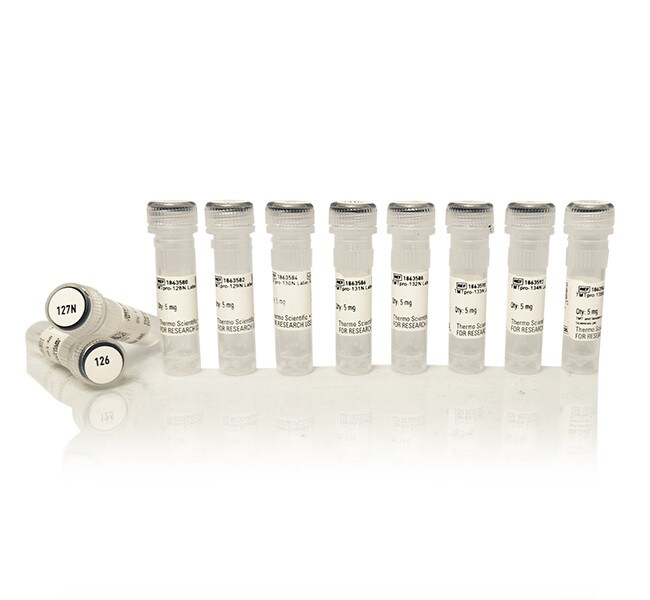
What are the primary applications of the TMTpro 10plex Isobaric Label Reagent Set (Unit Mass Reporter), 1 x 5 mg (Cat. No. A40000928)?
The TMTpro 10plex Isobaric Label Reagent Set (Unit Mass Reporter), 1 x 5 mg (Cat. No. A40000928) enables high-precision quantitative proteomics across a broad range of MS platforms. It features reagents with a 1 Da mass difference between reporter ions, making it ideal for use on non-Orbitrap instruments with low MS/MS resolving power, such as the Thermo Scientific Stellar series MS instruments and various MS instruments from other manufacturers.
This reagent set also supports 10plex quantification using the complementary ion cluster in MS2 spectra, which can enhance quantification accuracy and precision on Orbitrap and non-Orbitrap platforms. For more detailed information, please refer to the following publications:
https://pubs.acs.org/doi/10.1021/acs.jproteome.0c00813
https://pubmed.ncbi.nlm.nih.gov/39725028/
Find additional tips, troubleshooting help, and resources within our Mass Spectrometry Support Center.
Can the TMT and TMTpro reagents be mixed?
No, the TMT and TMTpro reagents cannot be mixed because the reporter ions are in the same region.
Find additional tips, troubleshooting help, and resources within our Mass Spectrometry Support Center.
Can TMTpro label reagents dissolved in anhydrous acetonitrile be dried down and stored for later use?
Yes, unused TMTpro label reagent that has been dissolved in anhydrous acetonitrile can be aliquoted into tubes, dried under vacuum at 25-30 degrees C, purged with nitrogen, and stored in a sealed bag with desiccant at -20 degrees C.
Find additional tips, troubleshooting help, and resources within our Mass Spectrometry Support Center.
Can I combine TMTpro tags with TMT tags?
We do not recommend mixing TMTpro and TMT tags, as they differ in chemical structure.
Find additional tips, troubleshooting help, and resources within our Mass Spectrometry Support Center.
At which step should I label my mass spec samples with TMT reagents?
TMT labeling can be performed after reduction, alkylation, digestion, or prior to cleanup, if the sample is buffered at appropriate pH (8-8.5) in a suitable buffer without primary amines (e.g., Tris, glycine). TMT labeling can also be performed after peptide clean-up. Labeling of peptides after clean-up enables measuring and normalizing of the peptide samples for equal mixing.
Find additional tips, troubleshooting help, and resources within our Mass Spectrometry Support Center.