Search

Thermo Scientific™
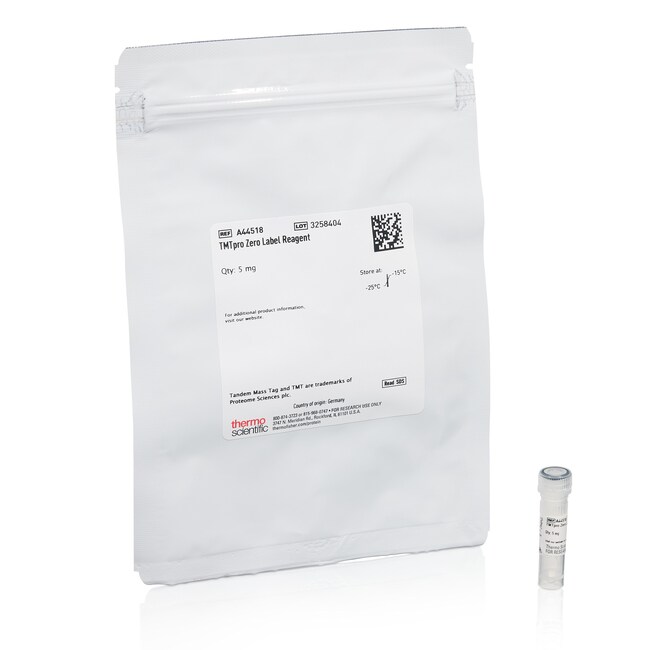
TMTpro™ 零标记试剂
Thermo Scientific TMTpro 零标记试剂作为 MS 级肽定量的轻标签用于方法优化,或者与 TMTpro 16 plex 标记试剂套件配合使用。
Have Questions?
更改视图

| 货号 | 数量 |
|---|---|
| A44518 | 1 x 5 mg |
| A44519 | 5 x 0.5 mg |
货号 A44518
价格(CNY)
3,656.00
Each
数量:
1 x 5 mg
价格(CNY)
3,656.00
Each
Thermo Scientific™ TMTpro Zero Label Reagent serves as a 'light' tag for MS-level peptide quantitation for method optimization or use with the TMTpro 16plex Label Reagent Set.
Thermo Scientific TMTpro 零标记试剂作为 MS 级肽定量的“轻”标签用于方法优化,或者与 TMTpro 16plex 标记试剂套件配合使用。
TMTpro 零标记试剂的特点包括:
•经济—轻”版本可用于 TMTpro 标记样品的优化和方法开发
• 高效—胺反应性、NHS 酯活化试剂可确保高效标记所有肽,无需考虑蛋白序列或蛋白水解酶的特异性
• 兼容—经过优化可与高分辨率 Thermo Scientific MS/MS 平台(如 Q Exactive 和 Orbitrap Fusion Tribrid 仪器系列,包括 Orbitrap Eclipse Tribrid 和 Orbitrap Exploris 480 质谱仪)配合使用,并且 Proteome Discoverer 2.3 完全支持数据分析
TMTpro 标记试剂是新一代串联质谱标签,设计用于提高样品多通路水平,同时不影响蛋白鉴别和定量。TMTpro 标签结构与 TMT 标签结构类似,因为标签仍为同量异序和胺反应性,但是在长间隔区和异丁基脯氨酸质量报告基因区不同。在 MS/MS 裂解之后,每个 TMTpro 标签在高分辨率 MS/MS 质谱的低质量区域生成一个唯一的报告质量(例如 TMTpro 126-134Da),用于蛋白质表达水平的相对定量。TMTpro 零标记试剂是 TMTpro 标签的“轻”版本,可用于方法开发,或者与一组“重”TMTpro 试剂或其中部分试剂联合使用。
要对 TMTpro 标记的肽进行高分辨率分析,建议对 Nanospray Flex 源使用 Acclaim PepMap 100 C18 LC 色谱柱(货号:164942 或 164939)。对于 EASY-Spray 离子源,推荐 LC 色谱柱为 EASY-Spray C18 LC 色谱柱(货号 ES802 或 ES803)。
这些产品仅适用于应用范围有限的标签许可。
仅供科研使用。不可用于诊断程序。
规格
描述TMTpro™ 零标记试剂,1 x 5 mg
最终产品类型肽段
适用于(设备)质谱仪
标签或染料Tandem Mass Tag™ (TMT) 标记
数量1 x 5 mg
运输条件干冰
工作流程步骤蛋白质标记
检测方法质谱分析
产品线TMT
原始材料肽
Unit SizeEach
内容与储存
在冰箱中储存(–5 至 –30°C)。