SteriSEQ™ 快速无菌检测系统
SteriSEQ™ 快速无菌检测系统
SteriSEQ™ 快速无菌检测系统
SteriSEQ™ 快速无菌检测系统
SteriSEQ™ 快速无菌检测系统
Applied Biosystems™

SteriSEQ™ 快速无菌检测系统

SteriSEQ™ Plus 支原体检测试剂盒是一款基于 TaqMan™ 技术的定量 PCR (qPCR) 试剂盒,用于检测复杂生物生产样本中的细菌和真菌污染。该试剂盒根据生物治疗生产细胞培养批次中细菌和真菌快速检测的标准进行设计和测试,符合或超过了欧洲药典 (E.了解更多信息
Have Questions?
更改视图buttonViewtableView
货号反应次数
A57185100 次反应
A5718650 次反应
货号 A57185
价格(CNY)
36,888.00
Each
添加至购物车
反应次数:
100 次反应
价格(CNY)
36,888.00
Each
添加至购物车

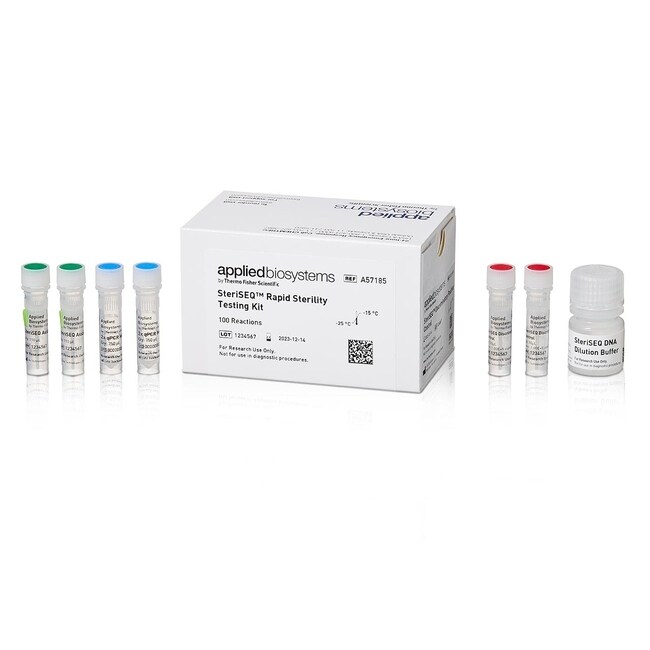
SteriSEQ™ Plus 支原体检测试剂盒是一款基于 TaqMan™ 技术的定量 PCR (qPCR) 试剂盒,用于检测复杂生物生产样本中的细菌和真菌污染。该试剂盒根据生物治疗生产细胞培养批次中细菌和真菌快速检测的标准进行设计和测试,符合或超过了欧洲药典 (E. P 2.6.27) 和美国药典 (USP1071)。该试剂盒每次反应可以检测 5 – 25 个基因组拷贝,每次反应的等效为 5 – 25 CFU。

SteriSEQ™ 快速无菌检测试剂盒的特点包括

  • 快速—获得样品结果的周转时间不到一天;在短短 5 小时内即可提供结果 < ; 5 小时
  • 特异性高—专门设计用于细菌 (16S rRNA) 和真菌 (18S rRNA) 的引物 / 探针
  • 灵敏度高—每个反应可检测到5-25个基因组拷贝的细菌和真菌物种。
  • 高效—通过同时检测细菌和真菌,为最终产品节省珍贵细胞,最大程度减少了样品材料的使用
  • 准确度高—可区分阳性对照有助于消除假阳性,内部阳性对照有助于确保样品中 PCR 反应

SteriSEQ 快速无菌‐试剂盒使用预定义的实验模板,这些模板包括以下版本的 AccuSEQ 实时 PCR 软件,用于 PCR 设置,操作和运行后分析:

  • AccuSEQ‐实时荧光定量 PCR 软件 3.2.1 或更高版本 (与 QuantStudio 5 实时‐荧光定量 PCR 系统配合使用)
  • AccuSEQ‐实时荧光定量 PCR 软件 2.2.1 或更高版本 (与 7500 Fast 实时‐荧光定量 PCR 仪器配合使用)
仅供科研使用。不可用于诊断程序。
规格
反应次数100 次反应
产品线SteriSEQ ™
数量100 reactions
反应形式96孔
检测方法qPCR
适用于(应用)实时 PCR (qPCR)
形式液体
标签或染料FAM + VIC , ABY, Alexa Fluor 647
PCR 方法qPCR
反应速度快速
Unit SizeEach
内容与储存
• SteriSEQ ™ μL 混合物, 2 x 110 μ L ;在 -25°C 至 -15°C 下避光储存
• qPCR 预混液 Plus , 2 x 750 μL μ L ; 初次解冻前,在 -25°C 至 -15°C 下储存,然后在 2°C 至 8°C 下避光储存
• SteriSEQ ™歧视性阳性对照品, 2 x 30°;在 -25°C 至 -15 μL C 下储存
• SteriSEQ ™ DNA 稀释缓冲液, 1 x 7 mL ; 初次解冻前,在 -25°C 至 -15°C 下储存,然后在室温下储存

常见问题解答 (FAQ)

Why does the SteriSEQ assay use ABY and Alexa Fluor dyes?

The SteriSEQ Rapid Sterility Testing System was built as a four-plex assay. We also needed a passive reference dye for the 7500 Fast Real-Time PCR System to display the amplification plots. Mastermix option was limited to bactopure (ROX passive reference dye) due to the sensitive nature of the product. FAM and VIC dyes were for fungi and bacteria targets, which were both MGB probes. For multiplex assays, the recommendation is not to use more than 2 MGB probes, so we were limited to QSY dyes for IPC and DPC. It is known that ABY channel tends to cross to ROX and having DPC in ABY channel caused ROX signal to be pulled up for high copy DPC. Therefore, IPC was placed in ABY channel since IPC levels are consistent across wells. This leaves DPC in Alexa/Cy5 channel. Alexa gave a stronger signal and therefore was chosen for DPC.

What are some in-process testing points that the SteriSEQ assay excels in?

The SteriSEQ Rapid Sterility test excels in several in-process testing points, for example:

Cell isolation and initial culture setup:
Sterility of source materials: At the beginning of the process, cell sources are collected. These source materials may be a potential point of contamination and regulatory bodies recommend that they are tested for microbial contaminants before being processed. Contaminants could be introduced from leukapheresis starting material or during handling.

Cell expansion and culture:
Since cells are cultured and expanded over time, in-process sterility testing for microbial contamination (e.g., bacteria, yeast, mold) should be conducted at multiple stages.

Why is in-process sterility testing encouraged?

In-process sterility testing enables the production process remains under control and microbial contamination risks are minimized before final product release. Testing helps ensure the overall safety and quality of the cell therapy product. Detecting contamination early in the manufacturing process (e.g., during cell expansion) can help prevent the continuation of a compromised batch, saving time and resources. This reduces the risk of wasting materials, labor, and other costs associated with manufacturing and testing.

How do the regulatory agencies view qPCR and nucleic acid-based testing (NAT) for sterility testing?

Regulatory agencies, including the FDA, accept qPCR and nucleic acid-based testing (NAT) for sterility as long as they are appropriately validated and produce comparable results to the compendial method within allowable limits established on a case-by-case basis . The FDA's 2024 guideline on ''Considerations for the Development of Chimeric Antigen Receptor (CAR) T Cell Products'' specifies that sterility testing should comply with USP Chapter <71> or use an alternative test method validated according to USP <1223>. USP <1223> provides further guidance on validating alternative methods, such as nucleic acid-based tests for sterility testing. Additionally, USP <1071> and Ph. Eur. 2.6.27 outline a risk-based approach for selecting rapid microbial testing methods, including NAT, for products with short shelf lives.

What is unique about cell-based therapies in regard to sterility?

Cell-based and other living therapies are unique as they cannot be terminally sterilized using heat, filtration, or other methods. Many of these therapies have short shelf lives and often the patient requires infusion as soon as possible following final formulation due to their disease state. Because of this, the FDA and other regulatory agencies can make exceptions to typical sterility requirements. For example, the FDA allows infusion of patients prior to the completion of rapid or traditional growth-based sterility tests provided the test is negative at the time of infusion.

Regarding growth-based sterility testing, the reason growth-based tests take 7 to 14 days or longer is because it takes that long to detect the slowest growing organisms. Fast growers such as E. coli can be detected sooner. A negative result is based on how long it takes to detect the most challenging species.