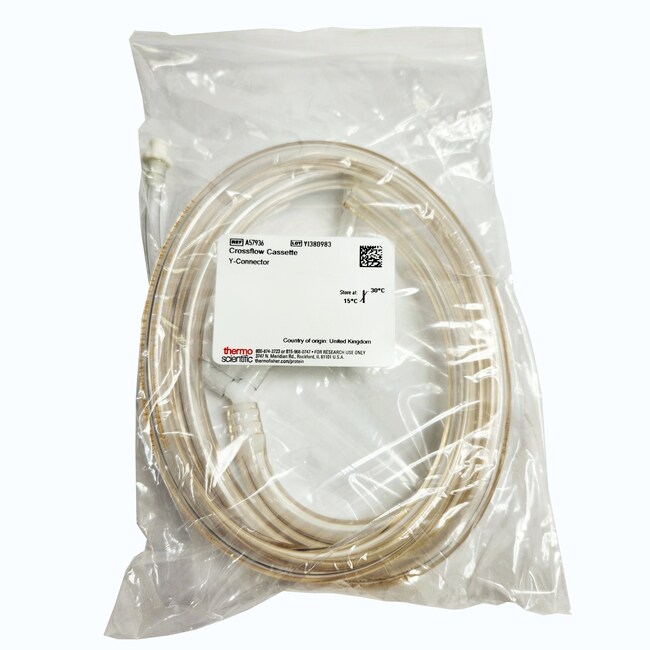
Crossflow Y-Connector
Thermo Scientific™

Crossflow Y-Connector

In order to filter sample volumes larger than 3 liters (up to 6 liters), two Pierce Crossflow Filtration Cassettes can be connected using the Y connector accessory, which is supplied with the appropriate tubing sizes and fittings.
Have Questions?
货号Quantity
A57936
货号 A57936
价格(CNY)
132.00
Each
添加至购物车
价格(CNY)
132.00
Each
添加至购物车
In order to filter sample volumes larger than 3 liters (up to 6 liters), two Pierce Crossflow Filtration Cassettes can be connected using the Y connector accessory, which is supplied with the appropriate tubing sizes and fittings. The tubing size required for connecting the cassettes is 16, while the size needed for the pump is 15. A pump head size of 15 is required for parallel running of two cassettes.
• The Y-connector connects the sample feed line to two Pierce Crossflow Cassettes
• Two cassettes are needed to process sample volumes ranging from 3–6 L.
规格
无菌Non-sterile
螺纹尺寸Connects size 15 hose to two size 16 hoses
可高温高压灭菌Not Autoclavable
材质PVC
总体长度(英制)4 ft.
总体长度(公制)122 cm
产品类型Plastic Hose Connection
Unit SizeEach

常见问题解答 (FAQ)

Are Pierce Crossflow Filtration Cassettes GMP grade?

Pierce Crossflow Filtration Cassettes are not GMP grade.

Find additional tips, troubleshooting help, and resources within our Protein Purification and Isolation Support Center.

Can I run Pierce Crossflow Filtration Cassettes without the pressure gauge?

A pressure gauge is provided with every Pierce Crossflow Filtration Cassette. Pierce Crossflow Filtration Cassettes can be run without a pressure gauge; however, it is important to limit the flow rate to 200-300 mL/min to prevent tearing and potential collapse of the tubing. The flow rate can be determined by measuring the volume flow over 1 min. Alternatively, a pump speed of 300-350 rpm or a pressure of 1-1.5 bar will maintain a flow rate of 200-300 mL/min.

Find additional tips, troubleshooting help, and resources within our Protein Purification and Isolation Support Center.

What are the factors that can speed up or slow down the rate of concentration or diafiltration?

High protein concentration and/or presence of particulate in the sample can slow down the rate of concentration/diafiltration. Adsorption of the sample to the membrane and lower temperature (4 degrees C vs room temperature) can also slow down concentration/diafiltration. Filtering your sample prior to processing with a crossflow filtration cassette will help speed up concentration/diafiltration.

Find additional tips, troubleshooting help, and resources within our Protein Purification and Isolation Support Center.

What are the advantages of using a crossflow ultrafiltration device vs. a stirred cell device?

Crossflow ultrafiltration and stirred cell devices both effectively concentrate biomolecules with similar sample recoveries; however, a crossflow filtration device concentrates sample much faster than a stirred cell device.

Find additional tips, troubleshooting help, and resources within our Protein Purification and Isolation Support Center.

Why should I use crossflow filtration instead of dialysis or chromatography methods?

Crossflow filtration is much faster for concentration and diafiltration than dialysis and chromatography methods.

Find additional tips, troubleshooting help, and resources within our Protein Purification and Isolation Support Center.