Search


引用和文献 (6)
Invitrogen™
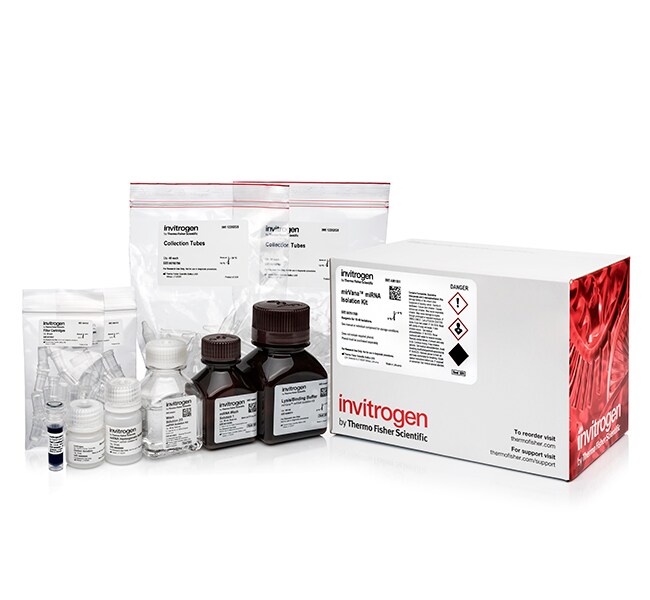
mirVana™ miRNA 分离试剂盒(不含苯酚)
mirVana™ miRNA 分离试剂盒使用快速程序通过基于高效玻璃纤维过滤柱 (GFF) 的方法从组织和细胞中分离小 RNA。该方法可分离大小范围在千碱基至 10 mer 之间的总了解更多信息
| 货号 | 数量 |
|---|---|
| AM1561 | 40 次制备 |
货号 AM1561
价格(CNY)
3,139.00
飞享价
Ends: 31-Dec-2026
4,269.00共减 1,130.00 (26%)
Each
数量:
40 次制备
价格(CNY)
3,139.00
飞享价
Ends: 31-Dec-2026
4,269.00共减 1,130.00 (26%)
Each
mirVana™ miRNA 分离试剂盒使用快速程序通过基于高效玻璃纤维过滤柱 (GFF) 的方法从组织和细胞中分离小 RNA。该方法可分离大小范围在千碱基至 10 mer 之间的总 RNA。每个试剂盒含有足量试剂和耗材,可用于40次总 RNA(包括小 RNA)分离,或20次单独大 RNA 和小 RNA 组分分离。苯酚必须单独购买。该试剂盒的特性包括:
•可高效分离总 RNA(含小 RNA)
• 可富集小 RNA(小于 200 nt),以提高下游分析的灵敏度
•简单的30分钟程序
•适用于 miRNA、siRNA、shRNA 和 snRNA 分析
• 几乎与所有细胞和组织类型兼容
高效回收小 RNA
当前的 RNA 纯化程序依赖于有机提取,然后是酒精沉淀或 GFF 或硅酸盐基质上核酸分子吸附。遗憾的是,前一种程序需要酒精沉淀,这较为耗时且不能高效回收小 RNA。后一程序通常会导致大量小 RNA 丢失。mirVana™ miRNA 分离试剂盒使用有机提取,然后在专用结合和洗涤条件下在 GFF 上进行纯化。因此,该试剂盒可从几乎所有细胞和组织类型中高效回收所有 RNA(从大 mRNA 和核糖体 RNA 至 10 mer)。mirVana™ miRNA 分离试剂盒可从由 102–107 个培养细胞或 0.5–250 mg 组织组成的样品中分离总 RNA(含小 RNA)。
富集小 RNA
尽管 mirVana™ miRNA 分离试剂盒可高效纯化所有大于 10 nt 的 RNA,但它也包括分离 RNA 组分的程序,特别是富集或消耗小 RNA 物质。通过 mirVana™ miRNA 分离试剂盒中随附的富集程序,可以高效地从较大的 RNA 物质中纯化 ∼200 nt 及更小的 RNA 分子。所得 RNA 制备液高度富集 miRNA、siRNA 和/或 snRNA。与相同测定方法与总 RNA 配合使用时相比,使用 mirVana™ miRNA 分离试剂盒程序进行的小 RNA 富集可在更少背景下进行更敏感的小 RNA 检测。
辅助产品
mirVana™ miRNA 分离试剂盒可供需要全套试剂盒(包括酸苯酚:氯仿)的用户使用。
•可高效分离总 RNA(含小 RNA)
• 可富集小 RNA(小于 200 nt),以提高下游分析的灵敏度
•简单的30分钟程序
•适用于 miRNA、siRNA、shRNA 和 snRNA 分析
• 几乎与所有细胞和组织类型兼容
高效回收小 RNA
当前的 RNA 纯化程序依赖于有机提取,然后是酒精沉淀或 GFF 或硅酸盐基质上核酸分子吸附。遗憾的是,前一种程序需要酒精沉淀,这较为耗时且不能高效回收小 RNA。后一程序通常会导致大量小 RNA 丢失。mirVana™ miRNA 分离试剂盒使用有机提取,然后在专用结合和洗涤条件下在 GFF 上进行纯化。因此,该试剂盒可从几乎所有细胞和组织类型中高效回收所有 RNA(从大 mRNA 和核糖体 RNA 至 10 mer)。mirVana™ miRNA 分离试剂盒可从由 102–107 个培养细胞或 0.5–250 mg 组织组成的样品中分离总 RNA(含小 RNA)。
富集小 RNA
尽管 mirVana™ miRNA 分离试剂盒可高效纯化所有大于 10 nt 的 RNA,但它也包括分离 RNA 组分的程序,特别是富集或消耗小 RNA 物质。通过 mirVana™ miRNA 分离试剂盒中随附的富集程序,可以高效地从较大的 RNA 物质中纯化 ∼200 nt 及更小的 RNA 分子。所得 RNA 制备液高度富集 miRNA、siRNA 和/或 snRNA。与相同测定方法与总 RNA 配合使用时相比,使用 mirVana™ miRNA 分离试剂盒程序进行的小 RNA 富集可在更少背景下进行更敏感的小 RNA 检测。
辅助产品
mirVana™ miRNA 分离试剂盒可供需要全套试剂盒(包括酸苯酚:氯仿)的用户使用。
仅供科研使用。不可用于诊断程序。
规格
洗脱体积100 μL
最终产品类型总 RNA、转录组 RNA、siRNA、snRNA、微小 RNA
适用于(应用)microRNA分析
高通量能力不兼容高通量应用(手动)
纯化时间30 min。
数量40 次制备
运输条件室温
原始材料量最多 250 mg 组织,最多 10^7 个细胞
产量Cells: ≤16 μg RNA per 50,000 cells
Tissue: ≤160 μg per 5 mg
Tissue: ≤160 μg per 5 mg
分离技术离心柱(玻璃纤维过滤柱), 有机提取
样品类型细菌, 细胞, 植物样品, 组织, 病毒样品, 酵母菌, Enzymatic Reactions
Unit SizeEach
内容与储存
• 30 mL miRNA 洗涤液 I(室温)
• 50 mL 洗涤液 2/3(室温)
• 80 个收集管(室温)
• 40 个滤芯(室温)
• 100 mL 裂解/结合缓冲液 (4°C)
• 10 mL miRNA 匀浆添加剂 (4°C)
• 1.4 mL 凝胶上样缓冲液 II (-20°C)
• 5 mL 洗脱液(-20°C、4°C 或室温)
• 50 mL 洗涤液 2/3(室温)
• 80 个收集管(室温)
• 40 个滤芯(室温)
• 100 mL 裂解/结合缓冲液 (4°C)
• 10 mL miRNA 匀浆添加剂 (4°C)
• 1.4 mL 凝胶上样缓冲液 II (-20°C)
• 5 mL 洗脱液(-20°C、4°C 或室温)
常见问题解答 (FAQ)
纯化miRNA样本的不同方法有哪些?
What are different methods for cleaning up my miRNA sample?
Can I order separately the Spin Cartridges and the Elution Tubes from the mirVana miRNA Isolation Kit, without phenol (Cat. No. AM1561)?
Do you offer a stand-alone phenol product that I can use with mirVana miRNA Isolation Kit, without phenol (Cat. No. AM1561)?
What kit do you recommend to capture small RNA that is >17 nt in size?
引用和文献 (6)
引用和文献
Abstract
[Differential expression profile of microRNA between hyperplastic scar and normal skin].
Journal:Zhonghua Yi Xue Za Zhi
PubMed ID:22781298
To explore the miRNA differential expression profiles of hyperplastic scar and normal skin so as to further elucidate the pathogenesis of hyperplastic scar and search for new therapeutic targets. The total RNA was extracted from 5 human hyperplastic scar and normal skin tissues by Trizol. The specimens were collected from
Circulating microRNAs in serum: novel biomarkers for patients with bladder cancer?
Journal:World J Urol
PubMed ID:23266581
'PURPOSE: Recent studies indicate that circulating microRNAs in serum/plasma are a novel class of non-invasive biomarkers with diagnostic and prognostic information. So far, circulating microRNAs have not been analyzed in patients with bladder cancer. METHODS: We collected serum from patients with non-muscle invasive bladder cancer (NMIBC), muscle invasive bladder cancer
[Isolation, identification and analysis of the expression profile of miRNAs in Aedes albopictus].
Journal:Nan Fang Yi Ke Da Xue Xue Bao
PubMed ID:20423824
'To verify the miRNA in Aedes albopictus and characterize the expression profile of several miRNAs across all the life stages of Aedes albopictus. Based on the published miRNA sequences of Anopheles gambiae and Aedes aegypti, 6 DIG-labeled antisense probes were synthesized. The total RNAs from Aedes albopictus in 6 developmental
MicroRNA expression profiles in the progression of prostate cancer-from high-grade prostate intraepithelial neoplasia to metastasis.
Journal:Urol Oncol
PubMed ID:21880514
'Models of the multistep process related to cancer progression have been designed for many cancers including prostate. The aim of this study is to propose a new model including a possible role for recently described micro RNAs in prostate cancer (CaP) progression. Sixty-three patients underwent radical prostatectomy to treat localized
High resolution of microRNA signatures in human whole saliva.
Journal:Arch Oral Biol
PubMed ID:21704302
Identifying discriminatory human salivary RNA biomarkers reflective of disease in a low-cost non-invasive screening assay is crucial to salivary diagnostics. Recent studies have reported both mRNA and microRNA (miRNA) in saliva, but little information has been documented on the quality and yield of RNA collected. Therefore, the aim of the