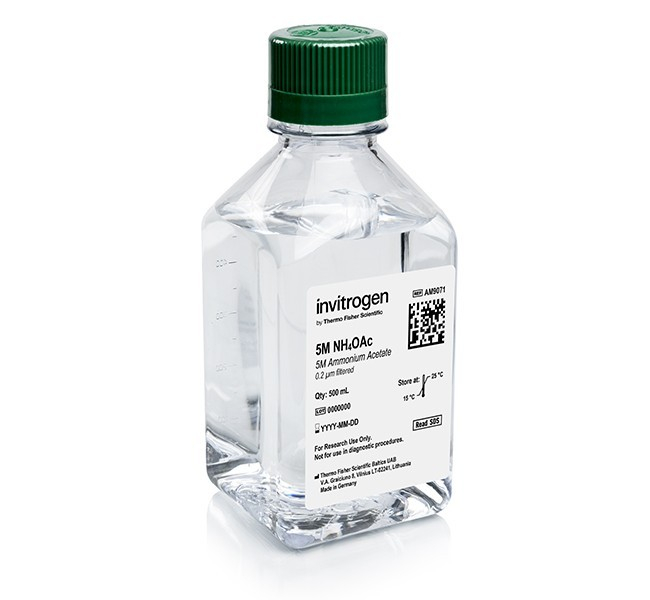
醋酸铵 (5M),无 RNase
Invitrogen17万+抗体限时买二赠一,靶点广,灵活用!
醋酸铵 (5M),无 RNase
Invitrogen™

醋酸铵 (5M),无 RNase

Ambion® 分子生物学级、5 M 醋酸铵溶液以容量为500mL 的一瓶装形式提供。该 溶液经认证无 RNase,经济实惠,即开即用。由于RNase无处不在,生产与了解更多信息
Have Questions?
更改视图buttonViewtableView
货号数量
AM9071500 mL
AM9070G100 mL
货号 AM9071
价格(CNY)
1,193.00
飞享价
Ends: 31-Dec-2025
1,512.00
共减 319.00 (21%)
Each
添加至购物车
数量:
500 mL
价格(CNY)
1,193.00
飞享价
Ends: 31-Dec-2025
1,512.00
共减 319.00 (21%)
Each
添加至购物车
Ambion® 分子生物学级、5 M 醋酸铵溶液以容量为500mL 的一瓶装形式提供。该 溶液经认证无 RNase,经济实惠,即开即用。由于RNase无处不在,生产与 RNA 配合使用的产品异常困难。Ambion®的无核酸酶试剂和缓冲液在多家经过专门设计以防止核酸酶引入的工厂生产。在生产过程的几个不同阶段均执行高灵敏度的 RNase检测,以确保达到最佳品质。这些试剂在非特异性污染核酸内切酶、核酸外切酶以及 RNase活性等方面经过严格测试。
仅供科研使用。不可用于诊断程序。
规格
化学名称或材料醋酸铵
包装类型瓶装
产品线Ambion
纯度分子生物学级
数量500 mL
运输条件室温
最大浓度5 M
形式液体
Unit SizeEach
内容与储存
在室温下储存。

常见问题解答 (FAQ)

使用哪种盐可以沉淀总RNA?每种盐的优势是什么?这些盐是否需要使用乙醇?

可使用以下3种盐:

•硫氰酸胍,需要乙醇。硫氰酸胍是分离RNA的常用试剂,我们特别推荐将其用于核糖核酸酶活性较高的组织,如胰腺或脾脏。
•醋酸铵,需要乙醇。醋酸铵可用于减少不必要的dNTPs和寡糖共沉淀。但是,纯化的核酸如果后续要使用T4多核苷酸激酶处理的话,不能使用醋酸铵,因为铵离子会抑制T4多核苷酸激酶。
•氯化锂,不需要乙醇。LiCl能有效沉淀RNA而不能有效沉淀蛋白质或DNA,而且也不会沉淀未掺入的游离核苷酸。

What salts can be used to precipitate total RNA? What are the advantages of each? Do they require ethanol?

The three salts that can be used are:

- Guanidine thiocyanate, which requires ethanol. Guanidine thiocyanate is a common agent used for isolating RNA and we recommend it especially for tissues high in ribonuclease activity, such as the pancreas or spleen.
- Ammonium acetate, which requires ethanol. Ammonium acetate is useful when reducing coprecipitation of unwanted dNTPs and oligosaccharides. However, it should not be used when the nucleic acid will be phosphorylated using T4 polynucleotide kinase, since this enzyme is inhibited by ammonium ions.
- Lithium chloride, which does not require ethanol. LiCl is very effective in precipitating RNA but does not efficiently precipitate protein or DNA. It also does not precipitate unincorporated nucleotides.

How can I concentrate DNA solution using ethanol precipitation?

Ethanol precipitation is frequently used for concentration of DNA solutions and for removal of protein, salt, and unincorporated nucleotides. The two most common protocols use either 0.3 M sodium acetate (0.1 volume of 3 M) or 2.5 M ammonium acetate (0.5 volume of 7.5 M), along with 2 to 2.5 volumes of ethanol. Studies at Thermo Fisher Scientific (1, 2) have shown these two salts to be equally effective for recovery of small amounts of DNA from small volumes and for removal of unincorporated nucleotides from labeling reactions.

DNA was found to precipitate readily with room temperature ethanol and room temperature centrifugation. For DNA concentrations >0.1 µg/mL, no incubation period is required. For improved recovery of DNA from dilute solutions (10 ng/mL), overnight incubation in the ethanol and extended (30 min) centrifugation is recommended. Addition of ammonium acetate to 2.5 M (without ethanol) has also been shown to be effective in precipitating proteins while leaving the DNA in solution (2).

1. Zeugin, J.A. and Hartley, J.L. (1985) FOCUS 7:4, 1.

2. Crouse, J. and Amorese, D. (1987) FOCUS 9:2, 3.