Search


引用和文献 (6)
Invitrogen™
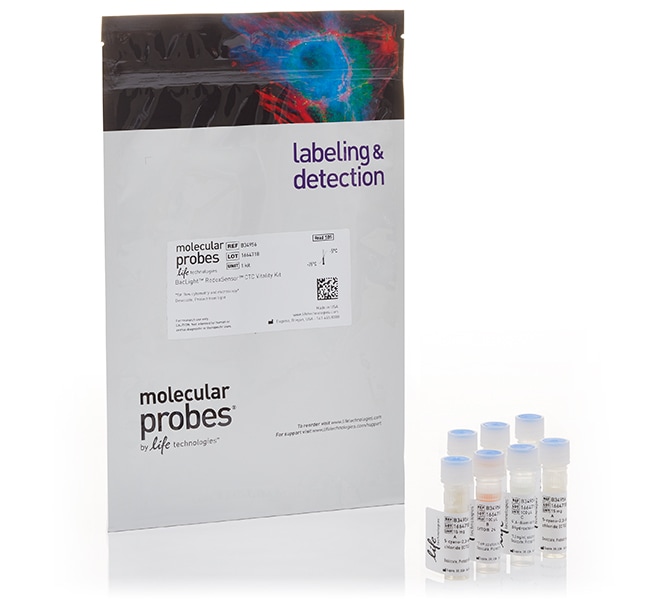
BacLight™ RedoxSensor™ CTC 活力试剂盒
The BacLight™ RedoxSensor™ CTC Vitality Kit provides effective reagents for evaluating bacterial cell health and vitality that can withstand fixation procedures.
| 货号 | 数量 |
|---|---|
| B34956 | 1 Kit |
货号 B34956
价格(CNY)
6,669.00
Online exclusive
Ends: 31-Dec-2026
8,860.00共减 2,191.00 (25%)
Each
数量:
1 Kit
价格(CNY)
6,669.00
Online exclusive
Ends: 31-Dec-2026
8,860.00共减 2,191.00 (25%)
Each
The BacLight™ RedoxSensor™ CTC Vitality Kit provides effective reagents for evaluating bacterial cell health and vitality that can withstand fixation procedures. Briefly, healthy cells respiring via the electron transport chain will absorb and reduce CTC into an insoluble, red fluorescent formazan product. Cells not respiring or respiring at slower rates will reduce less CTC and consequently produce less fluorescent product, giving a semi-quantitative estimate of healthy vs. unhealthy bacteria. Green- and blue-fluorescent nucleic acid stains are included as counterstains to assist differentiation of cells from debris and calculating total cell numbers.
仅供科研使用。不可用于诊断程序。
规格
细胞类型细菌
检测方法荧光
染料类型其他标记或染料
产品规格管、玻片
数量1 Kit
运输条件室温
溶解度DMSO(二甲亚砜)
发射波长范围UV,488
适用于(设备)荧光显微镜, 流式细胞仪
产品线BacLight、RedoxSensor
产品类型CTC 细胞活力试剂盒
Unit SizeEach
内容与储存
含 5 瓶 5-氰基-2,3-二甲苯基四唑氯化物(CTC,每瓶 15 mg)、1 瓶 SYTO™ 24 Green(100 µL,溶于 DMSO)m 和 DAPI(100 µL,5 mg/mL 溶液,溶于水)。 在冷柜(-5 至 -30°C)中避光储存
常见问题解答 (FAQ)
我可以在流式细胞仪上看到哪些细菌参数?
What bacterial parameters can I look at by flow cytometry?
引用和文献 (6)
引用和文献
Abstract
Flow cytometric analysis of 5-cyano-2,3-ditolyl tetrazolium chloride activity of marine bacterioplankton in dilution cultures.
Journal:Appl Environ Microbiol
PubMed ID:10347021
'The respiratory activity of marine bacteria is an important indication of the ecological functioning of these organisms in marine ecosystems. The redox dye 5-cyano-2,3-ditolyl tetrazolium chloride (CTC) is reduced intracellularly in respiring cells to an insoluble, fluorescent precipitate. This product is detectable and quantifiable by flow cytometry in individual cells.
Comparison of the antimicrobial effects of chlorine, silver ion, and tobramycin on biofilm.
Journal:Antimicrob Agents Chemother
PubMed ID:18195062
'The systematic understanding of how various antimicrobial agents are involved in controlling biofilms is essential in order to establish an effective strategy for biofilm control, since many antimicrobial agents are effective against planktonic cells but are ineffective when they are used against the same bacteria growing in a biofilm state.
Characterization of osmotically induced filaments of Salmonella enterica.
Journal:Appl Environ Microbiol
PubMed ID:22798362
'Salmonella enterica forms aseptate filaments with multiple nucleoids when cultured in hyperosmotic conditions. These osmotic-induced filaments are viable and form single colonies on agar plates even though they contain multiple genomes and have the potential to divide into multiple daughter cells. Introducing filaments that are formed during osmotic stress into
Inactivation of Escherichia coli by nanoparticulate zerovalent iron and ferrous ion.
Journal:Appl Environ Microbiol
PubMed ID:20870787
'The mechanism of Escherichia coli inactivation by nanoparticulate zerovalent iron (nZVI) and Fe(II) was investigated using reactive oxygen species (ROS) quenchers and probes, an oxidative stress assay, and microscopic observations. Disruption of cell membrane integrity and respiratory activity was observed under deaerated conditions [more disruption by nZVI than Fe(II)], and
How the insect immune system interacts with an obligate symbiotic bacterium.
Journal:Proc Biol Sci
PubMed ID:20719775
The animal immune system provides defence against microbial infection, and the evolution of certain animal-microbial symbioses is predicted to involve adaptive changes in the host immune system to accommodate the microbial partner. For example, the reduced humoral immune system in the pea aphid Acyrthosiphon pisum, including an apparently non-functional immune