Search


引用和文献 (6)
Invitrogen™
Alexa Fluor™ 488 酪胺 SuperBoost™ 试剂盒(山羊抗小鼠 IgG)
SuperBoost™ 酪胺信号放大是检测多色荧光免疫组织化学 (ICC)、免疫组织化学 (IHC ) 和原位杂交 (ISH) 应用中的低丰度靶标的最灵敏方法。SuperBoost了解更多信息
Have Questions?
更改视图

| 货号 | 数量 |
|---|---|
| B40912 | 足以用于 150 个玻片 |
| B40941 | 足够用于50张玻片 |
货号 B40912
价格(CNY)
8,155.00
Each
数量:
足以用于 150 个玻片
价格(CNY)
8,155.00
Each
SuperBoost™ 酪胺信号放大是检测多色荧光免疫组织化学 (ICC)、免疫组织化学 (IHC ) 和原位杂交 (ISH) 应用中的低丰度靶标的最灵敏方法。SuperBoost 试剂盒将 AlexaFluor™ 染料的亮度与聚-HRP 介导的酪胺标记反应的出色信号扩增相结合,获得的灵敏度比标准方法高 10-200 倍。SuperBoost 试剂盒的灵敏度也比 TSA™ 等常规酪胺放大技术高出 2-10 倍。为实现优异的研究结果,SuperBoost 试剂盒可提供成像方法难以提供的更为清晰的关键指标结果。
SuperBoost 试剂盒使用简便,可根据标准 ICC、IHC 或 FISH 实验方案轻松灵活调整,适用于任意类型的细胞或组织。使用 SuperBoost 试剂盒标记的细胞适用于任意类型的显微镜,可生成高分辨率的多重分析图像。该特定试剂盒配备 AlexaFluor 488 酪胺盐(激发/发射波长 496/524),使用标准绿色/FITC/GFP 滤光片立方进行检测。该试剂盒还含有多聚 HRP 标记的山羊抗小鼠 IgG 二抗。
SuperBoost 试剂盒的功能包括:
•通过荧光成像以出色的灵敏度检测低水平或难以检测的靶标
• 采用标准滤光片的简单实验方案和检测
• 适用于高分辨率多通路图像—与 DAPI、二抗和其他 SuperBoost 试剂盒共标记
• 需要的一抗量是标准 ICC/IHC/ISH 实验的 1/10-1/100
SuperBoost 试剂盒基于酪胺信号放大系统,该系统使用辣根过氧化物酶 (HRP) 的催化活性原位生成靶蛋白或核酸序列的高密度标记。使用 SuperBoost 试剂盒进行的典型 ICC/IHC/ISH 实验所需的一抗量为标准 ICC/IHC/ISH 实验的 1/10-1/100。SuperBoost 试剂盒可提供远高于背景的特异性信号强度,因此可以轻松优化实验方案,以便从观测到较高的内源性自发荧光的样品中检测特异性信号
SuperBoost 试剂盒的优点
利用 Alexa Fluor 酪胺增强信号:SuperBoost 试剂盒利用可与 HRP 反应的 Alexa Fluor 酰胺,最终将明亮、光稳定的 Alexa Fluor 染料沉积在周围蛋白质和其他类似分子上。SuperBoost 试剂盒是唯一款能够集 Alexa Fluor 染料的亮度与酪胺信号放大的增强功能于一身,以生成优异的信号的试剂盒。
Poly-HRP 优点:与 TSA 不同,SuperBoost 试剂盒采用了 poly-HRP 偶联的二抗。在此系统中,多种 HRP 酶与短链聚合物偶联,比常规 HRP 系统将信号增强数倍。poly-HRP 的结构形式使抗体能够像常规 HRP 偶联二抗一样,有效透过细胞或组织。酶/抗体蛋白的摩尔比的平均值为“4”。
反应终止液:与任何基于酶的标记系统一样,此系统也会发生信号过溢的情况。SuperBoost 试剂盒包含 HRP 终止液,可终止 HRP 反应。可利用 HRP 终止液获取尽可能高的信号,同时又不会导致背景信号升高。使用优化的 HRP 反应时间生成的图像与使用标准 ICC/IHC/ISH 方法产生的图像一样清晰,但前者的灵敏度是后者的 10-200 倍。
背景减少:SuperBoost 试剂盒包含用于消除或减少内源性过氧化物酶和荧光背景信号的封闭剂。这些封闭剂有助于确保仅增强特异性信号,同时阻断非特异性/背景信号。
SuperBoost 试剂盒使用简便,可根据标准 ICC、IHC 或 FISH 实验方案轻松灵活调整,适用于任意类型的细胞或组织。使用 SuperBoost 试剂盒标记的细胞适用于任意类型的显微镜,可生成高分辨率的多重分析图像。该特定试剂盒配备 AlexaFluor 488 酪胺盐(激发/发射波长 496/524),使用标准绿色/FITC/GFP 滤光片立方进行检测。该试剂盒还含有多聚 HRP 标记的山羊抗小鼠 IgG 二抗。
SuperBoost 试剂盒的功能包括:
•通过荧光成像以出色的灵敏度检测低水平或难以检测的靶标
• 采用标准滤光片的简单实验方案和检测
• 适用于高分辨率多通路图像—与 DAPI、二抗和其他 SuperBoost 试剂盒共标记
• 需要的一抗量是标准 ICC/IHC/ISH 实验的 1/10-1/100
SuperBoost 试剂盒基于酪胺信号放大系统,该系统使用辣根过氧化物酶 (HRP) 的催化活性原位生成靶蛋白或核酸序列的高密度标记。使用 SuperBoost 试剂盒进行的典型 ICC/IHC/ISH 实验所需的一抗量为标准 ICC/IHC/ISH 实验的 1/10-1/100。SuperBoost 试剂盒可提供远高于背景的特异性信号强度,因此可以轻松优化实验方案,以便从观测到较高的内源性自发荧光的样品中检测特异性信号
SuperBoost 试剂盒的优点
利用 Alexa Fluor 酪胺增强信号:SuperBoost 试剂盒利用可与 HRP 反应的 Alexa Fluor 酰胺,最终将明亮、光稳定的 Alexa Fluor 染料沉积在周围蛋白质和其他类似分子上。SuperBoost 试剂盒是唯一款能够集 Alexa Fluor 染料的亮度与酪胺信号放大的增强功能于一身,以生成优异的信号的试剂盒。
Poly-HRP 优点:与 TSA 不同,SuperBoost 试剂盒采用了 poly-HRP 偶联的二抗。在此系统中,多种 HRP 酶与短链聚合物偶联,比常规 HRP 系统将信号增强数倍。poly-HRP 的结构形式使抗体能够像常规 HRP 偶联二抗一样,有效透过细胞或组织。酶/抗体蛋白的摩尔比的平均值为“4”。
反应终止液:与任何基于酶的标记系统一样,此系统也会发生信号过溢的情况。SuperBoost 试剂盒包含 HRP 终止液,可终止 HRP 反应。可利用 HRP 终止液获取尽可能高的信号,同时又不会导致背景信号升高。使用优化的 HRP 反应时间生成的图像与使用标准 ICC/IHC/ISH 方法产生的图像一样清晰,但前者的灵敏度是后者的 10-200 倍。
背景减少:SuperBoost 试剂盒包含用于消除或减少内源性过氧化物酶和荧光背景信号的封闭剂。这些封闭剂有助于确保仅增强特异性信号,同时阻断非特异性/背景信号。
仅供科研使用。不可用于诊断程序。
规格
产品类型酪胺 SuperBoost 试剂盒
数量足以用于 150 个玻片
有效期每 6 个月
运输条件经批准可在室温下或置于湿冰上运输
偶联物Alexa Fluor 488
产品线SuperBoost
Unit SizeEach
内容与储存
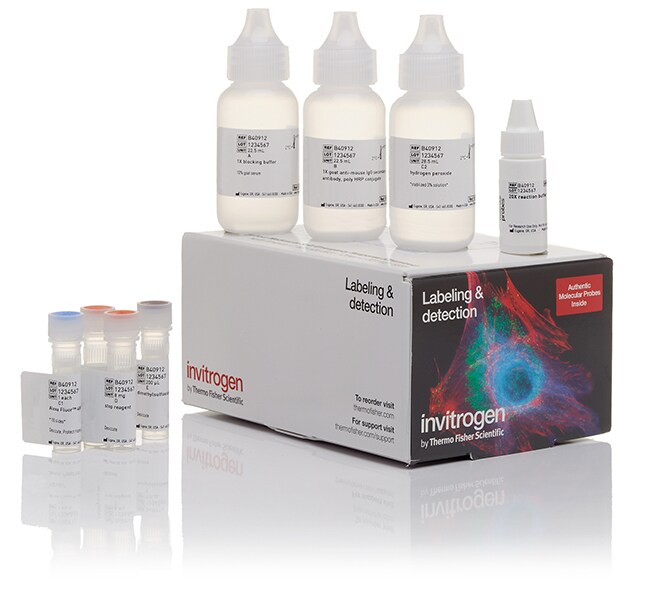
1个试剂盒足以用于150个显微镜玻片 (18 x 18 mm),其中含有:封闭缓冲液 (1X),22.5 mL聚-HRP-偶联山羊抗小鼠二抗 (1X),22.5 mL Alexa Fluor 酪胺试剂 过氧化氢
常见问题解答 (FAQ)
我用了一种神经元特异性抗体标记自己的神经元,但我无法从偶联荧光染料的一抗中获得足够的信号。我该如何改善?
我的抗原丰度极低,如何放大信号?
With a SuperBoost tyramide kit, I got excessive and non-specific labeling. What can I do to limit background and acquire a more localized labeling?
Is it possible to perform dual TSA labeling with SuperBoost tyramide kits?
How are SuperBoost tyramide kits different from the original TSA labeling kits?
引用和文献 (6)
引用和文献
Abstract
REST regulates the cell cycle for cardiac development and regeneration.
Journal:Nat Commun
PubMed ID:29215012
'Despite the importance of cardiomyocyte proliferation in cardiac development and regeneration, the mechanisms that promote cardiomyocyte cell cycle remain incompletely understood. RE1 silencing transcription factor (REST) is a transcriptional repressor of neuronal genes. Here we show that REST also regulates the cardiomyocyte cell cycle. REST binds and represses the cell
Attenuation of Follicular Helper T Cell-Dependent B Cell Hyperactivity by Abatacept Treatment in Primary Sjögren's Syndrome.
Journal:Arthritis Rheumatol
PubMed ID:28564491
'To assess the effect of abatacept (CTLA-4Ig), which limits T cell activation, on homeostasis of CD4+ T cell subsets and T cell-dependent B cell hyperactivity in patients with primary Sjögren''s syndrome (SS). Fifteen patients with primary SS treated with abatacept were included. Circulating CD4+ T cell and B cell subsets
Fibroblast-specific plasminogen activator inhibitor-1 depletion ameliorates renal interstitial fibrosis after unilateral ureteral obstruction.
Journal:Nephrol Dial Transplant
PubMed ID:31071225
Plasminogen activator inhibitor-1 (PAI-1) expression increases extracellular matrix deposition and contributes to interstitial fibrosis in the kidney after injury. While PAI-1 is ubiquitously expressed in the kidney, we hypothesized that interstitial fibrosis is strongly dependent on fibroblast-specific PAI-1 (fbPAI-1).
Inhibition of retinoic acid signaling induces aberrant pericyte coverage and differentiation resulting in vascular defects in congenital diaphragmatic hernia.
Journal:Am J Physiol Lung Cell Mol Physiol
PubMed ID:31268349
The mortality and morbidity of patients with congenital diaphragmatic hernia (CDH) is primarily caused by treatment-resistant, persistent pulmonary hypertension. Structural vascular changes, exemplified by extensive muscularization, are already present early in gestation, but the origin of these abnormalities is unknown. Understanding the origin of the vascular defects is important to
Proteolytic Processing of Neuregulin 2.
Journal:Mol Neurobiol
PubMed ID:31838721
Neuregulin 2 (NRG2) belongs to the EGF family of growth factors. Most of this family members require proteolytic cleavage to liberate their ectodomains capable of binding and activating their cognate ErbB receptors. To date, most of the studies investigating proteolytic processing of neuregulins focused on NRG1, which was shown to