Search

Invitrogen™
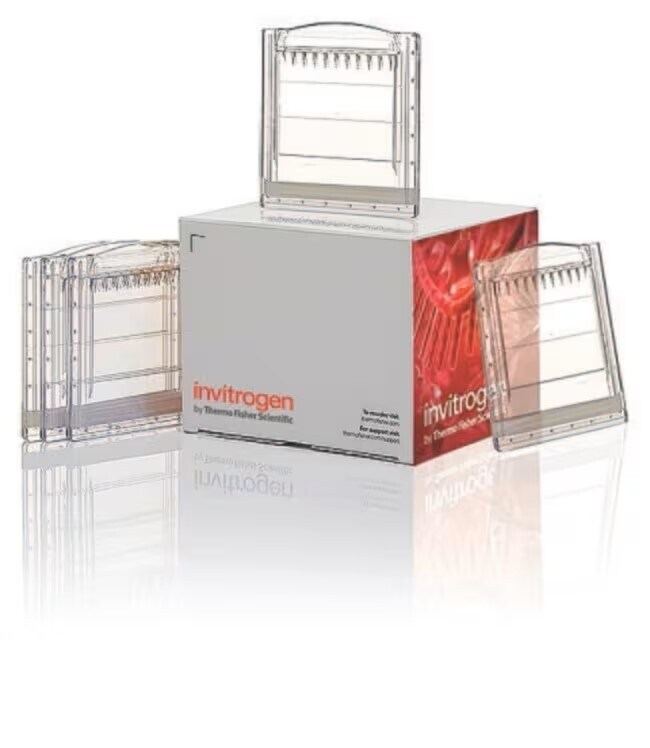
NativePAGE™ Bis-Tris Mini Protein Gels, 4 to 16%, 1.0 mm
Invitrogen NativePAGE Bis-Tris 凝胶系统是一种预制聚丙烯酰胺小型凝胶系统,可对非变性蛋白和蛋白复合物进行灵敏的高分辨率分析、分子量估算和纯度评估。
Have Questions?
更改视图

| 货号 | 孔 |
|---|---|
| BN2111BX10 | 10孔 |
| BN2112BX10 | 15孔 |
货号 BN2111BX10
价格(CNY)
3,096.00
Each
孔:
10孔
价格(CNY)
3,096.00
Each
Invitrogen NativePAGE Bis-Tris Protein gels are precast polyacrylamide mini-gels that provides sensitive, high-resolution analysis of native proteins and protein complexes for molecular mass estimations and assessment of purity. They are based on the blue native polyacrylamide gel electrophoresis (BN PAGE) technique developed by Schägger and von Jagow, which overcomes the limitations of traditional native electrophoresis by providing a near-neutral operating pH and detergent compatibility.
Invitrogen NativePAGE Bis-Tris Protein gels are precast polyacrylamide mini-gels that provides sensitive, high-resolution analysis of native proteins and protein complexes for molecular mass estimations and assessment of purity. They are based on the blue native polyacrylamide gel electrophoresis (BN PAGE) technique developed by Schägger and von Jagow, which overcomes the limitations of traditional native electrophoresis by providing a near-neutral operating pH and detergent compatibility.
Features of the NativePAGE Bis-Tris Protein gels include:
- Wide molecular weight resolving range of 15–10,000 kDa
- Neutral-pH separation, which better preserves the native state of protein complexes
- Resolution of all proteins regardless of their isoelectric point (pI)
- Ability to analyze membrane-protein complexes in their native conformations
- Ability to obtain better resolution than with traditional tris-glycine native electrophoresis
How NativePAGE Bis-Tris Protein gels work
In SDS-PAGE, SDS functions as a charge-shift molecule that denatures proteins by conferring on them a net negative charge and enables proteins to migrate towards the anode. BN PAGE uses Coomassie G-250 as the charge-shift molecule, which binds to proteins and confers a net negative charge while maintaining the proteins in their nondenatured, native state. The near-neutral pH of the NativePAGE Bis-Tris Protein gels provides maximum stability of both the proteins and the gel matrix, resulting in a highly sensitive method for analysis of native membrane-protein complexes and offering superior band resolution over traditional Tris-glycine gel systems.
For transferring proteins to a membrane, we recommend using NuPAGE transfer buffers for traditional wet transfer and PVDF membranes. NuPAGE transfer buffers maintain the neutral pH environment established during electrophoresis. Nitrocellulose membranes are not compatible for blotting since the membrane will bind the Coomassie G-250 dye very tightly. Alternatively, rapid semi-dry transfer can be done using the Power Blotter (Cat. No. PB0013) or rapid dry transfer using the iBlot 3 Gel Transfer Device (IB31001) using PVDF membranes.
仅供研究使用。
规格
适用于(设备)Mini Gel Tank
凝胶厚度1.0 mm
长度(公制)8 cm
分离模式分子量
数量10 块凝胶/盒
上样容量Up to 25 μL
有效期每 8 个月
运输条件Wet Ice
宽度(公制)8 cm
凝胶百分比4 to 16%
凝胶尺寸Mini
凝胶类型Bis-Tris
产品线NativePAGE
分离范围15 to 10,000 kDa
分离类型天然分子
孔10孔
Unit SizeEach
内容与储存
Store at 2°C to 8°C. Do not freeze.