Search


引用和文献 (10)
Invitrogen™
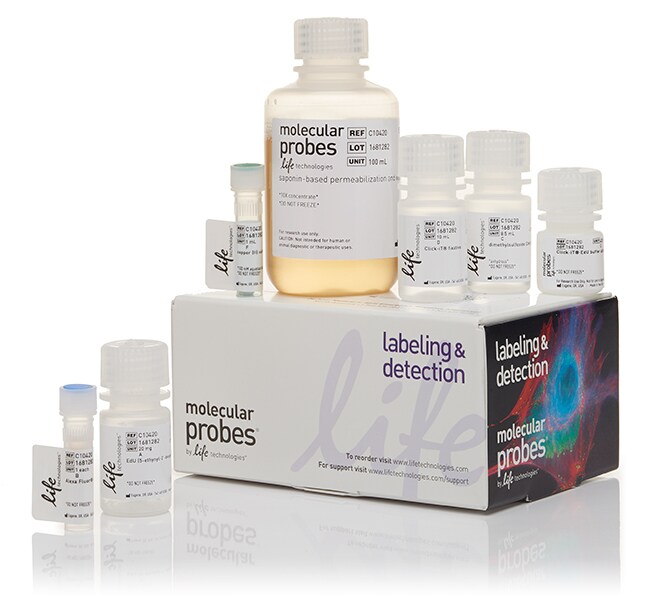
Click-iT™ EdU Alexa Fluor™ 488 流式细胞术分析试剂盒
Click-iT™ EdU Alexa Fluor™ 488 流式细胞分析检测试剂盒用于分析增殖细胞中的 DNA 复制,是一种较传统 BrdU 法更简单了解更多信息
Have Questions?
更改视图

| 货号 | 数量 |
|---|---|
| C10420 | 100 assays |
| C10425 | 50 assays |
货号 C10420
价格(CNY)
10,967.00
飞享价
Ends: 31-Dec-2026
14,574.00共减 3,607.00 (25%)
Each
数量:
100 assays
价格(CNY)
10,967.00
飞享价
Ends: 31-Dec-2026
14,574.00共减 3,607.00 (25%)
Each
Click-iT™ EdU Alexa Fluor™ 488 流式细胞分析检测试剂盒用于分析增殖细胞中的 DNA 复制,是一种较传统 BrdU 法更简单、更可靠的检测方法。采用流式细胞仪的 488 nm 激光分析新合成的 DNA。
•准确—检测结果优于 BrdU 检测
• 快速—可在短短 90 分钟内获得结果
• 经济—每个试剂盒可进行的检测次数更多
查看流式细胞分析所有 Click-iT™ EdU 和 Click-iT™ Plus EdU 检测的选择指南。
更出色的 BrdU 替代方法,提供更优结果
更准确的增殖分析方法可直接测量 DNA 合成。最初,这是通过掺入放射性核苷(即 3H-胸苷)来完成的。随后基于抗体的溴脱氧尿苷(BrdU,核苷类似物)法取代了这种检测方法。Click-iT™ EdU 流式细胞术检测试剂盒是替代 BrdU 检测的新方法。EdU(5-乙炔基-2´-脱氧尿苷)是胸苷类似物,可在活跃的 DNA 合成过程中掺入 DNA 中。检测基于点击化学:一种在叠氮化物和炔烃之间的铜催化共价反应。在该应用中,在 EdU 的乙炔基团中发现了炔烃,而叠氮化物偶联至 Alexa Fluor™ 488、Alexa Fluor™ 647 或 Pacific BlueTM 染料。标准流式细胞分析方法用于检测细胞群中 S 期细胞的比例(图 1)。
温和的条件允许与细胞周期染料和抗体配合使用
在进行检测时,Click-iT™ EdU 标记的优势显而易见(图 2)。在温和条件下,小分子叠氮染料高效地与掺入的 EdU 反应,然后采用标准醛基固定,洗涤剂透化,从而使 Click-iT™ Plus 检测试剂检测出 DNA。这与 BrdU 检测相反,BrdU 检测需要使用 HCl、加热或用 DNase 消化变性 DNA,使 BrdU 暴露以便用抗 BrdU 抗体检测。BrdU 检测的样品处理会改变细胞周期分布的信号变化,且使用 HCl 方法会破坏抗原识别位点。相反,易于使用的 EdU 细胞增殖试剂盒与细胞周期染料兼容。本款 EdU 检测试剂盒还可结合表面和细胞内标记物的抗体进行多重分析。
快速简便的实验方案
Click-iT™ EdU 方案基于免疫组化抗体标记的醛基固定和洗涤剂透化步骤,但 EdU 与其他
固定剂/透化剂(包括皂苷和甲醇)兼容。只需五步就能分析细胞增殖数据:’
•使用 EdUM 处理细胞
• 固定并透化细胞
• 使用 Click-iT™ 检测混合物检测 S 期细胞 30 min
• 洗涤一次
• 分析
以经济的方式获得准确结果
通过增加每个试剂盒可进行的测定数量,Click-IT™ EdU Alexa Fluor™ 488 流式细胞分析检测试剂盒的价格低于传统 BrdU 测定,使其适用于大型实验。
仅供研究使用。不适用于人或动物的治疗或诊断用途。
•准确—检测结果优于 BrdU 检测
• 快速—可在短短 90 分钟内获得结果
• 经济—每个试剂盒可进行的检测次数更多
查看流式细胞分析所有 Click-iT™ EdU 和 Click-iT™ Plus EdU 检测的选择指南。
更出色的 BrdU 替代方法,提供更优结果
更准确的增殖分析方法可直接测量 DNA 合成。最初,这是通过掺入放射性核苷(即 3H-胸苷)来完成的。随后基于抗体的溴脱氧尿苷(BrdU,核苷类似物)法取代了这种检测方法。Click-iT™ EdU 流式细胞术检测试剂盒是替代 BrdU 检测的新方法。EdU(5-乙炔基-2´-脱氧尿苷)是胸苷类似物,可在活跃的 DNA 合成过程中掺入 DNA 中。检测基于点击化学:一种在叠氮化物和炔烃之间的铜催化共价反应。在该应用中,在 EdU 的乙炔基团中发现了炔烃,而叠氮化物偶联至 Alexa Fluor™ 488、Alexa Fluor™ 647 或 Pacific BlueTM 染料。标准流式细胞分析方法用于检测细胞群中 S 期细胞的比例(图 1)。
温和的条件允许与细胞周期染料和抗体配合使用
在进行检测时,Click-iT™ EdU 标记的优势显而易见(图 2)。在温和条件下,小分子叠氮染料高效地与掺入的 EdU 反应,然后采用标准醛基固定,洗涤剂透化,从而使 Click-iT™ Plus 检测试剂检测出 DNA。这与 BrdU 检测相反,BrdU 检测需要使用 HCl、加热或用 DNase 消化变性 DNA,使 BrdU 暴露以便用抗 BrdU 抗体检测。BrdU 检测的样品处理会改变细胞周期分布的信号变化,且使用 HCl 方法会破坏抗原识别位点。相反,易于使用的 EdU 细胞增殖试剂盒与细胞周期染料兼容。本款 EdU 检测试剂盒还可结合表面和细胞内标记物的抗体进行多重分析。
快速简便的实验方案
Click-iT™ EdU 方案基于免疫组化抗体标记的醛基固定和洗涤剂透化步骤,但 EdU 与其他
固定剂/透化剂(包括皂苷和甲醇)兼容。只需五步就能分析细胞增殖数据:’
•使用 EdUM 处理细胞
• 固定并透化细胞
• 使用 Click-iT™ 检测混合物检测 S 期细胞 30 min
• 洗涤一次
• 分析
以经济的方式获得准确结果
通过增加每个试剂盒可进行的测定数量,Click-IT™ EdU Alexa Fluor™ 488 流式细胞分析检测试剂盒的价格低于传统 BrdU 测定,使其适用于大型实验。
仅供研究使用。不适用于人或动物的治疗或诊断用途。
仅供科研使用。不可用于诊断程序。
规格
检测方法荧光
染料类型Alexa Fluor™ 488
产品规格管
数量100 assays
运输条件室温
发射波长范围488
适用于(设备)流式细胞仪
产品线Alexa Fluor, Click-iT
产品类型流式细胞分析测定试剂盒
Unit SizeEach
内容与储存
含有 EdU(5-乙炔基-2'-脱氧尿苷)、Alexa Fluor™ 488 叠氮化物、无水二甲基亚砜 (DMSO)、Click-iT™ 固定剂、Click-iT™ 皂苷基透化液和洗涤缓冲液、硫酸铜 (II) 和 Click-iT™ EdU 缓冲液添加剂。储存于 2°C 至 8°C 干燥避光储存。
常见问题解答 (FAQ)
我发现自己的点击标记样品无信号或特异性信号非常低,如何提高信号?
我对自己的Click-iT EdU TUNEL标记样品成像时,观测到较高的非特异性本底。这是什么原因造成的?如何降低本底干扰?
我注意到,当我在click反应后用DAPI染色细胞并检测EdU的掺入时,相比于我的无click反应对照样品,DAPI信号非常低。是什么原因导致DAPI信号降低?
我观测到自己的的click标记样品无信号或信号非常低,如何提高信号?
当我分析click标记样品时,观测到较高的本底干扰,这是什么原因所致?如何减少本底干扰?
引用和文献 (10)
引用和文献
Abstract
Inositol pyrophosphate synthesis by inositol hexakisphosphate kinase 1 is required for homologous recombination repair.
Journal:J Biol Chem
PubMed ID:23255604
'Inositol pyrophosphates, such as diphosphoinositol pentakisphosphate (IP(7)), are water-soluble inositol phosphates that contain high energy diphosphate moieties on the inositol ring. Inositol hexakisphosphate kinase 1 (IP6K1) participates in inositol pyrophosphate synthesis, converting inositol hexakisphosphate (IP(6)) to IP(7). In the present study, we show that mouse embryonic fibroblasts (MEFs) lacking IP6K1
IDO1 metabolites activate ß-catenin signaling to promote cancer cell proliferation and colon tumorigenesis in mice.
Journal:
PubMed ID:23669411
Indoleamine 2,3 dioxygenase-1 (IDO1) catabolizes tryptophan along the kynurenine pathway. Although IDO1 is expressed in inflamed and neoplastic epithelial cells of the colon, its role in colon tumorigenesis is not well understood. We used genetic and pharmacologic approaches to manipulate IDO1 activity in mice with colitis-associated cancer and human colon
Lung myofibroblasts are characterized by down-regulated cyclooxygenase-2 and its main metabolite, prostaglandin E2.
Journal:
PubMed ID:23755232
Prostaglandin E2 (PGE2), the main metabolite of cyclooxygenase (COX), is a well-known anti-fibrotic agent. Moreover, myofibroblasts expressing a-smooth muscle actin (a-SMA), fibroblast expansion and epithelial-mesenchymal transition (EMT) are critical to the pathogenesis of idiopathic pulmonary fibrosis (IPF). Our aim was to investigate the expression of COX-2 and PGE2 in human
An organotypic coculture model supporting proliferation and differentiation of medullary thymic epithelial cells and promiscuous gene expression.
Journal:J Immunol
PubMed ID:23269248
Understanding intrathymic T cell differentiation has been greatly aided by the development of various reductionist in vitro models that mimic certain steps/microenvironments of this complex process. Most models focused on the faithful in vitro restoration of T cell differentiation and selection. In contrast, suitable in vitro models emulating the developmental
PARG dysfunction enhances DNA double strand break formation in S-phase after alkylation DNA damage and augments different cell death pathways.
Journal:
PubMed ID:23744356
Poly(ADP-ribose) glycohydrolase (PARG) is the primary enzyme responsible for the degradation of poly(ADP-ribose). PARG dysfunction sensitizes cells to alkylating agents and induces cell death; however, the details of this effect have not been fully elucidated. Here, we investigated the mechanism by which PARG deficiency leads to cell death in different