Search


引用和文献 (6)
Invitrogen™
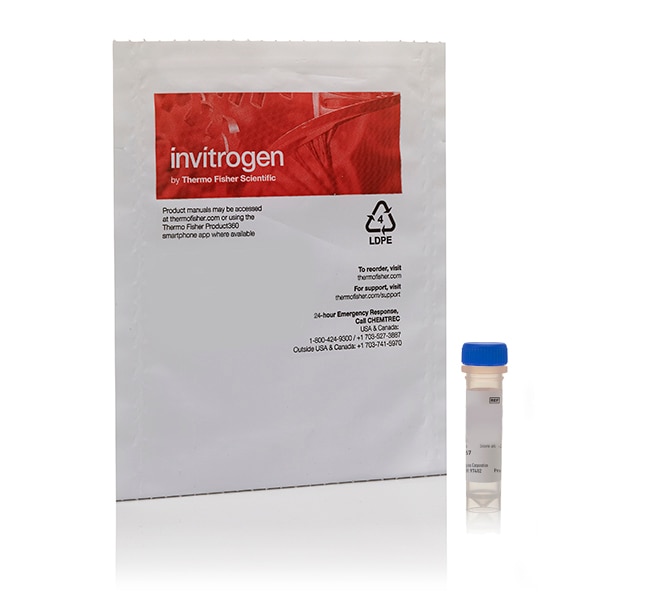
CellLight™ 质膜-CFP,BacMam 2.0
CellLight™ 质膜-CFP (BacMam 2.0) 可采用蓝绿色荧光蛋白 (CFP) 轻松标记活细胞内的质膜。您只需要将试剂加入到细胞中,过夜孵育,第二天早上即可直接进行成像观察。想要标记其他细胞结构?了解更多有关 CellLight™了解更多信息
| 货号 | 数量 |
|---|---|
| C10606 | 1 瓶 |
货号 C10606
价格(CNY)
8,599.00
Each
数量:
1 瓶
价格(CNY)
8,599.00
Each
CellLight™ 质膜-CFP (BacMam 2.0) 可采用蓝绿色荧光蛋白 (CFP) 轻松标记活细胞内的质膜。您只需要将试剂加入到细胞中,过夜孵育,第二天早上即可直接进行成像观察。
想要标记其他细胞结构?了解更多有关 CellLight™ 荧光蛋白标记工具的信息
这种即用型构建体可使用 BacMam 2.0 技术转染到细胞中,并在此表达融合到 Lck 酪氨酸激酶豆蔻酰化/棕榈酰化序列的 CFP。您可以在未对细胞内膜染色的情况下观察活细胞内的质膜-CFP 行为,并可采用多种追踪和示踪染料,以便对动态细胞过程进行成像。
表达 CellLight™ 构建体的细胞也可采用甲醛固定,以便利用免疫细胞化学技术进行多通路成像。
CellLight™ 技术特性:
•快速便捷:只需将 CellLight™ 试剂加入细胞,过夜孵育,随后即可成像—或冷冻储存,以便后续实验直接使用
• 高效:转导率高达 90%,适用于多种哺乳动物细胞系,包括原代细胞、干细胞和神经元
• 灵活:在多重分析实验或共定位研究中,可共转导多种 BacMam 试剂;通过简单调整剂量即可严格控制表达水平
• 低毒性:CellLight™ 试剂不会在哺乳动物细胞中复制,适于生物安全等级 (BSL) 1 级处理
BacMam 技术
CellLight™ 质膜-CFP (BacMam 2.0) 是 Lck 酪氨酸激酶豆蔻酰化/棕榈酰化序列和 CFP 的融合构建体,可准确、特异地靶向细胞质膜-CFP。这种融合构建体包装在昆虫病毒杆状病毒中,不会在人类细胞中复制,生物安全等级 (BSL) 1 级,被指定为可以在大多数实验室中安全使用。BacMam 技术可高效、超低毒性转导/转染大多数哺乳动物细胞类型。这种瞬时转染检测可从过夜孵育后持续最多五天 — 足以完成大部分动态细胞分析。与所有转染/转导技术一样,BacMam 方法无法以同等效率转染/转导所有细胞,因此不太适合细胞群研究或自动成像/计数。CellLight™ 试剂非常适合细胞或亚细胞共定位实验,以及需要特殊分辨率的细胞功能研究。
想要标记其他细胞结构?了解更多有关 CellLight™ 荧光蛋白标记工具的信息
这种即用型构建体可使用 BacMam 2.0 技术转染到细胞中,并在此表达融合到 Lck 酪氨酸激酶豆蔻酰化/棕榈酰化序列的 CFP。您可以在未对细胞内膜染色的情况下观察活细胞内的质膜-CFP 行为,并可采用多种追踪和示踪染料,以便对动态细胞过程进行成像。
表达 CellLight™ 构建体的细胞也可采用甲醛固定,以便利用免疫细胞化学技术进行多通路成像。
CellLight™ 技术特性:
•快速便捷:只需将 CellLight™ 试剂加入细胞,过夜孵育,随后即可成像—或冷冻储存,以便后续实验直接使用
• 高效:转导率高达 90%,适用于多种哺乳动物细胞系,包括原代细胞、干细胞和神经元
• 灵活:在多重分析实验或共定位研究中,可共转导多种 BacMam 试剂;通过简单调整剂量即可严格控制表达水平
• 低毒性:CellLight™ 试剂不会在哺乳动物细胞中复制,适于生物安全等级 (BSL) 1 级处理
BacMam 技术
CellLight™ 质膜-CFP (BacMam 2.0) 是 Lck 酪氨酸激酶豆蔻酰化/棕榈酰化序列和 CFP 的融合构建体,可准确、特异地靶向细胞质膜-CFP。这种融合构建体包装在昆虫病毒杆状病毒中,不会在人类细胞中复制,生物安全等级 (BSL) 1 级,被指定为可以在大多数实验室中安全使用。BacMam 技术可高效、超低毒性转导/转染大多数哺乳动物细胞类型。这种瞬时转染检测可从过夜孵育后持续最多五天 — 足以完成大部分动态细胞分析。与所有转染/转导技术一样,BacMam 方法无法以同等效率转染/转导所有细胞,因此不太适合细胞群研究或自动成像/计数。CellLight™ 试剂非常适合细胞或亚细胞共定位实验,以及需要特殊分辨率的细胞功能研究。
仅供科研使用。不可用于诊断程序。
规格
颜色蓝色
检测方法荧光
染料类型CFP(蓝绿色荧光蛋白)
发射可见光
激发波长范围435⁄485
适用于(设备)共聚焦显微镜、荧光显微镜
形式液体
产品线CellLight
数量1 瓶
运输条件湿冰
技术荧光强度
标签类型荧光蛋白
产品类型细胞膜染色剂
亚细胞定位细胞膜
Unit SizeEach
内容与储存
在 2°C 至 6°C 下避光储存。切勿冷冻。
常见问题解答 (FAQ)
我采用CellLight 标记试剂处理神经元时,转导效率很低,该如何提高转染效率?
How can I increase the transduction efficiency with the BacMam 2.0 reagents such as the the CellLight and Premo products?
Is there any way to preserve the CellLights labeling beyond 5 days?
Are the CellLights products toxic to cells?
For how long will the CellLights products label my cells?
引用和文献 (6)
引用和文献
Abstract
Relocalization of junctional adhesion molecule A during inflammatory stimulation of brain endothelial cells.
Journal:Mol Cell Biol
PubMed ID:22733993
'Junctional adhesion molecule A (JAM-A) is a unique tight junction (TJ) transmembrane protein that under basal conditions maintains endothelial cell-cell interactions but under inflammatory conditions acts as a leukocyte adhesion molecule. This study investigates the fate of JAM-A during inflammatory TJ complex remodeling and paracellular route formation in brain endothelial
Improved throughput traction microscopy reveals pivotal role for matrix stiffness in fibroblast contractility and TGF-ß responsiveness.
Journal:Am J Physiol Lung Cell Mol Physiol
PubMed ID:22659883
'Lung fibroblast functions such as matrix remodeling and activation of latent transforming growth factor-ß1 (TGF-ß1) are associated with expression of the myofibroblast phenotype and are directly linked to fibroblast capacity to generate force and deform the extracellular matrix. However, the study of fibroblast force-generating capacities through methods such as traction
Exosomes reflect the hypoxic status of glioma cells and mediate hypoxia-dependent activation of vascular cells during tumor development.
Journal:Proc Natl Acad Sci U S A
PubMed ID:23589885
'Hypoxia, or low oxygen tension, is a major regulator of tumor development and aggressiveness. However, how cancer cells adapt to hypoxia and communicate with their surrounding microenvironment during tumor development remain important questions. Here, we show that secreted vesicles with exosome characteristics mediate hypoxia-dependent intercellular signaling of the highly malignant
BacMam technology and its application to drug discovery.
Journal:Expert Opin Drug Discov
PubMed ID:23488908
The recombinant baculovirus/insect cell system was firmly established as a leading method for recombinant protein production when a new potential use for these viruses was revealed in 1995. It was reported that engineered recombinant baculoviruses could deliver functional expression cassettes to mammalian cell types; a system which has come to
Baculovirus-mediated gene transfer into mammalian cells.
Journal:Proc Natl Acad Sci U S A
PubMed ID:8637876
This paper describes the use of the baculovirus Autographa californica multiple nuclear polyhedrosis virus (AcMNPV) as a vector for gene delivery into mammalian cells. A modified AcMNPV virus was prepared that carried the Escherichia coli lacZ reporter gene under control of the Rous sarcoma virus promoter and mammalian RNA processing