Search

Invitrogen™
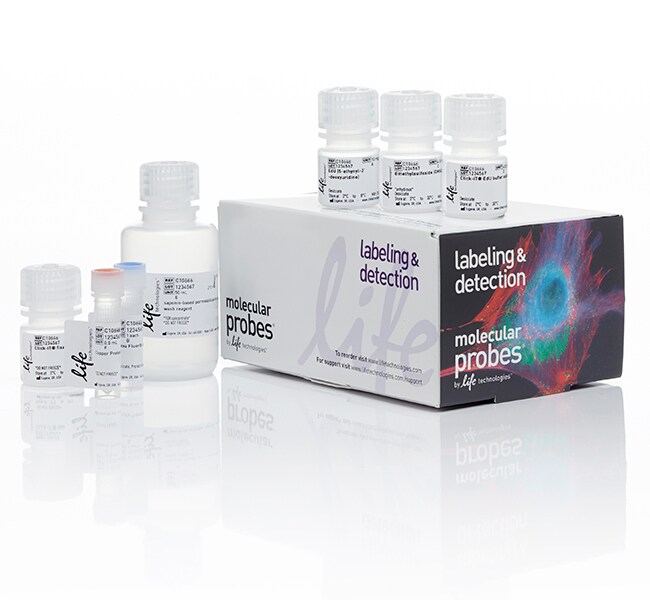
Click-iT™ Plus EdU Alexa Fluor™ 594 Flow Cytometry Assay Kit
The Click-iT Plus EdU Alexa Fluor 594 Flow Cytometry Assay Kit provides a simplified, more robust assay for analyzing DNA了解更多信息
| 货号 | 数量 |
|---|---|
| C10646 | 50 assays |
货号 C10646
价格(CNY)
5,426.00
飞享价
Ends: 31-Dec-2026
7,210.00共减 1,784.00 (25%)
Each
数量:
50 assays
价格(CNY)
5,426.00
飞享价
Ends: 31-Dec-2026
7,210.00共减 1,784.00 (25%)
Each
The Click-iT Plus EdU Alexa Fluor 594 Flow Cytometry Assay Kit provides a simplified, more robust assay for analyzing DNA replication in proliferating cells compared to traditional BrdU methods. Newly synthesized DNA is analyzed using the 532- or 561-nm laser of the flow cytometer. The Click-iT Plus formulation is compatible with standard fluorophores, including R-PE and R-PE tandems, as well as fluorescent proteins.
• Multiplexable—compatible with R-PE (and tandems) and fluorescent proteins
• Accurate—superior results compared to BrdU assays
• Fast—results in as little as 60 minutes
View selection guide for all Click-iT EdU and Click-iT Plus EdU assays for flow cytometry.
Multiplexable
Click-iT Plus Alexa Fluor 594 EdU assays can be used in conjunction with R-PE and R-PE tandems, as well as fluorescent proteins such as GFP and mCherry. The Alexa Fluor 594 labeling reagent is excited readily at either 532 or 561 nm and emits at 615 nm.
An Advanced Method Giving You Results Superior to BrdU
The most accurate method of proliferation analysis is direct measurement of DNA synthesis. Originally, this was performed through incorporation of radioactive nucleosides. This method was replaced by antibody-based detection of the nucleoside analog bromodeoxyuridine (BrdU). The Click-iT Plus EdU Flow Cytometry assay is a novel alternative to the BrdU assay. EdU (5-ethynyl-2´-deoxyuridine) is a thymidine analog that is incorporated into DNA during active DNA synthesis. Detection is based on click chemistry, which is a copper-catalyzed covalent reaction between an azide and an alkyne. In this application, the alkyne is found in the ethynyl moiety of EdU, while the azide is coupled to the Alexa Fluor dye. Standard flow cytometry methods are used for determining the percentage of S-phase cells in the population.
Mild Conditions Allow Use with Cell Cycle Dyes and Antibodies
The small size of the dye azide allows for efficient detection of the incorporated EdU using mild conditions, while standard aldehyde-based fixation and detergent permeabilization are sufficient for the Click-iT Plus detection reagent to gain access to the DNA. This is in contrast to BrdU assays that require DNA denaturation (using HCl, heat, or digestion with DNase) to expose the BrdU so that it can be detected with an anti-BrdU antibody. Sample processing for the BrdU assay can result in signal alteration of the cell cycle distribution, as well as destruction of antigen recognition sites when using the HCl method. In contrast, the easy-to-use Click-iT Plus EdU assay is compatible with cell cycle dyes. The Click-iT Plus EdU assay can also be multiplexed with antibodies against surface and intracellular markers, as well as conjugates labeled with standard fluorophores including R-PE, R-PE tandems, and fluorescent proteins (GFP and mCherry).
Quick and Simple Protocol
The Click-iT Plus EdU protocol is based on the aldehyde fixation and detergent permeabilization steps for immunohistochemical antibody labeling. However, EdU is compatible with other fixation/permeabilization agents including saponin and methanol. In just five steps you’ll be ready to analyze your cell proliferation data:
1. Treat cells with EdU.
2. Fix and permeabilize cells.
3. Detect S-phase cells with Click-iT Plus detection cocktail for 30 min.
4. Wash once.
5. Analyze.
Results can be seen in as little as 60 minutes in some circumstances, but we recommend 90 minutes for all applications.
• Multiplexable—compatible with R-PE (and tandems) and fluorescent proteins
• Accurate—superior results compared to BrdU assays
• Fast—results in as little as 60 minutes
View selection guide for all Click-iT EdU and Click-iT Plus EdU assays for flow cytometry.
Multiplexable
Click-iT Plus Alexa Fluor 594 EdU assays can be used in conjunction with R-PE and R-PE tandems, as well as fluorescent proteins such as GFP and mCherry. The Alexa Fluor 594 labeling reagent is excited readily at either 532 or 561 nm and emits at 615 nm.
An Advanced Method Giving You Results Superior to BrdU
The most accurate method of proliferation analysis is direct measurement of DNA synthesis. Originally, this was performed through incorporation of radioactive nucleosides. This method was replaced by antibody-based detection of the nucleoside analog bromodeoxyuridine (BrdU). The Click-iT Plus EdU Flow Cytometry assay is a novel alternative to the BrdU assay. EdU (5-ethynyl-2´-deoxyuridine) is a thymidine analog that is incorporated into DNA during active DNA synthesis. Detection is based on click chemistry, which is a copper-catalyzed covalent reaction between an azide and an alkyne. In this application, the alkyne is found in the ethynyl moiety of EdU, while the azide is coupled to the Alexa Fluor dye. Standard flow cytometry methods are used for determining the percentage of S-phase cells in the population.
Mild Conditions Allow Use with Cell Cycle Dyes and Antibodies
The small size of the dye azide allows for efficient detection of the incorporated EdU using mild conditions, while standard aldehyde-based fixation and detergent permeabilization are sufficient for the Click-iT Plus detection reagent to gain access to the DNA. This is in contrast to BrdU assays that require DNA denaturation (using HCl, heat, or digestion with DNase) to expose the BrdU so that it can be detected with an anti-BrdU antibody. Sample processing for the BrdU assay can result in signal alteration of the cell cycle distribution, as well as destruction of antigen recognition sites when using the HCl method. In contrast, the easy-to-use Click-iT Plus EdU assay is compatible with cell cycle dyes. The Click-iT Plus EdU assay can also be multiplexed with antibodies against surface and intracellular markers, as well as conjugates labeled with standard fluorophores including R-PE, R-PE tandems, and fluorescent proteins (GFP and mCherry).
Quick and Simple Protocol
The Click-iT Plus EdU protocol is based on the aldehyde fixation and detergent permeabilization steps for immunohistochemical antibody labeling. However, EdU is compatible with other fixation/permeabilization agents including saponin and methanol. In just five steps you’ll be ready to analyze your cell proliferation data:
1. Treat cells with EdU.
2. Fix and permeabilize cells.
3. Detect S-phase cells with Click-iT Plus detection cocktail for 30 min.
4. Wash once.
5. Analyze.
Results can be seen in as little as 60 minutes in some circumstances, but we recommend 90 minutes for all applications.
For Research Use Only. Not for use in diagnostic procedures.
规格
激发/发射532 or 561⁄615
产品线Alexa Fluor, Click-iT
运输条件Room Temperature
数量50 assays
Unit SizeEach
内容与储存
Contains EdU (5-ethynyl-2' -deoxyuridine), AlexaFluor 594 picolyl azide, anhydrous dimethylsulfoxide (DMSO), Click-iT fixative, Click-iT saponin-based permeabilization and wash buffer, Copper Protectant, and Click-iT EdU buffer additive.
Store at 2–8°C. Dessicate and protect from light.
Store at 2–8°C. Dessicate and protect from light.