Search


引用和文献 (8)
Invitrogen™
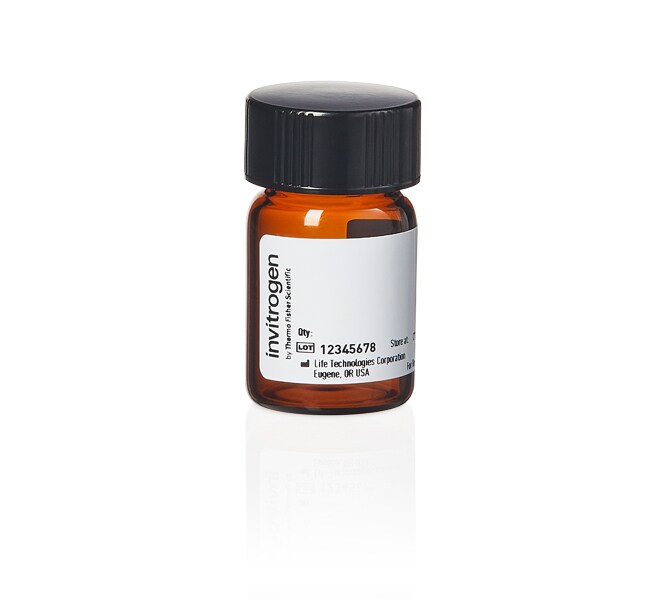
5(6) TAMRA(5-(和-6)-羧基四甲基罗丹明),异构体混合物
5(6) TAMRA(5-(和-6)-羧基四甲基罗丹明),异构体混合物
| 货号 | 数量 |
|---|---|
| C300 | 100 mg |
货号 C300
价格(CNY)
3,823.00
Each
数量:
100 mg
价格(CNY)
3,823.00
Each
5(6)-TAMRA contains a carboxylic acid that can be used to react with primary amines via carbodiimide activation of the carboxylic acid. This bright, orange-fluorescent dye produces conjugates with absorption/emission maxima of ∼555/580 nm.
5(6)-TAMRA 含可用于通过羧酸的碳二亚胺活化与伯胺发生反应的羧酸。这种明亮的橙色荧光染料可产生最大吸收/发射波长 ∼555/580 nm 的偶联物。
仅供科研使用。不可用于诊断程序。
规格
化学反应性胺
发射580
标签或染料TAMRA™ 异构体,TMR(四甲基罗丹明)
产品类型5(6)-TAMRA
数量100 mg
反应一部分羧酸
运输条件室温
标签类型经典染料
Unit SizeEach
内容与储存
室温避光储存。
常见问题解答 (FAQ)
What is the excitation and emission wavelength for rhodamine?
引用和文献 (8)
引用和文献
Abstract
Extending the applicability of carboxyfluorescein in solid-phase synthesis.
Journal:Bioconjug Chem
PubMed ID:12757391
'Optimized coupling protocols are presented for the efficient and automated generation of carboxyfluorescein-labeled peptides. Side products, generated when applying earlier protocols for the in situ activation of carboxyfluorescein, were eliminated by a simple procedure, yielding highly pure fluorescent peptides and minimizing postsynthesis workup. For the cost-efficient labeling of large compound
Pathway for polyarginine entry into mammalian cells.
Journal:Biochemistry
PubMed ID:14992581
Cationic peptides known as protein transduction domains (PTDs) provide a means to deliver molecules into mammalian cells. Here, nonaarginine (R(9)), the most efficacious of known PTDs, is used to elucidate the pathway for PTD internalization. Although R(9) is found in the cytosol as well as the nucleolus when cells are
Insertion and organization within membranes of the delta-endotoxin pore-forming domain, helix 4-loop-helix 5, and inhibition of its activity by a mutant helix 4 peptide.
Journal:J Biol Chem
PubMed ID:10811807
The pore-forming domain of Bacillus thuringiensis Cry1Ac insecticidal protein comprises of a seven alpha-helix bundle (alpha1-alpha7). According to the "umbrella model," alpha4 and alpha5 helices form a hairpin structure thought to be inserted into the membrane upon binding. Here, we have synthesized and characterized the hairpin domain, alpha4-loop-alpha5, its alpha4
A 'puff and advance' technique for visually controlled staining of turtle retinal ganglion cells.
Journal:J Neurosci Methods
PubMed ID:1696675
We describe a 'puff and advance' technique for visually controlled staining of retinal ganglion cells (GCs) in the unfixed, living retina for light and electron microscopy. Glass microelectrodes are filled with rhodamine-isothiocyanate labeled horseradish peroxidase (Rh-HRP), or Lucifer yellow (LY), or a mixture of both, or with 5,6-carboxytetramethylrhodamine (5,6-Rh) and
High-resolution liquid chromatography of fluorescent dye-labeled nucleic acids.
Journal:Anal Biochem
PubMed ID:7695100
Using 100 mM of triethylammonium acetate as ion-pairing reagent, phosphodiester oligonucleotides labeled fluorescently at their 5' terminus could be separated successfully on alkylated nonporous 2.3-microns poly(styrene-divinylbenzene) particles by means of high-resolution liquid chromatography. Applying excitation wavelengths of 490, 520, 550, and 575 nm, respectively, optimum sensitivity was achieved for the