Search


引用和文献 (7)
Invitrogen™
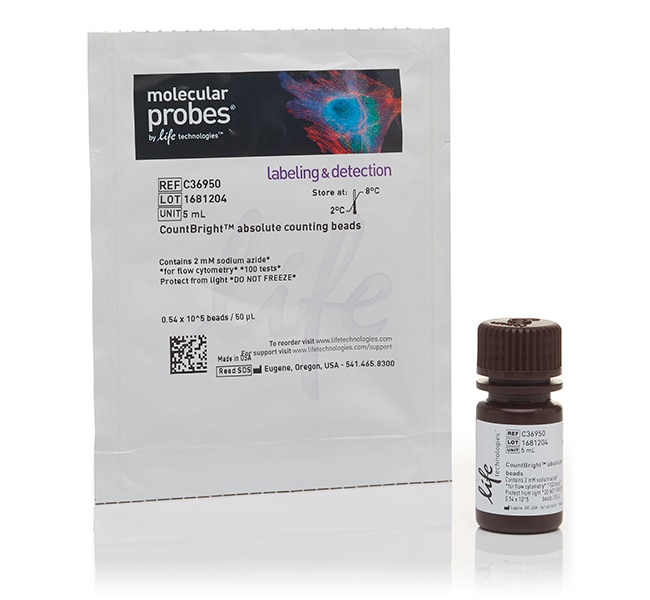
CountBright™ 绝对计数微珠,用于流式细胞分析
CountBright™ absolute counting beads are a calibrated suspension of microspheres that are brightly fluorescent across a wide range of excitation了解更多信息
| 货号 | 数量 |
|---|---|
| C36950 | 5 mL |
货号 C36950
价格(CNY)
3,883.00
飞享价
Ends: 31-Dec-2026
5,108.00共减 1,225.00 (24%)
Each
数量:
5 mL
价格(CNY)
3,883.00
飞享价
Ends: 31-Dec-2026
5,108.00共减 1,225.00 (24%)
Each
CountBright™ absolute counting beads are a calibrated suspension of microspheres that are brightly fluorescent across a wide range of excitation and emission wavelengths (UV to 635 nm excitation and 385-800 nm emission). CountBright™ absolute counting beads are mixed with the cell sample and assayed via flow cytometry. By comparing the ratio of bead events to cell events, absolute numbers of cells in the sample can be calculated. Because CountBright™ beads are mixed in the test sample, absolute cell counts using this single-platform method are more accurate and less complicated than cell concentration determined using multiple-platform testing. CountBright™ absolute counting beads can be used with any sample type, including no-wash/lysed whole blood.
View information about all flow cytometry cell counting beads.
View information about all flow cytometry cell counting beads.
仅供科研使用。不可用于诊断程序。
规格
检测方法荧光
直径(公制)7 μm
发射任意激光(UV 至 633/635)
激发波长范围紫外至 635/385 至 800 nm
适用于(设备)流式细胞仪
产品规格溶液
测试数量100
数量5 mL
运输条件室温
产品线CountBright
产品类型细胞计数微珠
Unit SizeEach
内容与储存
包含 1 瓶 CountBright™ 绝对计数微珠 (5 mL)。在冰箱(2°C 至 8°C)中避光储存。
常见问题解答 (FAQ)
使用Live/Dead BacLight细菌活力和计数试剂盒进行流式细胞术实验时,部分细胞好像同时出现红绿两种信号,这些细胞是已经死亡、仍在存活还是即将死亡?
如何通过流式细胞术对细菌进行计数?
我不太清楚CountBright绝对计数微珠(货号C36950)实验方案中的公式,你们可以帮助我吗?
我用计数微珠进行细胞计数,但在散点图上找不到微珠,该怎么办?
我想用流式细胞仪计数细胞,我该怎么做?
引用和文献 (7)
引用和文献
Abstract
An impaired transendothelial migration potential of chronic lymphocytic leukemia (CLL) cells can be linked to ephrin-A4 expression.
Journal:Blood
PubMed ID:19828693
'Chronic lymphocytic leukemia (CLL) cell migration into lymphoid tissues is an important aspect of the pathobiology of this disease. Here, we investigated the role of ephrin-A4 (EFNA4) in the transendothelial migration (TEM) capacity of CLL and normal B cells through interacting with endothelial EphA2 (erythropoietin-producing hepatocellular carcinoma). CLL cells showed
Analysis of microRNA and protein transfer by exosomes during an immune synapse.
Journal:
PubMed ID:23719941
'Immune cells release microRNA-containing exosomes that can be taken up by recipient cells. Exosomes can thus act as mediators of cell-cell communication through direct exchange of genetic material between cells. Exosome-mediated transfer of miRNAs between T cells and antigen-presenting cells (APCs) can take place over long distances. Our work has
Inhibition of NF-?B-mediated signaling by the cyclin-dependent kinase inhibitor CR8 overcomes prosurvival stimuli to induce apoptosis in chronic lymphocytic leukemia cells.
Journal:Clin Cancer Res
PubMed ID:23532892
Chronic lymphocytic leukemia (CLL) is currently incurable with standard chemotherapeutic agents, highlighting the need for novel therapies. Overcoming proliferative and cytoprotective signals generated within the microenvironment of lymphoid organs is essential for limiting CLL progression and ultimately developing a cure. We assessed the potency of cyclin-dependent kinase (CDK) inhibitor CR8,
PKCa negatively regulates in vitro proplatelet formation and in vivo platelet production in mice.
Journal:Platelets
PubMed ID:23402219
Proplatelet formation is a part of the intricate process by which platelets are generated by their precursor cell, the megakaryocyte. The processes that drive megakaryocyte maturation and platelet production are however still not well understood. The protein kinase C (PKC) family of serine/threonine kinases has been demonstrated as an important
CD26 inhibition enhances perfusion recovery in ApoE-/-mice.
Journal:Curr Vasc Pharmacol
PubMed ID:23391419
The adaptive growth of blood vessels is important to prevent tissue loss following arterial occlusion. Extravasation of monocytes is essential for this process. The peptidase CD26 targets SDF-1 alpha, a chemokine regulating monocyte trafficking. We hypothesized that blocking SDF-1 alpha inactivation, using a commercially available CD26 inhibitor, accelerates perfusion recovery