Search


引用和文献 (5)
Invitrogen™
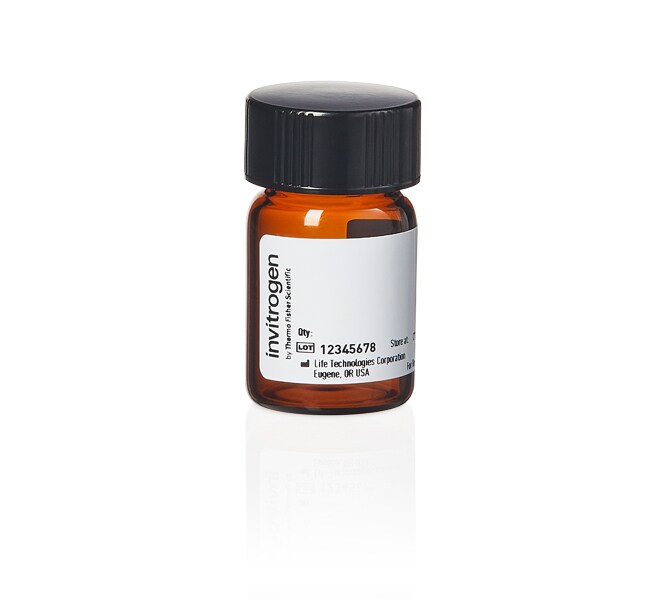
BODIPY™ FL 磺化琥珀酰亚胺酯
The amine-reactive BODIPY® FL sulfosuccinimidyl ester can be used to create green-fluorescent bioconjugates. This reactive moiety is sulfonated to increase了解更多信息
| 货号 | 数量 |
|---|---|
| D6140 | 5 mg |
货号 D6140
价格(CNY)
6,643.00
Each
数量:
5 mg
价格(CNY)
6,643.00
Each
The amine-reactive BODIPY® FL sulfosuccinimidyl ester can be used to create green-fluorescent bioconjugates. This reactive moiety is sulfonated to increase water solubility. The electronically neutral BODIPY® FL dye has the most fluorescein-like spectra of the green-fluorescent BODIPY® dyes.
仅供科研使用。不可用于诊断程序。
规格
化学反应性胺
标签或染料BODIPY™ FL
产品类型FL 磺化琥珀酰亚胺酯
数量5 mg
反应一部分活性酯、琥珀酰亚胺酯
运输条件室温
标签类型BODIPY 染料
产品线BODIPY
Unit SizeEach
内容与储存
在冷冻冰箱(-5 至 -30°C)中避光储存。
引用和文献 (5)
引用和文献
Abstract
Fluorescent quenching-based quantitative detection of specific DNA/RNA using a BODIPY((R)) FL-labeled probe or primer.
Journal:Nucleic Acids Res
PubMed ID:11239011
We have developed a simple method for the quantitative detection of specific DNA or RNA molecules based on the finding that BODIPY((R)) FL fluorescence was quenched by its interaction with a uniquely positioned guanine. This approach makes use of an oligonucleotide probe or primer containing a BODIPY((R)) FL-modified cytosine at
Ultrasensitive fluorescence-based detection of nascent proteins in gels.
Journal:Anal Biochem
PubMed ID:10706791
The most common method of analysis of proteins synthesized in a cell-free translation system (e.g., nascent proteins) involves the use of radioactive amino acids such as [(35)S]methionine or [(14)C]leucine. We report a sensitive, nonisotopic, fluorescence-based method for the detection of nascent proteins directly in polyacrylamide gels. A fluorescent reporter group
Binding and internalization of lipopolysaccharide by Cla-1, a human orthologue of rodent scavenger receptor B1.
Journal:J Biol Chem
PubMed ID:12651854
Scavenger receptor, class B, type I (SR-BI) mediates selective uptake of high density lipoprotein (HDL) cholesteryl ester. SR-BI recognizes HDL, low density lipoprotein (LDL), exchangeable apolipoproteins, and protein-free lipid vesicles containing negatively charged phospholipids. Lipopolysaccharides (LPS) are highly glycosylated anionic phospholipids contributing to septic shock. Despite significant structural similarities between
Synthesis of fluorescent analogs of alpha-conotoxin MII.
Journal:Bioconjug Chem
PubMed ID:17105243
Alpha-conotoxins (alpha-CTxs) are small peptides that are competitive inhibitors of nicotinic acetylcholine receptors (nAChRs) and have been used to study the kinetics of nAChRs. Alpha-CTx MII, from the venom of Conus magus, has been shown to potently block both rat alpha3beta2 and rat chimeric alpha6/alpha3beta2beta3 cloned nAChRs expressed in Xenopus
A high-throughput nonisotopic protein truncation test.
Journal:Nat Biotechnol
PubMed ID:12524552
Nonsense or frameshift mutations, which result in a truncated gene product, are prevalent in a variety of disease-related genes, including APC (implicated in colorectal cancer), BRCA1 and BRCA2 (breast and ovarian cancer), PKD1 (polycystic kidney disease), NF1 and NF2 (neurofibromatosis), and DMD (Duchenne muscular dystrophy). Such chain-truncating mutations can be