Search


引用和文献 (11)
Invitrogen™
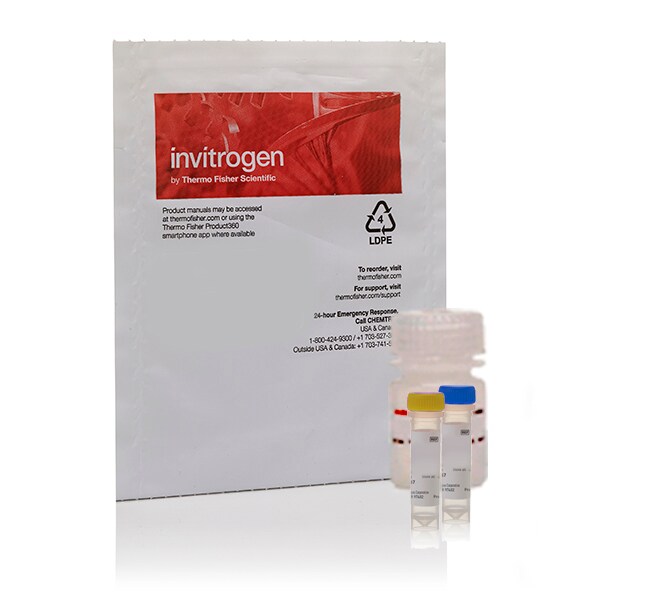
EnzChek™ 溶菌酶检测试剂盒
EnzChek™ 溶菌酶检测试剂盒为研究人员提供了一种简单灵敏的检测方法来测量溶液中的溶菌酶活性。利用荧光计或荧光微孔板读数仪测量溶菌酶活性产生的荧光强度增加。查看我们完整的荧光微孔板检测产品线。•检测到低至 20 U/mL 的溶菌酶活性浓度• 使用标准荧光素 (FITC)了解更多信息
| 货号 | 数量 |
|---|---|
| E22013 | 400 Assays |
货号 E22013
价格(CNY)
5,309.00
Each
数量:
400 Assays
价格(CNY)
5,309.00
Each
EnzChek™ 溶菌酶检测试剂盒为研究人员提供了一种简单灵敏的检测方法来测量溶液中的溶菌酶活性。利用荧光计或荧光微孔板读数仪测量溶菌酶活性产生的荧光强度增加。
查看我们完整的荧光微孔板检测产品线。
•检测到低至 20 U/mL 的溶菌酶活性浓度
• 使用标准荧光素 (FITC) 激发/发射设置
• 规格允许持续测量溶菌酶活性
该测定试剂盒利用一种创新性方法测量溶菌酶活性。使用的溶壁微球菌细胞壁已被荧光素广泛标记,从而导致荧光信号猝灭。活性溶菌酶可水解粘多糖细胞壁内 N-乙酰胞壁酸与 N-乙酰-D-葡糖胺残基之间的 b-(1-4)-糖苷键,从而消除猝灭并产生与溶菌酶活性成比例的显著荧光强度增加。
查看我们完整的荧光微孔板检测产品线。
•检测到低至 20 U/mL 的溶菌酶活性浓度
• 使用标准荧光素 (FITC) 激发/发射设置
• 规格允许持续测量溶菌酶活性
该测定试剂盒利用一种创新性方法测量溶菌酶活性。使用的溶壁微球菌细胞壁已被荧光素广泛标记,从而导致荧光信号猝灭。活性溶菌酶可水解粘多糖细胞壁内 N-乙酰胞壁酸与 N-乙酰-D-葡糖胺残基之间的 b-(1-4)-糖苷键,从而消除猝灭并产生与溶菌酶活性成比例的显著荧光强度增加。
仅供科研使用。不可用于诊断程序。
规格
检测方法荧光强度
数量400 Assays
运输条件室温
底物属性脂基底物
底物类型溶菌酶底物
目标酶溶菌酶
适用于(应用)溶菌酶检测
适用于(设备)荧光微孔板读数仪
产品线EnzChek
产品类型溶菌酶检测
Unit SizeEach
内容与储存
在冷冻冰箱(-5°C 至 -30°C)中避光储存。
常见问题解答 (FAQ)
How can I limit signal saturation when using the EnzChek Lysozyme Assay Kit (Cat. No. E22013)?
How was the substrate (Component A) in the EnzChek Lysozyme Assay Kit labeled?
May other buffers be used for the EnzChek Lysozyme assay?
引用和文献 (11)
引用和文献
Abstract
Vogesella mureinivorans sp. nov., a peptidoglycan-degrading bacterium from lake water.
Journal:Int J Syst Evol Microbiol
PubMed ID:19946047
'A novel, non-pigmented, rod-shaped, Gram-negative strain was isolated from mesotrophic lake water in Zealand, Denmark. Phylogenetic analysis of the 16S rRNA gene sequence of the bacterium, designated strain 389(T), indicated that the strain belonged to the genus Vogesella and formed a monophyletic group with Vogesella perlucida DS-28(T) (99.1?% nucleotide similarity);
Structure-function analysis of HsiF, a gp25-like component of the type VI secretion system, in Pseudomonas aeruginosa.
Journal:Microbiology
PubMed ID:21873404
'Bacterial pathogens use a range of protein secretion systems to colonize their host. One recent addition to this arsenal is the type VI secretion system (T6SS), which is found in many Gram-negative bacteria. The T6SS involves 12-15 components, including a ClpV-like AAA(+) ATPase. Moreover, the VgrG and Hcp components have
Mechanisms of systemic vasodilation by lysozyme-c in septic shock.
Journal:J Appl Physiol (1985)
PubMed ID:22096116
In septic shock (SS), cardiovascular collapse is caused by the release of inflammatory mediators. We previously found that lysozyme-c (Lzm-S), released from leukocytes, contributed to systemic vasodilation in a canine model of SS. We then delineated the pathway by which this occurs in a canine carotid artery organ bath preparation
Mutations of the Listeria monocytogenes peptidoglycan N-deacetylase and O-acetylase result in enhanced lysozyme sensitivity, bacteriolysis, and hyperinduction of innate immune pathways.
Journal:Infect Immun
PubMed ID:21768286
Listeria monocytogenes is a Gram-positive intracellular pathogen that is naturally resistant to lysozyme. Recently, it was shown that peptidoglycan modification by N-deacetylation or O-acetylation confers resistance to lysozyme in various Gram-positive bacteria, including L. monocytogenes. L. monocytogenes peptidoglycan is deacetylated by the action of N-acetylglucosamine deacetylase (Pgd) and acetylated by
Alcohol use disorders affect antimicrobial proteins and anti-pneumococcal activity in epithelial lining fluid obtained via bronchoalveolar lavage.
Journal:Alcohol Alcohol
PubMed ID:20729531
Our overall objective was to examine whether characteristics of epithelial lining fluid (ELF) from subjects with alcohol use disorders (AUDs) obtained via bronchoalveolar lavage (BAL) contribute to their predisposition to pneumococcal pneumonia. We sought to compare the anti-pneumococcal activity of acellular human BAL from subjects with AUDs to matched controls.