Search


引用和文献 (5)
Invitrogen™
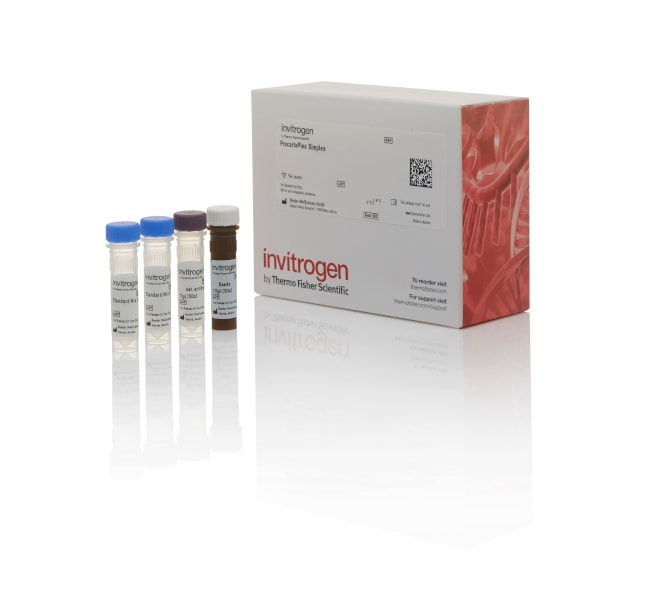
D-dimer Human ProcartaPlex™ Simplex Kit
The Human D-dimer Simplex ProcartaPlex Kit measures D-dimer protein and is designed to be combinable with other Simplex kits so that you can create your own multiplex panel that utilizes Luminex xMAP technology for protein detection/quantitation.
| 货号 | 数量 |
|---|---|
| EPX01A-12149-901 | 96 次测试 |
货号 EPX01A-12149-901
价格(CNY)
-
数量:
96 次测试
Human D-dimer Simplex ProcartaPlex Kit 用于测量 D-二聚体蛋白,经设计可与其他 Simplex 试剂盒结合使用,方便您自行创建多通路检测组合以利用 Luminex xMAP 技术进行蛋白检测/定量。将多个 Simplex 试剂盒结合使用时(即,未使用预配置的多通路检测组合),无论通路大小,每个检测板都只需要一个缓冲液试剂盒(单独出售)。
关于适用于 Luminex 平台的 ProcartaPlex 检测
ProcartaPlex 免疫检测基于 ELISA 夹心法的原理,使用两种高度特异性抗体结合一种蛋白的不同抗原决定簇,从而达到借助 Luminex 仪器同时定量所有蛋白靶标的目的。ProcartaPlex 多通路检测只需 25 µL 血浆或血清,或 50 µL 细胞培养物上清液,只需四小时即可获得分析结果。
• 每份样品可得到更多结果—在单一 25 - 50 µL 样品中可同时测量多种蛋白靶标
•成熟的 Luminex 技术—较常参考的蛋白检测和定量测定多通路平台
ProcartaPlex 检测利用 Luminex xMAP(多分析物分析)技术用于在单一 25-50 µL 样品(血浆、血清、细胞培养物上清液和其他体液)中同时检测和定量测定多达 80 种蛋白靶标。
ProcartaPlex 检测中的 Luminex 微珠用精确比例的红色和红外荧光基团进行内部染色,生成光谱独特的标记,可通过 Luminex xMAP 检测系统(例如 Luminex 200、FLEXMAP 3D 和 MAGPIX)识别。与夹心ELISA类似,ProcartaPlex测定使用匹配的抗体对来鉴定目的蛋白质。在多通路检测中,每种光谱独特的微珠用单一靶蛋白特异性抗体标记,并且用生物素化抗体和链霉素亲和素 R-藻红蛋白 (RPE) 识别结合蛋白。蛋白特异性抗体与独特微珠偶联可用于在单孔中分析多个靶标。
ProcartaPlex 检测与 ELISA 之间极显著的区别在于 ProcartaPlex 检测中的捕获抗体与微珠偶联并且不吸附于微孔板孔中,因此 ProcartaPlex 检测试剂在溶液中自由漂浮。例如,对于检测,Luminex 200仪器包含两个激光器,一个用于区分每个珠子的光谱特征,另一个用于量化RPE荧光的量,其与样品中存在的蛋白质的量成比例。ProcartaPlex 多通路测定可以在样品量明显减少的情况下分析更多靶蛋白,同时还能执行传统三明治 ELISA。
ProcartaPlex 多通路检测组合有多种规格,可以覆盖六个物种(人、小鼠、大鼠、非人灵长类动物、猪和犬)。如需了解更多信息,包括各蛋白靶标的综合列表,请访问 thermofisher.com/procartaplex。
关于适用于 Luminex 平台的 ProcartaPlex 检测
ProcartaPlex 免疫检测基于 ELISA 夹心法的原理,使用两种高度特异性抗体结合一种蛋白的不同抗原决定簇,从而达到借助 Luminex 仪器同时定量所有蛋白靶标的目的。ProcartaPlex 多通路检测只需 25 µL 血浆或血清,或 50 µL 细胞培养物上清液,只需四小时即可获得分析结果。
• 每份样品可得到更多结果—在单一 25 - 50 µL 样品中可同时测量多种蛋白靶标
•成熟的 Luminex 技术—较常参考的蛋白检测和定量测定多通路平台
ProcartaPlex 检测利用 Luminex xMAP(多分析物分析)技术用于在单一 25-50 µL 样品(血浆、血清、细胞培养物上清液和其他体液)中同时检测和定量测定多达 80 种蛋白靶标。
ProcartaPlex 检测中的 Luminex 微珠用精确比例的红色和红外荧光基团进行内部染色,生成光谱独特的标记,可通过 Luminex xMAP 检测系统(例如 Luminex 200、FLEXMAP 3D 和 MAGPIX)识别。与夹心ELISA类似,ProcartaPlex测定使用匹配的抗体对来鉴定目的蛋白质。在多通路检测中,每种光谱独特的微珠用单一靶蛋白特异性抗体标记,并且用生物素化抗体和链霉素亲和素 R-藻红蛋白 (RPE) 识别结合蛋白。蛋白特异性抗体与独特微珠偶联可用于在单孔中分析多个靶标。
ProcartaPlex 检测与 ELISA 之间极显著的区别在于 ProcartaPlex 检测中的捕获抗体与微珠偶联并且不吸附于微孔板孔中,因此 ProcartaPlex 检测试剂在溶液中自由漂浮。例如,对于检测,Luminex 200仪器包含两个激光器,一个用于区分每个珠子的光谱特征,另一个用于量化RPE荧光的量,其与样品中存在的蛋白质的量成比例。ProcartaPlex 多通路测定可以在样品量明显减少的情况下分析更多靶蛋白,同时还能执行传统三明治 ELISA。
ProcartaPlex 多通路检测组合有多种规格,可以覆盖六个物种(人、小鼠、大鼠、非人灵长类动物、猪和犬)。如需了解更多信息,包括各蛋白靶标的综合列表,请访问 thermofisher.com/procartaplex。
仅供科研使用。不可用于诊断程序。
规格
测定范围根据批次 1 测定:317.99 - 1,302,500 pg/mL
检测灵敏度参见检验报告
磁珠类型D-二聚体 [44]
适用于(设备)Luminex™ 仪器
产品规格Simplex 试剂盒
基因纤维蛋白原 α 链
基因别名Fib2
基因 ID (Entrez)2243
基因符号FGA
产品线ProcartaPlex
蛋白质纤维蛋白原 α 链
样品类型血清、血浆、细胞培养物上清液, Plasma, Cell Culture Supernatants
样品体积血清,血浆:25 μL;CCS:50 μL
运输条件湿冰
UniProt IDP02671
可组合性可结合使用
产品类型Simplex 试剂盒
数量96 次测试
研究领域Immunology
种属人
Unit SizeEach
内容与储存
- 1 小瓶捕获微珠 (50X)
- 1 小瓶生物素化检测抗体 (50X)
- 2 小瓶人标准品 D-二聚体(冻干)
- 储存在 2–8°C 下。
常见问题解答 (FAQ)
在我的 ProcartaPlex 检测数据分析过程中,我收到一条警告消息,指出存在高度聚集的珠子。我应该怎么办?
在我的 ProcartaPlex 检测数据分析期间,珠子落在珠子图上珠子区域的下方或左下方。为什么是这样?
在我的 ProcartaPlex 检测数据分析期间,珠子没有出现在门控区域中。发生了什么?
我所有的 ProcartaPlex 检测孔的珠数都不稳定。什么地方出了错?
我的 ProcartaPlex 检测标准曲线的微珠计数正确且规则,但对于我的样品,微珠计数不稳定,我收到一条警告消息,提示“采集中至少有一个区域未达到最大计数”。我应该怎么办?
引用和文献 (5)
引用和文献
Abstract
Immune activation in prolonged cART-suppressed HIV patients is comparable to that of healthy controls.
Journal:Virology
PubMed ID:28644978
'Sustained immune activation during chronic HIV infection is considered to augment co-morbidity and mortality. Effective combination antiretroviral therapy (cART) has shown to dampen immune activation especially during the first year cART, but the effects of long-term cART in patients without major comorbidities remains under-investigated. We performed a comprehensive analysis including
The host response in critically ill sepsis patients on statin therapy: a prospective observational study.
Journal:Ann Intensive Care
PubMed ID:29349709
'Statins can exert pleiotropic anti-inflammatory, vascular protective and anticoagulant effects, which in theory could improve the dysregulated host response during sepsis. We aimed to determine the association between prior statin use and host response characteristics in critically ill patients with sepsis.'
Impact of HIV infection on the presentation, outcome and host response in patients admitted to the intensive care unit with sepsis; a case control study.
Journal:Crit Care
PubMed ID:27719675
'Sepsis is a prominent reason for intensive care unit (ICU) admission in patients with HIV. We aimed to investigate the impact of HIV infection on presentation, outcome and host response in sepsis.'
Association of diabetes and diabetes treatment with the host response in critically ill sepsis patients.
Journal:Crit Care
PubMed ID:27495247
Diabetes is associated with chronic inflammation and activation of the vascular endothelium and the coagulation system, which in a more acute manner are also observed in sepsis. Insulin and metformin exert immune modulatory effects. In this study, we aimed to determine the association of diabetes and preadmission insulin and metformin
Thrombocytopenia is associated with a dysregulated host response in critically ill sepsis patients.
Journal:Blood
PubMed ID:26956172
Preclinical studies have suggested that platelets influence the host response during sepsis. We sought to assess the association of admission thrombocytopenia with the presentation, outcome, and host response in patients with sepsis. Nine hundred thirty-one consecutive sepsis patients were stratified according to platelet counts (very low <50 × 10(9)/L, intermediate-low