Search


引用和文献 (5)
Invitrogen™
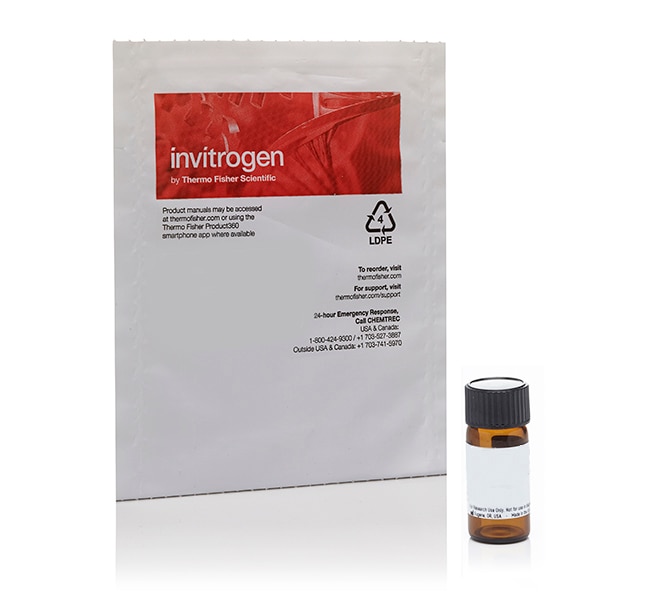
人血浆纤维蛋白原,Alexa Fluor™ 594 偶联物
Molecular Probes™ 纤维蛋白原偶联物通过将荧光染料分子连接至纯化人纤维蛋白原进行制备(每个纤维蛋白原分子连接大约 15 个染料分子),纯化偶联物以去除未反应的染料,然后冻干用于储存。荧光标记的纤维蛋白原已被证明是研究血小板活化以及随后的纤维蛋白原结合的有价值工具。例如,荧光素标记的纤维蛋白原已经用于通过流式细胞分析检测与活化的血小板结合的纤维蛋白原。人纤维蛋白原偶联物规格:•了解更多信息
| 货号 | 数量 |
|---|---|
| F13193 | 5 mg |
货号 F13193
价格(CNY)
4,404.00
Each
数量:
5 mg
价格(CNY)
4,404.00
Each
Molecular Probes™ 纤维蛋白原偶联物通过将荧光染料分子连接至纯化人纤维蛋白原进行制备(每个纤维蛋白原分子连接大约 15 个染料分子),纯化偶联物以去除未反应的染料,然后冻干用于储存。
荧光标记的纤维蛋白原已被证明是研究血小板活化以及随后的纤维蛋白原结合的有价值工具。例如,荧光素标记的纤维蛋白原已经用于通过流式细胞分析检测与活化的血小板结合的纤维蛋白原。
人纤维蛋白原偶联物规格:
• 标记(激发/发射波长):Alexa Fluor™ 594(约 590/617 nm)
•光谱类似于 Texas Red 染料偶联物,但更明亮
•冻干产品在缓冲液(例如 pH 值为 8.3 的碳酸氢钠)中溶解后使用
•通常使用荧光显微镜或流式细胞分析检测荧光
查找更多有关细胞粘附和受体结合的探针
请参阅《Molecular Probes™ 手册》中的用于细胞粘附、趋化作用、多药耐药性和谷胱甘肽的探针—第 15.6 节以及用于追踪受体结合和吞噬作用的探针—第 16.1 节,以获取有关这些探针的更多信息。
仅供研究使用。不可用于人或动物的治疗或诊断。
荧光标记的纤维蛋白原已被证明是研究血小板活化以及随后的纤维蛋白原结合的有价值工具。例如,荧光素标记的纤维蛋白原已经用于通过流式细胞分析检测与活化的血小板结合的纤维蛋白原。
人纤维蛋白原偶联物规格:
• 标记(激发/发射波长):Alexa Fluor™ 594(约 590/617 nm)
•光谱类似于 Texas Red 染料偶联物,但更明亮
•冻干产品在缓冲液(例如 pH 值为 8.3 的碳酸氢钠)中溶解后使用
•通常使用荧光显微镜或流式细胞分析检测荧光
查找更多有关细胞粘附和受体结合的探针
请参阅《Molecular Probes™ 手册》中的用于细胞粘附、趋化作用、多药耐药性和谷胱甘肽的探针—第 15.6 节以及用于追踪受体结合和吞噬作用的探针—第 16.1 节,以获取有关这些探针的更多信息。
仅供研究使用。不可用于人或动物的治疗或诊断。
仅供科研使用。不可用于人或动物的治疗或诊断。
规格
标签类型Alexa Fluor 染料
产品线Alexa Fluor
蛋白质子类型纤维蛋白原
数量5 mg
运输条件室温
偶联物Alexa Fluor 594
形式Lyophilized
种属Human
Unit SizeEach
内容与储存
储存在冰箱(-5 至 -30°C)中并避光。
引用和文献 (5)
引用和文献
Abstract
Interactions between Eph kinases and ephrins provide a mechanism to support platelet aggregation once cell-to-cell contact has occurred.
Journal:Proc Natl Acad Sci U S A
PubMed ID:12084815
'Eph kinases are receptor tyrosine kinases whose ligands, the ephrins, are also expressed on the surface of cells. Interactions between Eph kinases and ephrins on adjacent cells play a central role in neuronal patterning and vasculogenesis. Here we examine the expression of ephrins and Eph kinases on human blood platelets
Localization and Kinetics of the Transferrin-Dependent Iron Transport Machinery in the Mouse Placenta.
Journal:Curr Dev Nutr
PubMed ID:33937615
In vivo two-photon microscopy protocol for imaging microglial responses and spine elimination at sites of fibrinogen deposition in mouse brain.
Journal:STAR Protoc
PubMed ID:34258598
Artificial cell membrane binding thrombin constructs drive in situ fibrin hydrogel formation.
Journal:Nat Commun
PubMed ID:31015421
A novel in vitro model for haematogenous spreading of S. aureus device biofilms demonstrating clumping dispersal as an advantageous dissemination mechanism.
Journal:Cell Microbiol
PubMed ID:28873268