Search

Thermo Scientific™
Phusion Green 热启动 II 高保真 DNA 聚合酶 (2 U/μL)
Thermo Scientific Phusion 高保真 DNA 聚合酶为高效 PCR 设立了“金标准”。Phusion 高保真了解更多信息
Have Questions?
更改视图

| 货号 | 颜色 | 反应次数 |
|---|---|---|
| F549L | Colorless | 500 次反应 |
| F549S | Colorless | 100 次反应 |
| F549XL | Colorless | 2,000 次反应 |
货号 F549L
价格(CNY)
2,803.00
飞享价
Ends: 31-Dec-2026
4,004.00共减 1,201.00 (30%)
Each
颜色:
Colorless
反应次数:
500 次反应
价格(CNY)
2,803.00
飞享价
Ends: 31-Dec-2026
4,004.00共减 1,201.00 (30%)
Each
Thermo Scientific Phusion 高保真 DNA 聚合酶为高效 PCR 设立了“金标准”。Phusion 高保真 DNA 聚合酶的错误率是 Taq 的 1/50,是 Pfu 的 1/6,因此是克隆和其他需要高保真度的应用的极佳之选。与其他 DNA 聚合酶相比,Phusion DNA 聚合酶性能稳定,实验方案耗时少(即使存在 PCR 抑制剂),能以更低的酶量实现更高的产出。
Phusion 热启动 II 高保真 DNA 聚合酶由 Phusion DNA 聚合酶和可逆的特异性 Affibody 配体(可在室温下抑制 DNA 聚合酶活性)混合而成,故在用其扩增时不会产生非特异性产物。Affibody 配体还可抑制聚合酶的 3´→5´ 核酸外切酶活性,从而防止在反应构建过程中引物和模板 DNA 降解。在促进聚合酶活性的温度下,配体得到释放,使聚合酶完全活化。Phusion 热启动 II DNA 聚合酶在高温下立即重新激活,因此在 PCR 实验方案中不需要单独的激活步骤。
Phusion 绿色热启动 II 高保真 DNA 聚合酶由 Phusion 热启动 II DNA 聚合酶和 5X Phusion 绿色缓冲液混合而成。缓冲液包括密度试剂和两种示踪染料,其不干扰 Phusion 热启动 II DNA 聚合酶的稳健性能。研究人员可直接将 PCR 产物上样到凝胶上,这使得此产品成为可用于 DNA 测序、连接和限制性酶切等下游应用的通用选项。
产品优势
•在室温下配制反应体系
•反应体系配制期间无非特异性扩增和引物降解现象
•借助独特的热启动技术,无需等待即可重新激活
•高保真度 (52X Taq)
•延伸时间短 (15-30 s/kb),可实现快速 PCR
•反应稳定,几乎无需优化
•以极少酶用量实现更高的产物得率
•直接上样至凝胶
应用
•高保真 PCR
•高通量
•扩增复杂(高 GC 含量)模板
•生成测序模板
•多通路 PCR
•长片段 PCR
•克隆
•突变
•微阵列
使用 Phusion DNA 聚合酶
Phusion DNA 聚合酶的退火规则与许多常见 DNA 聚合酶(如 Taq DNA 聚合酶)不同。为了获得最佳结果,请使用 www.thermofisher.cn/tmcalculator 上的 Tm 计算器。
Phusion 热启动 II 高保真 DNA 聚合酶由 Phusion DNA 聚合酶和可逆的特异性 Affibody 配体(可在室温下抑制 DNA 聚合酶活性)混合而成,故在用其扩增时不会产生非特异性产物。Affibody 配体还可抑制聚合酶的 3´→5´ 核酸外切酶活性,从而防止在反应构建过程中引物和模板 DNA 降解。在促进聚合酶活性的温度下,配体得到释放,使聚合酶完全活化。Phusion 热启动 II DNA 聚合酶在高温下立即重新激活,因此在 PCR 实验方案中不需要单独的激活步骤。
Phusion 绿色热启动 II 高保真 DNA 聚合酶由 Phusion 热启动 II DNA 聚合酶和 5X Phusion 绿色缓冲液混合而成。缓冲液包括密度试剂和两种示踪染料,其不干扰 Phusion 热启动 II DNA 聚合酶的稳健性能。研究人员可直接将 PCR 产物上样到凝胶上,这使得此产品成为可用于 DNA 测序、连接和限制性酶切等下游应用的通用选项。
产品优势
•在室温下配制反应体系
•反应体系配制期间无非特异性扩增和引物降解现象
•借助独特的热启动技术,无需等待即可重新激活
•高保真度 (52X Taq)
•延伸时间短 (15-30 s/kb),可实现快速 PCR
•反应稳定,几乎无需优化
•以极少酶用量实现更高的产物得率
•直接上样至凝胶
应用
•高保真 PCR
•高通量
•扩增复杂(高 GC 含量)模板
•生成测序模板
•多通路 PCR
•长片段 PCR
•克隆
•突变
•微阵列
使用 Phusion DNA 聚合酶
Phusion DNA 聚合酶的退火规则与许多常见 DNA 聚合酶(如 Taq DNA 聚合酶)不同。为了获得最佳结果,请使用 www.thermofisher.cn/tmcalculator 上的 Tm 计算器。
仅供科研使用。不可用于诊断程序。
规格
颜色Colorless
保真度(相对于 Taq)52 X
热启动内置热启动
反应次数500 次反应
突出端平末端
聚合酶Phusion 热启动 II DNA 聚合酶
产品类型热启动 DNA 聚合酶
数量500 U (2 U/μL)
反应形式独立
运输条件干冰
尺寸(最终产品)20 kb 或更小
最大浓度2 U/μL
适用于(应用)克隆, High-fidelity PCR
高 GC PCR 扩增效果高
反应速度快速
Unit SizeEach
内容与储存
包括:
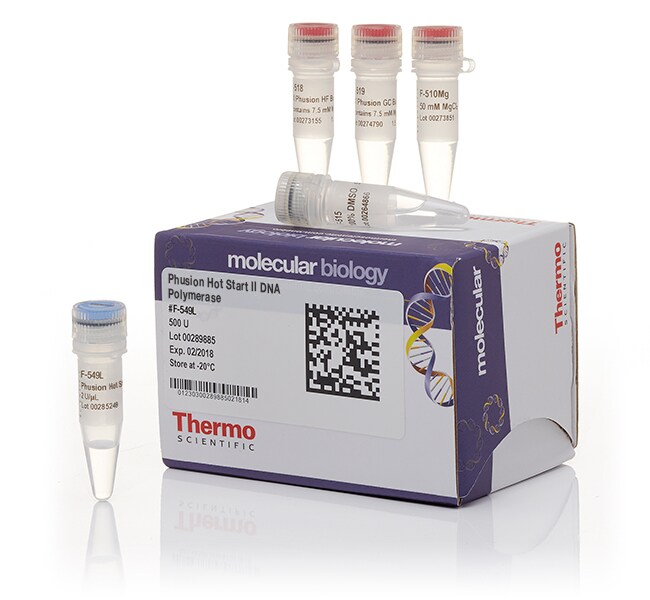
•Phusion 热启动 II 高保真 DNA 聚合酶 (2 U/μL)
• 5X Phusion HF 缓冲液
• 5X Phusion GC 缓冲液
• DMSO
• 50 mM MgCl2 溶液
Phusion HF 和 Phusion GC 缓冲液都在1X 终浓度的情况下提供1.5 mM MgCl2。在-20°C 条件下储存。
•Phusion 热启动 II 高保真 DNA 聚合酶 (2 U/μL)
• 5X Phusion HF 缓冲液
• 5X Phusion GC 缓冲液
• DMSO
• 50 mM MgCl2 溶液
Phusion HF 和 Phusion GC 缓冲液都在1X 终浓度的情况下提供1.5 mM MgCl2。在-20°C 条件下储存。