Search

Thermo Scientific™
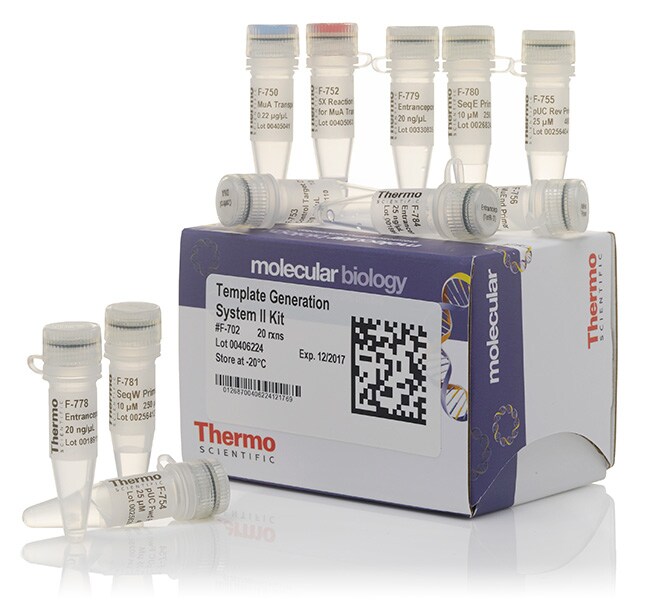
模板传代系统 II 试剂盒
Thermo Scientific transposon technology is the first technology that allows scientist to insert constructed linear DNA fragment into circular or了解更多信息
| 货号 | 数量 |
|---|---|
| F702 | 20 reactions |
货号 F702
价格(CNY)
-
数量:
20 reactions
Thermo Scientific transposon technology is the first technology that allows scientist to insert constructed linear DNA fragment into circular or linear DNA target randomly and very efficiently. The Thermo Scientific Template Generation System II Kit (TGS II Kit) is based on the transposition reaction of the bacteriophage Mu. This system has been simplified to work in vitro, and an artificial Mu transposon, designated as the Entranceposon, has been constructed. The reaction is catalyzed by a single enzyme, MuA Transposase.
TGS II Kit provides the tools for inserting the Entranceposon into foreign DNA at random locations. Insertion of an Entranceposon into unknown target DNA provides primer binding sites for different applications. A simple and fast in vitro transposition reaction takes place in a single reaction tube.
Features:
• Provides templates for DNA sequencing more simply and with less hands-on time than any other method
• Thousands of ready-to-sequence templates from a single transposition reaction: Enough to sequence even large DNA clones (e.g. BAC clones) without fragmentation or subcloning
• Simple mapping of the Entranceposon insertions by colony-PCR or restriction enzyme digestion enables directed sequencing. Fewer sequencing reactions are required to complete a sequence than with the 'shotgun' approach
• Universal primers: The sequencing and mapping primers are included in the kit, no need for custom primers.
• Bidirectional sequencing: A single template clone can be used for sequencing the flanking DNA on both sides of the Entranceposon insertion
• Three different antibiotic resistance genes are available in each TGS II Kit
• All components needed as well as detailed instruction manual to perform the reactions are included in the kit. TGS II Kit is an updated version of the TGS I Kit.
Applications
The Template Generation System II Kit is designed for inserting an artificial Mu transposon into unknown target DNA to provide primer binding sites for:
• Rapid sequencing of templates without primer walking or custom primers
• Shotgun sequencing of large DNA clones directly without time-consuming fragmentation and subcloning into a library
• Insertion of PCR priming sites into target DNA with an unknown sequence
• Random insertional mutagenesis of cloned DNA; direct amplification, mapping or sequencing using primers at the insertion site
• Sequencing with transposons vs. traditional sequencing
• Special Applications:
• BAC sequencing
• Transposition reaction into linear target DNA
TGS II Kit provides the tools for inserting the Entranceposon into foreign DNA at random locations. Insertion of an Entranceposon into unknown target DNA provides primer binding sites for different applications. A simple and fast in vitro transposition reaction takes place in a single reaction tube.
Features:
• Provides templates for DNA sequencing more simply and with less hands-on time than any other method
• Thousands of ready-to-sequence templates from a single transposition reaction: Enough to sequence even large DNA clones (e.g. BAC clones) without fragmentation or subcloning
• Simple mapping of the Entranceposon insertions by colony-PCR or restriction enzyme digestion enables directed sequencing. Fewer sequencing reactions are required to complete a sequence than with the 'shotgun' approach
• Universal primers: The sequencing and mapping primers are included in the kit, no need for custom primers.
• Bidirectional sequencing: A single template clone can be used for sequencing the flanking DNA on both sides of the Entranceposon insertion
• Three different antibiotic resistance genes are available in each TGS II Kit
• All components needed as well as detailed instruction manual to perform the reactions are included in the kit. TGS II Kit is an updated version of the TGS I Kit.
Applications
The Template Generation System II Kit is designed for inserting an artificial Mu transposon into unknown target DNA to provide primer binding sites for:
• Rapid sequencing of templates without primer walking or custom primers
• Shotgun sequencing of large DNA clones directly without time-consuming fragmentation and subcloning into a library
• Insertion of PCR priming sites into target DNA with an unknown sequence
• Random insertional mutagenesis of cloned DNA; direct amplification, mapping or sequencing using primers at the insertion site
• Sequencing with transposons vs. traditional sequencing
• Special Applications:
• BAC sequencing
• Transposition reaction into linear target DNA
仅供科研使用。不可用于诊断程序。
规格
产品规格管装
反应次数20 次反应
产品类型模板传代系统 II 试剂盒
数量20 reactions
原始材料DNA
足够用于20 次反应
适用于(应用)预扩增, Pre-amplification
形式溶液
反应速度快速
Unit SizeEach