Search
 元素搜索
元素搜索 结构搜索
结构搜索

Thermo Scientific Chemicals
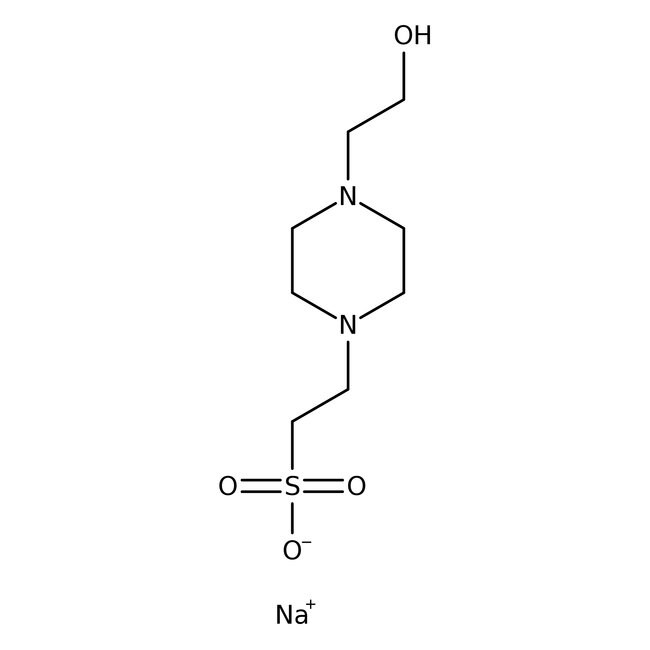
HEPES hemisodium salt
A zwitterionic buffer | CAS: 103404-87-1 | C8H17N2NaO4S | 260.28 g/mol
Have Questions?
更改视图


化学标识符
CAS103404-87-1
 规格表
规格表HEPES hemisodium salt is common buffer for biological sciences, particularly used in cell culture to maintain physiological pH. It acts a buffering component, which is used in the preparation of buffers. It is described as one of the best all-purpose buffers available for use in biological research.
This Thermo Scientific Chemicals brand product was originally part of the Alfa Aesar product portfolio. Some documentation and label information may refer to the legacy brand. The original Alfa Aesar product / item code or SKU reference has not changed as a part of the brand transition to Thermo Scientific Chemicals.
Applications
HEPES hemisodium salt is common buffer for biological sciences, particularly used in cell culture to maintain physiological pH. It acts a buffering component, which is used in the preparation of buffers. It is described as one of the best all-purpose buffers available for use in biological research.
Solubility
Soluble in water.
Notes
Incompatible with strong oxidizing agents.
HEPES hemisodium salt is common buffer for biological sciences, particularly used in cell culture to maintain physiological pH. It acts a buffering component, which is used in the preparation of buffers. It is described as one of the best all-purpose buffers available for use in biological research.
Solubility
Soluble in water.
Notes
Incompatible with strong oxidizing agents.
RUO – Research Use Only
General References:
- Kebede, N.; Francis, P. S.; Barbante, G. J.; Hogan, C. F. Electrogenerated chemiluminescence of tris(2, 2' bipyridine)ruthenium(II) using common biological buffers as co-reactant, pH buffer and supporting electrolyte. Analyst 2015, 140 (21), 7142-7145.
- Flourat, A. L.; Peru, A. A. M.; Teixeira, A. R. S.; Brunissen, F.; Allais, F. Chemo-enzymatic synthesis of key intermediates (S)-γ-hydroxymethyl-α, β-butenolide and (S)-γ-hydroxymethyl-γ-butyrolactone via lipase-mediated Baeyer-Villiger oxidation of levoglucosenone. Green Chem. 2015, 17 (1), 404-412.