Search
 元素搜索
元素搜索 结构搜索
结构搜索
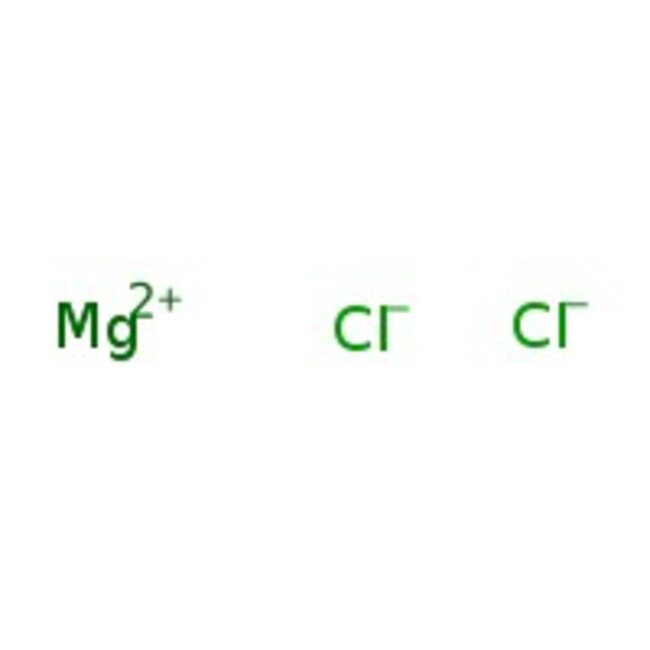

Thermo Scientific Chemicals
Magnesium chloride, 1M aq. soln.
CAS: 7786-30-3 | Cl2Mg | 95.21 g/mol
Have Questions?
更改视图


化学标识符
CAS7786-30-3
IUPAC Namemagnesium(2+) dichloride
Molecular FormulaCl2Mg
InChI KeyTWRXJAOTZQYOKJ-UHFFFAOYSA-L
SMILES[Mg++].[Cl-].[Cl-]
查看更多内容
规格 规格表
规格表
规格表Transition TemperatureComponent is dissolve in 18.2 megahom, UV treated water and filtered through sub-micron filter
Appearance (Color)Clear and colorless solution
Magnesium chloride, 1M aq. soln., sterile is used as an excellent magnesium ion source for synthesis and biology research. Magnesium chloride is widely used to supply the magnesium ion in various molecular biology applications, including PCR reactions and buffers. It was used to prepare buffer to lyse cells for immunoprecipitation1 and to prepare serum-free medium for electrophysiological studies of rat brain slice cultures.
This Thermo Scientific Chemicals brand product was originally part of the Alfa Aesar product portfolio. Some documentation and label information may refer to the legacy brand. The original Alfa Aesar product / item code or SKU reference has not changed as a part of the brand transition to Thermo Scientific Chemicals.
Applications
Magnesium chloride, 1M aq. soln., sterile is used as an excellent magnesium ion source for synthesis and biology research. Magnesium chloride is widely used to supply the magnesium ion in various molecular biology applications, including PCR reactions and buffers. It was used to prepare buffer to lyse cells for immunoprecipitation1 and to prepare serum-free medium for electrophysiological studies of rat brain slice cultures.
Solubility
Soluble in water (542 mg/ml at 20°C), alcohol, methanol (15.5 g/100g at 0°C), and ethanol (3.61 g/100g at 0°C).
Notes
Store in cool place. Keep container tightly closed in a dry and well-ventilated place. Very hygroscopic.
Magnesium chloride, 1M aq. soln., sterile is used as an excellent magnesium ion source for synthesis and biology research. Magnesium chloride is widely used to supply the magnesium ion in various molecular biology applications, including PCR reactions and buffers. It was used to prepare buffer to lyse cells for immunoprecipitation1 and to prepare serum-free medium for electrophysiological studies of rat brain slice cultures.
Solubility
Soluble in water (542 mg/ml at 20°C), alcohol, methanol (15.5 g/100g at 0°C), and ethanol (3.61 g/100g at 0°C).
Notes
Store in cool place. Keep container tightly closed in a dry and well-ventilated place. Very hygroscopic.
RUO – Research Use Only
General References:
- Arivazhagan Rajendran et. Al. Direct and real-time observation of rotary movement of a DNA nanomechanical device.Journal of the American Chemical Society. 2013, 135,(3), 1117-1123.
- Jason I Kilpatrick et. Al. Directly probing the effects of ions on hydration forces at interfaces. Journal of the American Chemical Society. 2013, 135,(7), 2628-2634.