Search
 元素搜索
元素搜索 结构搜索
结构搜索

Thermo Scientific Chemicals
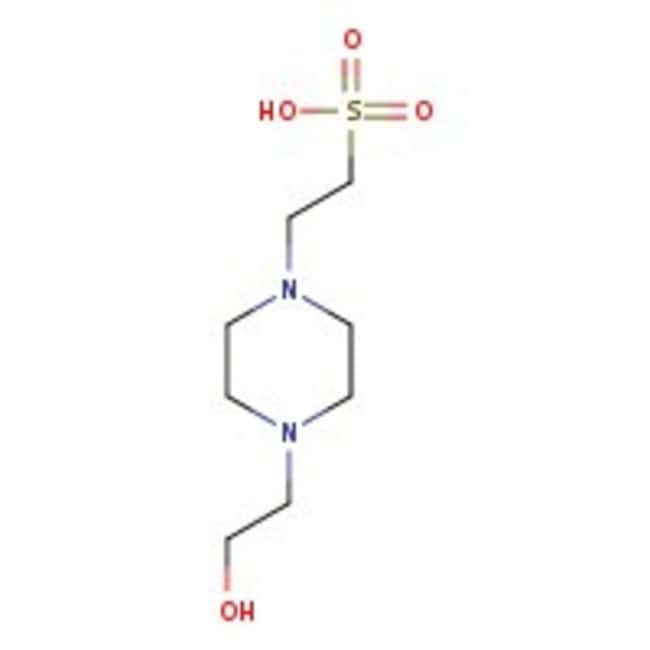
HEPES, 0.5M buffer soln., pH 8.0
CAS: 7365-45-9 | C8H18N2O4S | 238.30 g/mol
Have Questions?
更改视图


规格
CAS7365-45-9
ChEBICHEBI:42334
化学名称或材料HEPES buffer soln.
IUPAC 名称2-[4-(2-hydroxyethyl)piperazin-1-yl]ethanesulfonic acid
InChI 键JKMHFZQWWAIEOD-UHFFFAOYSA-N
查看更多内容
HEPES has been utilized extensively for research and commercial applications in the cell culture and tissue culture industries. It is useful in the pH range 6.8-8.2. HEPES is used as a zwitterionic, all-purpose Good’s buffer for use in biological research. HEPES is widely used in cell culture, largely because it is better at maintaining physiological pH despite changes in carbon dioxide concentration when compared to bicarbonate buffers, which are also commonly used in cell culture.
This Thermo Scientific Chemicals brand product was originally part of the Alfa Aesar product portfolio. Some documentation and label information may refer to the legacy brand. The original Alfa Aesar product / item code or SKU reference has not changed as a part of the brand transition to Thermo Scientific Chemicals.
Applications
HEPES has been utilized extensively for research and commercial applications in the cell culture and tissue culture industries. It is useful in the pH range 6.8-8.2. HEPES is used as a zwitterionic, all-purpose “Good’s” buffer for use in biological research. HEPES is widely used in cell culture, largely because it is better at maintaining physiological pH despite changes in carbon dioxide concentration when compared to bicarbonate buffers, which are also commonly used in cell culture.
Solubility
Fully miscible.
Notes
Keep container tightly closed. Store away from oxidizing agents. Store in cool, dry conditions in well sealed containers.
HEPES has been utilized extensively for research and commercial applications in the cell culture and tissue culture industries. It is useful in the pH range 6.8-8.2. HEPES is used as a zwitterionic, all-purpose “Good’s” buffer for use in biological research. HEPES is widely used in cell culture, largely because it is better at maintaining physiological pH despite changes in carbon dioxide concentration when compared to bicarbonate buffers, which are also commonly used in cell culture.
Solubility
Fully miscible.
Notes
Keep container tightly closed. Store away from oxidizing agents. Store in cool, dry conditions in well sealed containers.
RUO – Research Use Only
David M.L. Goodgame.; Martin Joy, A. EPR study of the Cr(V) and radical species produced in the reduction of Cr(VI) by ascorbate. Inorganica Chimica Acta. 1987, 135, (2), 115-118.