Search


引用和文献 (66)
Invitrogen™
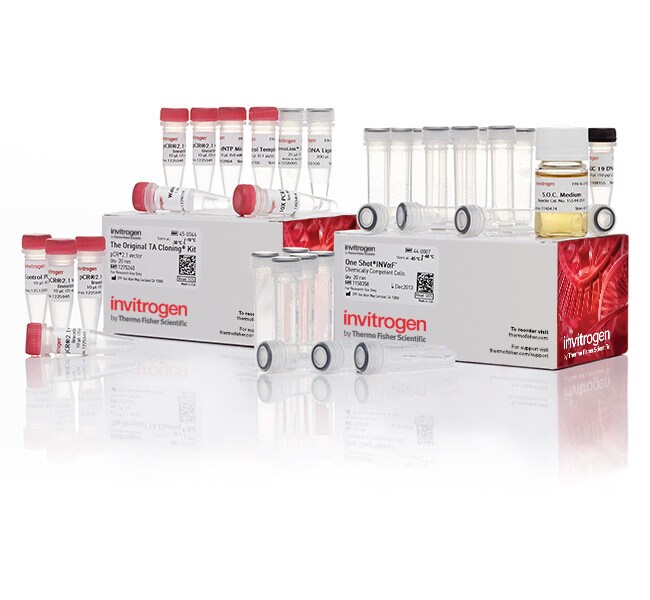
TA 克隆™试剂盒,含 pCR™2.1 载体和 One Shot™ INVαF' 化学感受态大肠杆菌
TA 克隆™试剂盒(含 PCR™2.1 载体)提供了一种快速的一步法克隆策略,可将经 Taq 扩增的 PCR 产物直接插入质粒载体中了解更多信息
Have Questions?
更改视图

| 货号 | 反应次数 | 载体 |
|---|---|---|
| K200001 | 20 次反应 | pCRII |
| K200040 | 40 次反应 | pCR2.1 |
货号 K200001
价格(CNY)
3,965.00
飞享价
Ends: 31-Dec-2026
7,927.00共减 3,962.00 (50%)
Each
反应次数:
20 次反应
载体:
pCRII
价格(CNY)
3,965.00
飞享价
Ends: 31-Dec-2026
7,927.00共减 3,962.00 (50%)
Each
TA 克隆™试剂盒(含 PCR™2.1 载体)提供了一种快速的一步法克隆策略,可将经 Taq 扩增的 PCR 产物直接插入质粒载体中。TA Cloning™ 试剂盒使用 pCR™2.1 克隆载体和 ExpressLink™ T4 DNA 连接酶,在十五分钟的室温连接步骤中生成连接产物。反应通常产生 >80% 包含插入片段的重组体。
TA Cloning™ 试剂盒(含 pCR™2.1 载体)的特点:
•快速且方便 — 15分钟、室温连接
•高效 — 蓝/白斑筛选和 >80% 含正确插入片段的克隆体
•灵活 — 可选择卡那霉素或氨苄青霉素抗性,实现灵活的抗生素选择
•轻松 — 无需对 PCR 产物进行任何酶修饰
•流程简化 — 不需要使用包含限制性位点的 PCR 引物
pCR™2.1 载体提供:
• 3'-T 突出端,用于直接连接 Taq 扩增 PCR 产物
• T7 启动子,用于体外 RNA 转录和测序
• 两侧具有 EcoR I 位点的通用性多位点接头,可方便地切除插入片段
• M13 正向和反向引物位点,用于测序
TA Cloning™ 的工作原理
Taq 聚合酶具有非模板依赖性活性,可在 PCR 产物的 3' 末端引入单脱氧腺苷 (A)。该试剂盒中提供的线性化载体具有单个 3' 脱氧胸苷 (T) 残基。这使得 PCR 插入片段高效地与载体连接。
试剂盒配置
TA Cloning™ 试剂盒提供多种配置:不含感受态细胞(K2020-20 和 K2020-40)、含 One Shot™ INVF' 化学感受态大肠杆菌(K2000-01 和 K2000-40)、含 One Shot™ TOP10F' 化学感受态大肠杆菌(K2030-01 和 K2030-40)以及含 One Shot™ TOP10 化学感受态大肠杆菌(K2040-01 和 K2040-40),分 20 和 40 次反应试剂盒规格。
TA Cloning™ 试剂盒(含 pCR™2.1 载体)的特点:
•快速且方便 — 15分钟、室温连接
•高效 — 蓝/白斑筛选和 >80% 含正确插入片段的克隆体
•灵活 — 可选择卡那霉素或氨苄青霉素抗性,实现灵活的抗生素选择
•轻松 — 无需对 PCR 产物进行任何酶修饰
•流程简化 — 不需要使用包含限制性位点的 PCR 引物
pCR™2.1 载体提供:
• 3'-T 突出端,用于直接连接 Taq 扩增 PCR 产物
• T7 启动子,用于体外 RNA 转录和测序
• 两侧具有 EcoR I 位点的通用性多位点接头,可方便地切除插入片段
• M13 正向和反向引物位点,用于测序
TA Cloning™ 的工作原理
Taq 聚合酶具有非模板依赖性活性,可在 PCR 产物的 3' 末端引入单脱氧腺苷 (A)。该试剂盒中提供的线性化载体具有单个 3' 脱氧胸苷 (T) 残基。这使得 PCR 插入片段高效地与载体连接。
试剂盒配置
TA Cloning™ 试剂盒提供多种配置:不含感受态细胞(K2020-20 和 K2020-40)、含 One Shot™ INVF' 化学感受态大肠杆菌(K2000-01 和 K2000-40)、含 One Shot™ TOP10F' 化学感受态大肠杆菌(K2030-01 和 K2030-40)以及含 One Shot™ TOP10 化学感受态大肠杆菌(K2040-01 和 K2040-40),分 20 和 40 次反应试剂盒规格。
仅供科研使用。不可用于诊断程序。
规格
细菌或酵母菌株INVαF ́
细胞类型化学感受态大肠杆菌
克隆方法TA克隆
适用于(应用)PCR克隆
反应次数20 次反应
产品线One Shot
产品类型克隆试剂盒
促进剂T7
数量20 reactions
载体pCRII
产品规格试剂盒
Unit SizeEach
内容与储存
TA Cloning™ 试剂盒包含线性化 pCR™2.1 载体、ExpressLink™ T4 DNA 连接酶、5X ExpressLink™ T4 DNA 连接缓冲液、dNTP、10X PCR 缓冲液、无菌水和对照品。感受态细胞试剂盒包含 One Shot™ 化学感受态大肠杆菌、S.O.C. 培养基和一种超螺旋对照质粒。
在 -80°C 下储存 One Shot™ 大肠杆菌。所有其他组分储存在 -20°C 下。正确存放时,所有试剂均可保证 6 个月的稳定。
在 -80°C 下储存 One Shot™ 大肠杆菌。所有其他组分储存在 -20°C 下。正确存放时,所有试剂均可保证 6 个月的稳定。
引用和文献 (66)
引用和文献
Abstract
Hyperornithinaemia-hyperammonaemia-homocitrullinuria syndrome is caused by mutations in a gene encoding a mitochondrial ornithine transporter.
Journal:Nature genetics
PubMed ID:10369256
Rapamycin antifungal action is mediated via conserved complexes with FKBP12 and TOR kinase homologs in Cryptococcus neoformans.
Journal:Molecular and cellular biology
PubMed ID:10330150
Cryptococcus neoformans is a fungal pathogen that causes meningitis in patients immunocompromised by AIDS, chemotherapy, organ transplantation, or high-dose steroids. Current antifungal drug therapies are limited and suffer from toxic side effects and drug resistance. Here, we defined the targets and mechanisms of antifungal action of the immunosuppressant rapamycin in
Procollagen with skipping of alpha 1(I) exon 41 has lower binding affinity for alpha 1(I) C-telopeptide, impaired in vitro fibrillogenesis, and altered fibril morphology.
Journal:The Journal of biological chemistry
PubMed ID:11706004
Previous in vitro data on type I collagen self-assembly into fibrils suggested that the amino acid 776-796 region of the alpha1(I) chain is crucial for fibril formation because it serves as the recognition site for the telopeptide of a docking collagen monomer. We used a natural collagen mutation with a
Molecular characterization of Ancylostoma inhibitors of coagulation factor Xa. Hookworm anticoagulant activity in vitro predicts parasite bloodfeeding in vivo.
Journal:J Biol Chem
PubMed ID:11741914
'Bloodfeeding hookworms, which currently infect over a billion people in the developing world, are a leading cause of gastrointestinal hemorrhage and iron deficiency anemia. The major anticoagulant inhibitor of coagulation factor Xa has been identified from the hookworm parasite Ancylostoma ceylanicum using reverse transcription PCR and 3''-rapid amplification of cDNA
The catalytic mechanism of Cdc25A phosphatase.
Journal:J Biol Chem
PubMed ID:11805096
'Cdc25 phosphatases are dual specificity phosphatases that dephosphorylate and activate cyclin-dependent kinases (CDKs), thereby effecting the progression from one phase of the cell cycle to the next. Despite its central role in the cell cycle, relatively little is known about the catalytic mechanism of Cdc25. In order to provide insights