Search

Invitrogen™
TA Cloning ™试剂盒,含 PCR™2.1 载体,不含感受态细胞
TA 克隆™试剂盒(含 PCR™2.1 载体)提供了一种快速的一步法克隆策略,可将经 Taq 扩增的 PCR 产物直接插入质粒载体中了解更多信息
Have Questions?
更改视图

| 货号 | 反应次数 |
|---|---|
| K202020 | 20 次反应 |
| K202040 | 40 次反应 |
货号 K202020
价格(CNY)
2,307.00
Online exclusive
Ends: 31-Dec-2026
4,611.00共减 2,304.00 (50%)
Each
反应次数:
20 次反应
价格(CNY)
2,307.00
Online exclusive
Ends: 31-Dec-2026
4,611.00共减 2,304.00 (50%)
Each
TA 克隆™试剂盒(含 PCR™2.1 载体)提供了一种快速的一步法克隆策略,可将经 Taq 扩增的 PCR 产物直接插入质粒载体中。TA Cloning™ 试剂盒使用 pCR™2.1 克隆载体和 ExpressLink™ T4 DNA 连接酶,在十五分钟的室温连接步骤中生成连接产物。反应通常产生 >80% 包含插入片段的重组体。
TA Cloning™ 试剂盒(含 pCR™2.1 载体)的特点:
•快速且方便 — 15分钟、室温连接
•高效 — 蓝/白斑筛选和 >80% 含正确插入片段的克隆体
•灵活 — 可选择卡那霉素或氨苄青霉素抗性,实现灵活的抗生素选择
•轻松 — 无需对 PCR 产物进行任何酶修饰
•流程简化 — 不需要使用包含限制性位点的 PCR 引物
pCR™2.1 载体提供:
• 3'-T 突出端,用于直接连接 Taq 扩增 PCR 产物
• T7 启动子,用于体外 RNA 转录和测序
• 两侧具有 EcoR I 位点的通用性多位点接头,可方便地切除插入片段
• M13 正向和反向引物位点,用于测序
TA Cloning™ 的工作原理
Taq 聚合酶具有非模板依赖性活性,可在 PCR 产物的 3' 末端引入单脱氧腺苷 (A)。该试剂盒中提供的线性化载体具有单个 3' 脱氧胸苷 (T) 残基。这使得 PCR 插入片段高效地与载体连接。
试剂盒配置
TA Cloning™ 试剂盒提供多种配置:不含感受态细胞(K2020-20 和 K2020-40)、含 One Shot™ INVF' 化学感受态大肠杆菌(K2000-01 和 K2000-40)、含 One Shot™ TOP10F' 化学感受态大肠杆菌(K2030-01 和 K2030-40)以及含 One Shot™ TOP10 化学感受态大肠杆菌(K2040-01 和 K2040-40),分 20 和 40 次反应试剂盒规格。
TA Cloning™ 试剂盒(含 pCR™2.1 载体)的特点:
•快速且方便 — 15分钟、室温连接
•高效 — 蓝/白斑筛选和 >80% 含正确插入片段的克隆体
•灵活 — 可选择卡那霉素或氨苄青霉素抗性,实现灵活的抗生素选择
•轻松 — 无需对 PCR 产物进行任何酶修饰
•流程简化 — 不需要使用包含限制性位点的 PCR 引物
pCR™2.1 载体提供:
• 3'-T 突出端,用于直接连接 Taq 扩增 PCR 产物
• T7 启动子,用于体外 RNA 转录和测序
• 两侧具有 EcoR I 位点的通用性多位点接头,可方便地切除插入片段
• M13 正向和反向引物位点,用于测序
TA Cloning™ 的工作原理
Taq 聚合酶具有非模板依赖性活性,可在 PCR 产物的 3' 末端引入单脱氧腺苷 (A)。该试剂盒中提供的线性化载体具有单个 3' 脱氧胸苷 (T) 残基。这使得 PCR 插入片段高效地与载体连接。
试剂盒配置
TA Cloning™ 试剂盒提供多种配置:不含感受态细胞(K2020-20 和 K2020-40)、含 One Shot™ INVF' 化学感受态大肠杆菌(K2000-01 和 K2000-40)、含 One Shot™ TOP10F' 化学感受态大肠杆菌(K2030-01 和 K2030-40)以及含 One Shot™ TOP10 化学感受态大肠杆菌(K2040-01 和 K2040-40),分 20 和 40 次反应试剂盒规格。
仅供科研使用。不可用于诊断程序。
规格
细菌或酵母菌株不包括在内
克隆方法TA克隆
适用于(应用)PCR克隆
反应次数20 次反应
产品线TA Cloning
产品类型克隆试剂盒
促进剂T7
数量20 reactions
载体pCR2.1
产品规格试剂盒
Unit SizeEach
内容与储存
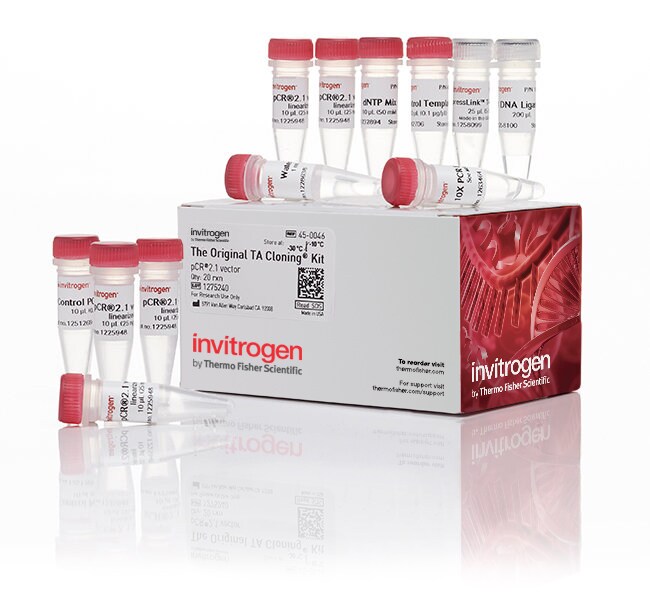
TA Cloning™ 试剂盒包含线性化 pCR™2.1 载体、ExpressLink™ T4 DNA 连接酶、5X ExpressLink™ T4 DNA 连接缓冲液、dNTP、10X PCR 缓冲液、无菌水和对照品。
将所有组成部分储存在 -20°C 下。妥善储存时,所有试剂均可保证 6 个月的稳定。
将所有组成部分储存在 -20°C 下。妥善储存时,所有试剂均可保证 6 个月的稳定。