Search


引用和文献 (61)
Invitrogen™
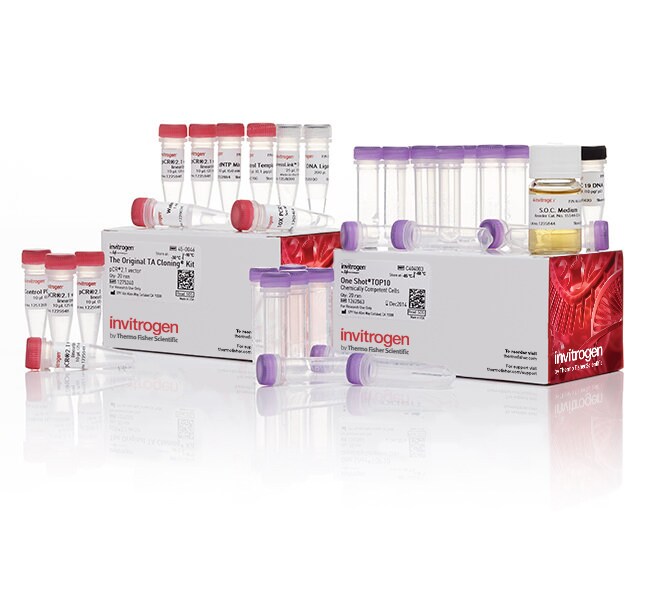
TA Cloning™试剂盒,含 pCR™2.1 载体和 One Shot™ TOP10 化学感受态大肠杆菌
TA 克隆™试剂盒(含 PCR™2.1 载体)提供了一种快速的一步法克隆策略,可将经 Taq 扩增的 PCR 产物直接插入质粒载体中了解更多信息
Have Questions?
更改视图

| 货号 | 反应次数 | 载体 |
|---|---|---|
| K204001 | 20 次反应 | pCRII |
| K204040 | 40 次反应 | pCR2.1 |
货号 K204001
价格(CNY)
3,990.00
飞享价
Ends: 31-Dec-2026
7,977.00共减 3,987.00 (50%)
Each
反应次数:
20 次反应
载体:
pCRII
价格(CNY)
3,990.00
飞享价
Ends: 31-Dec-2026
7,977.00共减 3,987.00 (50%)
Each
TA 克隆™试剂盒(含 PCR™2.1 载体)提供了一种快速的一步法克隆策略,可将经 Taq 扩增的 PCR 产物直接插入质粒载体中。TA Cloning™ 试剂盒使用 pCR™2.1 克隆载体和 ExpressLink™ T4 DNA 连接酶,在十五分钟的室温连接步骤中生成连接产物。反应通常产生 >80% 包含插入片段的重组体。
TA Cloning™ 试剂盒(含 pCR™2.1 载体)的特点:
•快速且方便 — 15分钟、室温连接
•高效 — 蓝/白斑筛选和 >80% 含正确插入片段的克隆体
•灵活 — 可选择卡那霉素或氨苄青霉素抗性,实现灵活的抗生素选择
•轻松 — 无需对 PCR 产物进行任何酶修饰
•流程简化 — 不需要使用包含限制性位点的 PCR 引物
pCR™2.1 载体提供:
• 3'-T 突出端,用于直接连接 Taq 扩增 PCR 产物
• T7 启动子,用于体外 RNA 转录和测序
• 两侧具有 EcoR I 位点的通用性多位点接头,可方便地切除插入片段
• M13 正向和反向引物位点,用于测序
TA Cloning™ 的工作原理
Taq 聚合酶具有非模板依赖性活性,可在 PCR 产物的 3' 末端引入单脱氧腺苷 (A)。该试剂盒中提供的线性化载体具有单个 3' 脱氧胸苷 (T) 残基。这使得 PCR 插入片段高效地与载体连接。
试剂盒配置
TA Cloning™ 试剂盒提供多种配置:不含感受态细胞(K2020-20 和 K2020-40)、含 One Shot™ INVF' 化学感受态大肠杆菌(K2000-01 和 K2000-40)、含 One Shot™ TOP10F' 化学感受态大肠杆菌(K2030-01 和 K2030-40)以及含 One Shot™ TOP10 化学感受态大肠杆菌(K2040-01 和 K2040-40),分 20 和 40 次反应试剂盒规格。
TA Cloning™ 试剂盒(含 pCR™2.1 载体)的特点:
•快速且方便 — 15分钟、室温连接
•高效 — 蓝/白斑筛选和 >80% 含正确插入片段的克隆体
•灵活 — 可选择卡那霉素或氨苄青霉素抗性,实现灵活的抗生素选择
•轻松 — 无需对 PCR 产物进行任何酶修饰
•流程简化 — 不需要使用包含限制性位点的 PCR 引物
pCR™2.1 载体提供:
• 3'-T 突出端,用于直接连接 Taq 扩增 PCR 产物
• T7 启动子,用于体外 RNA 转录和测序
• 两侧具有 EcoR I 位点的通用性多位点接头,可方便地切除插入片段
• M13 正向和反向引物位点,用于测序
TA Cloning™ 的工作原理
Taq 聚合酶具有非模板依赖性活性,可在 PCR 产物的 3' 末端引入单脱氧腺苷 (A)。该试剂盒中提供的线性化载体具有单个 3' 脱氧胸苷 (T) 残基。这使得 PCR 插入片段高效地与载体连接。
试剂盒配置
TA Cloning™ 试剂盒提供多种配置:不含感受态细胞(K2020-20 和 K2020-40)、含 One Shot™ INVF' 化学感受态大肠杆菌(K2000-01 和 K2000-40)、含 One Shot™ TOP10F' 化学感受态大肠杆菌(K2030-01 和 K2030-40)以及含 One Shot™ TOP10 化学感受态大肠杆菌(K2040-01 和 K2040-40),分 20 和 40 次反应试剂盒规格。
仅供科研使用。不可用于诊断程序。
规格
细菌或酵母菌株TOP10
细胞类型化学感受态大肠杆菌
克隆方法TA克隆
适用于(应用)PCR克隆
反应次数20 次反应
产品线One Shot
产品类型克隆试剂盒
促进剂T7
数量20 reactions
载体pCRII
产品规格试剂盒
Unit SizeEach
内容与储存
TA Cloning™ 试剂盒包含线性化 pCR™2.1 载体、ExpressLink™ T4 DNA 连接酶、5X ExpressLink™ T4 DNA 连接缓冲液、dNTP、10X PCR 缓冲液、无菌水和对照品。感受态细胞试剂盒包含 One Shot™ 化学感受态大肠杆菌、S.O.C. 培养基和一种超螺旋对照质粒。
在 -80°C 下储存 One Shot™ 大肠杆菌。所有其他组分储存在 -20°C 下。正确存放时,所有试剂均可保证 6 个月的稳定。
在 -80°C 下储存 One Shot™ 大肠杆菌。所有其他组分储存在 -20°C 下。正确存放时,所有试剂均可保证 6 个月的稳定。
引用和文献 (61)
引用和文献
Abstract
Molecular cloning of translocation t(1;14)(q21;q32) defines a novel gene (BCL9) at chromosome 1q21.
Journal:Blood
PubMed ID:9490669
Abnormalities of chromosome 1q21 are common in B-cell malignancies and have been associated with a poor response to therapy. The nature of the involved gene(s) on chromosome 1q21 remains unknown. A cell line (CEMO- 1) has recently been established from a patient with precursor-B-cell acute lymphoblastic leukemia (ALL), which exhibited
Molecular cloning and biological activity of a novel lysyl oxidase-related gene expressed in cartilage.
Journal:J Biol Chem
PubMed ID:11292829
We cloned a cDNA encoding a novel lysyl oxidase-related protein, named LOXC, by suppression subtractive hybridization between differentiated and calcified ATDC5 cells, a clonal mouse chondrogenic EC cell line. The deduced amino acid sequence of mouse LOXC consists of 757 amino acids and shows 50% identity with that of mouse
Differential gene expression between developing queens and workers in the honey bee, Apis mellifera [see comments]
Journal:Proc Natl Acad Sci U S A
PubMed ID:10318926
'Many insects show polyphenisms, or alternative morphologies, which are based on differential gene expression rather than genetic polymorphism. Queens and workers are alternative forms of the adult female honey bee and represent one of the best known examples of insect polyphenism. Hormonal regulation of caste determination in honey bees has
The mouse pale ear (ep) mutation is the homologue of human Hermansky- Pudlak syndrome.
Journal:Proc Natl Acad Sci U S A
PubMed ID:9256466
'The recessive mutation at the pale ear (ep) locus on mouse chromosome 19 was found to be the homologue of human Hermansky-Pudlak syndrome (HPS). A positional cloning strategy using yeast artificial chromosomes spanning the HPS locus was used to identify the HPS gene and its murine counterpart. These genes and
A novel N-terminal splice variant of the rat H+-K+-ATPase alpha2 subunit. Cloning, functional expression, and renal adaptive response to chronic hypokalemia.
Journal:J Biol Chem
PubMed ID:9446555
'The H+-K+-ATPase of renal collecting duct mediates K+ conservation during chronic hypokalemia. K+ deprivation promotes H+-K+-ATPase alpha2 (HKalpha2) gene expression in the medullary collecting duct, the principal site of active K+ reabsorption, suggesting that this isozyme contributes to renal K+ reclamation. We report here that alternative transcriptional initiation and mRNA