Search


引用和文献 (8)
Invitrogen™
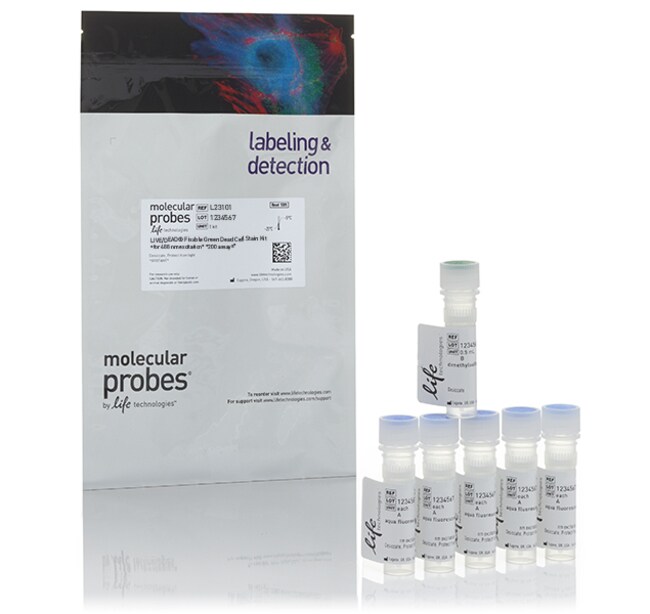
LIVE/DEAD™ 可固定绿色死细胞染色剂试剂盒,用于 488 nm 激发
在细胞内抗体染色所需的固定和透化前,或者在使用甲醛固定消除生物危害性物质前,使用 LIVE/DEAD™ 可固定绿色死细胞染色剂试剂盒测定细胞活力。本试剂盒经过优化和验证,可与蓝色激光流式细胞仪配合使用。•稳定—染料在单独小瓶中冷冻干燥,以维持稳定性•稳健—染色模式在固定前后相同•明亮信号—能够以单通道轻松分辨活/死细胞查看用于流式细胞分析的所有可固定活力染料的选择指南。稳定与以溶液形式销售的产品不同,LIVE/DEAD™ 可固定绿色染色剂以 40 次测试瓶便利包装,有助于确保染料随时间推移的稳定性和性能。溶液中的胺反应性染料在短时间内会失去其有效性,因此建议在再水化后完全使用小瓶了解更多信息
Have Questions?
更改视图

| 货号 | 数量 |
|---|---|
| L23101 | 200 次检测 |
| L34970 | 400 次检测 |
| L34969 | 80 次检测 |
货号 L23101
价格(CNY)
3,060.00
飞享价
Ends: 31-Dec-2026
4,065.00共减 1,005.00 (25%)
Each
数量:
200 次检测
价格(CNY)
3,060.00
飞享价
Ends: 31-Dec-2026
4,065.00共减 1,005.00 (25%)
Each
在细胞内抗体染色所需的固定和透化前,或者在使用甲醛固定消除生物危害性物质前,使用 LIVE/DEAD™ 可固定绿色死细胞染色剂试剂盒测定细胞活力。本试剂盒经过优化和验证,可与蓝色激光流式细胞仪配合使用。
•稳定—染料在单独小瓶中冷冻干燥,以维持稳定性
•稳健—染色模式在固定前后相同
•明亮信号—能够以单通道轻松分辨活/死细胞
查看用于流式细胞分析的所有可固定活力染料的选择指南。
稳定
与以溶液形式销售的产品不同,LIVE/DEAD™ 可固定绿色染色剂以 40 次测试瓶便利包装,有助于确保染料随时间推移的稳定性和性能。溶液中的胺反应性染料在短时间内会失去其有效性,因此建议在再水化后完全使用小瓶。如果无法做到这一点,将小瓶以小体积等分,并储存在 -80°C 下,避免冻融循环。
稳健
死细胞鉴别染色剂可在固定剂(如细胞内磷酸化研究所需的甲醛或基于乙醇的固定方法)处理后失去敏感性。LIVE/DEAD™ 可固定绿色染色剂是一种与细胞内和细胞外胺共价结合的胺反应性染料,在甲醛固定后保留染色模式。
极佳亮度
LIVE/DEAD™ 可固定绿色染色剂根据其在使用蓝色 488 nm 激光激发时提供明亮信号的荧光特性所选择。绿色荧光反应性染料的最大激发波长为 ∼495 nm,使其适用于与蓝色激光器配合使用,发射波长为 ∼520 nm,可在 FITC 通道中进行采集。因为可以使用流式细胞仪的单色染料和单通道来区分活细胞和死细胞、所以它是多色实验的理想选择。
工作原理
在细胞膜受损的细胞中,染料可与细胞内部和细胞表面的游离胺基反应,产生强烈的荧光染色。在活细胞中,染料的反应活性仅限于细胞表面的胺,从而导致更少的荧光强度。活细胞与死细胞之间的强度差异通常大于 50 倍,可轻松分辨。
提供多种颜色
LIVE/DEAD™ 可固定死细胞染色剂有多种颜色可供选择,以满足您的多色检测组合需求。
•稳定—染料在单独小瓶中冷冻干燥,以维持稳定性
•稳健—染色模式在固定前后相同
•明亮信号—能够以单通道轻松分辨活/死细胞
查看用于流式细胞分析的所有可固定活力染料的选择指南。
稳定
与以溶液形式销售的产品不同,LIVE/DEAD™ 可固定绿色染色剂以 40 次测试瓶便利包装,有助于确保染料随时间推移的稳定性和性能。溶液中的胺反应性染料在短时间内会失去其有效性,因此建议在再水化后完全使用小瓶。如果无法做到这一点,将小瓶以小体积等分,并储存在 -80°C 下,避免冻融循环。
稳健
死细胞鉴别染色剂可在固定剂(如细胞内磷酸化研究所需的甲醛或基于乙醇的固定方法)处理后失去敏感性。LIVE/DEAD™ 可固定绿色染色剂是一种与细胞内和细胞外胺共价结合的胺反应性染料,在甲醛固定后保留染色模式。
极佳亮度
LIVE/DEAD™ 可固定绿色染色剂根据其在使用蓝色 488 nm 激光激发时提供明亮信号的荧光特性所选择。绿色荧光反应性染料的最大激发波长为 ∼495 nm,使其适用于与蓝色激光器配合使用,发射波长为 ∼520 nm,可在 FITC 通道中进行采集。因为可以使用流式细胞仪的单色染料和单通道来区分活细胞和死细胞、所以它是多色实验的理想选择。
工作原理
在细胞膜受损的细胞中,染料可与细胞内部和细胞表面的游离胺基反应,产生强烈的荧光染色。在活细胞中,染料的反应活性仅限于细胞表面的胺,从而导致更少的荧光强度。活细胞与死细胞之间的强度差异通常大于 50 倍,可轻松分辨。
提供多种颜色
LIVE/DEAD™ 可固定死细胞染色剂有多种颜色可供选择,以满足您的多色检测组合需求。
仅供科研使用。不可用于诊断程序。
规格
细胞渗透性不透过
细胞类型真核细胞
描述LIVE/DEAD™ 可固定绿色死细胞染色剂试剂盒,用于 488 nm 激发
检测方法荧光
染料类型其他标记或染料
发射波长520 nm
激发波长495 nm
形式实心
产品规格管
数量200 次检测
运输条件室温
溶解度DMSO(二甲亚砜)
颜色绿色
适用于(应用)活力测定试剂盒
适用于(设备)流式细胞仪
产品线LIVE/DEAD
产品类型染色剂
Unit SizeEach
内容与储存
包含5小瓶 LIVE/DEAD™ 可固定死细胞染色剂以及 500 μL DMSO。
在 -20°C 下储存。
在 -20°C 下储存。
常见问题解答 (FAQ)
我如何为LIVE/DEAD细胞活力实验准备死细胞对照?
哪一种细胞活力试剂盒兼容固定?
为什么我要在实验中纳入活性染色?
我能用Attune NxT声波聚焦流式细胞仪检测的大小下限是多少?
Attune NxT自动进样器有何作用?
引用和文献 (8)
引用和文献
Abstract
Techniques to improve the direct ex vivo detection of low frequency antigen-specific CD8+ T cells with peptide-major histocompatibility complex class I tetramers.
Journal:Cytometry A
PubMed ID:18836993
'The ability to quantify and characterize antigen-specific CD8+ T cells irrespective of functional readouts using fluorochrome-conjugated peptide-major histocompatibility complex class I (pMHCI) tetramers in conjunction with flow cytometry has transformed our understanding of cellular immune responses over the past decade. In the case of prevalent CD8+ T cell populations that
Amine reactive dyes: an effective tool to discriminate live and dead cells in polychromatic flow cytometry.
Journal:J Immunol Methods
PubMed ID:16756987
'Membrane-damaged cells caused by either mechanical trauma or through normal biological processes can produce artifacts in immunophenotyping analysis by flow cytometry. Dead cells can nonspecifically bind monoclonal antibody conjugates, potentially leading to erroneous conclusions, particularly when cell frequencies are low. To date, DNA intercalating dyes (Ethidium monoazaide (EMA), Propidium Iodide,
Phenotypic Screening with Human iPS Cell-Derived Cardiomyocytes: HTS-Compatible Assays for Interrogating Cardiac Hypertrophy.
Journal:
PubMed ID:24071917
'A major hurdle for cardiovascular disease researchers has been the lack of robust and physiologically relevant cell-based assays for drug discovery. Derivation of cardiomyocytes from human-induced pluripotent stem (iPS) cells at high purity, quality, and quantity enables the development of relevant models of human cardiac disease with source material that
Anakinra treatment in patients with refractory inflammatory myopathies and possible predictive response biomarkers: a mechanistic study with 12 months follow-up.
Journal:Ann Rheum Dis
PubMed ID:23625983
'OBJECTIVE: To perform a mechanistic study on the effect of interleukin (IL)-1 blockade by anakinra in patients with refractory myositis and to explore possible predictive biomarkers. METHODS: Fifteen patients with refractory myositis were treated with anakinra for 12 months. Clinical response was assessed by the six-item core set measures of
Blocking angiotensin-converting enzyme induces potent regulatory T cells and modulates TH1- and TH17-mediated autoimmunity.
Journal:Proc Natl Acad Sci U S A
PubMed ID:19706421
The renin-angiotensin-aldosterone system (RAAS) is a major regulator of blood pressure. The octapeptide angiotensin II (AII) is proteolytically processed from the decapeptide AI by angiotensin-converting enzyme (ACE), and then acts via angiotensin type 1 and type 2 receptors (AT1R and AT2R). Inhibitors of ACE and antagonists of the AT1R are