Search


引用和文献 (3)
Invitrogen™
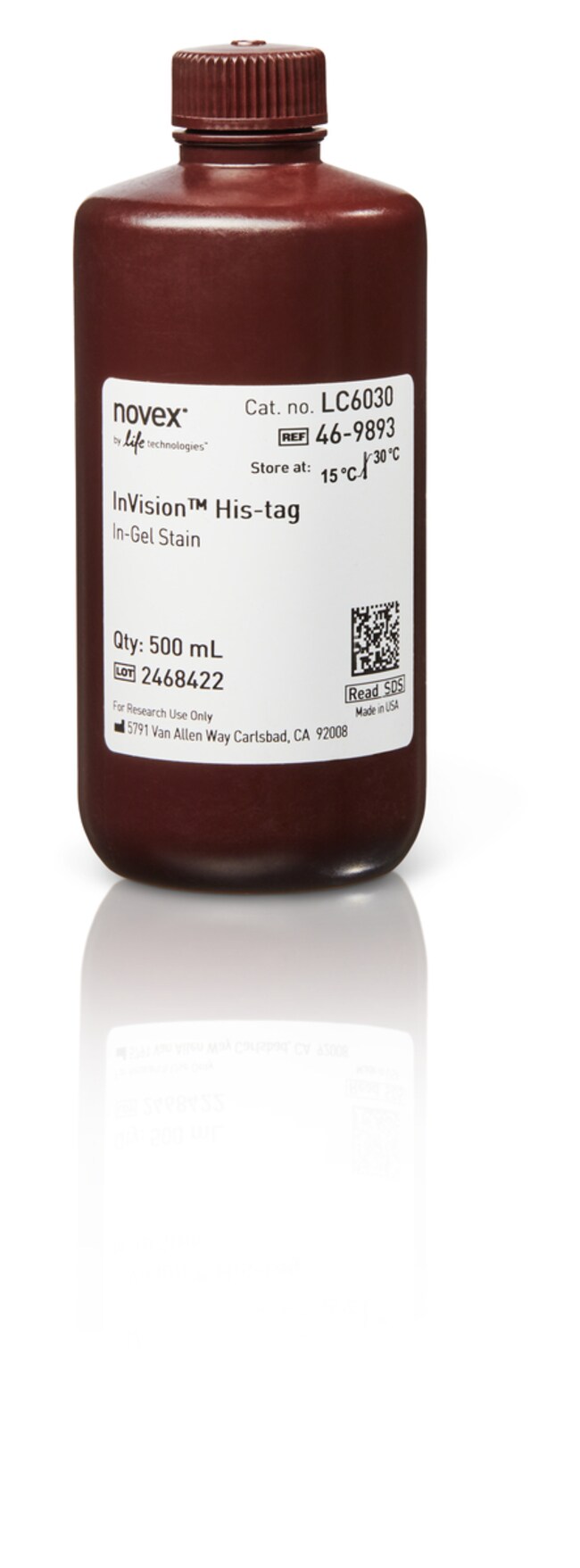
InVision™ His-Tag 胶内染料
InVision His-Tag 胶内染料是一种即用型、快速、灵敏且高特异性的荧光染料,用于电泳后在聚丙烯酰胺凝胶中直接可视化 His 标记的融合蛋白条带。特性:•对融合到寡核苷酸序列的蛋白染色• 消除凝胶中免疫印迹法—直接检测出的 His了解更多信息
| 货号 | 数量 |
|---|---|
| LC6030 | 500 mL |
货号 LC6030
价格(CNY)
8,522.00
Each
数量:
500 mL
价格(CNY)
8,522.00
Each
InVision His-Tag 胶内染料是一种即用型、快速、灵敏且高特异性的荧光染料,用于电泳后在聚丙烯酰胺凝胶中直接可视化 His 标记的融合蛋白条带。
特性:
•对融合到寡核苷酸序列的蛋白染色
• 消除凝胶中免疫印迹法—直接检测出的 His 标记蛋白
• 使用紫外线透射仪或配备适当过滤器或激光的成像设备,可检测纳克级的蛋白条带
• 3 小时内即可获得结果
比较所有 His-tag 染料›
快速且简单易用的染色
InVision His-tag 胶内染料方案易于操作,仅需要极少手动操作时间,可以在各种凝胶类型中进行快速、可扩展蛋白表达筛选。电泳后,将凝胶固定,在染料中孵育,洗涤并通过将凝胶暴露于紫外光或可见光下以检测出特异性 His 标记融合蛋白。不到 3 小时即可检测到纳克级的 His 标记的融合蛋白。记录 InVision Stain 信号后,可以进行总蛋白染色。
特性:
•对融合到寡核苷酸序列的蛋白染色
• 消除凝胶中免疫印迹法—直接检测出的 His 标记蛋白
• 使用紫外线透射仪或配备适当过滤器或激光的成像设备,可检测纳克级的蛋白条带
• 3 小时内即可获得结果
比较所有 His-tag 染料›
快速且简单易用的染色
InVision His-tag 胶内染料方案易于操作,仅需要极少手动操作时间,可以在各种凝胶类型中进行快速、可扩展蛋白表达筛选。电泳后,将凝胶固定,在染料中孵育,洗涤并通过将凝胶暴露于紫外光或可见光下以检测出特异性 His 标记融合蛋白。不到 3 小时即可检测到纳克级的 His 标记的融合蛋白。记录 InVision Stain 信号后,可以进行总蛋白染色。
仅供科研使用。不可用于诊断程序。
规格
检测定位凝胶内检测
检测方法荧光
数量500 mL
有效期每 6 个月
靶标分子蛋白质(His 标记)
产品线InVision
产品类型His 标签蛋白胶内染料
Unit SizeEach
内容与储存
InVision™ His-tag 胶内染料以 1X 即用型染色试剂的形式提供。在室温下储存。如果储存恰当,可以保证稳定6个月。
常见问题解答 (FAQ)
我使用InVision His-Tag In-Gel Stain对His标签融合蛋白染色,并使用BenchMark His标签蛋白标准品作为阳性对照。结果看到BenchMark His标签蛋白标准品出现一些多余条带。问题出在哪里?
我在使用InVisionHis-Tag In-Gel Stain时,得到了较高的、不均匀的背景。你们有何建议?
我在使用InVisionHis-Tag In-Gel Stain时,得到的染色效果很弱。你们有何建议?
InVision His-Tag In-Gel Stain能否用于E-PAGE凝胶染色?
经过InVision His-Tag In-Gel Stain染色的His标签融合蛋白,能否用于免疫印迹分析?
引用和文献 (3)
引用和文献
Abstract
Novel determinant of PKC-epsilon anchoring at cardiac Z-lines.
Journal:Am J Physiol Heart Circ Physiol
PubMed ID:15964917
'The Z-line represents a critical link between the transverse tubule network and cytoskeleton of cardiac cells with a role in anchoring structural proteins, ion channels, and signaling molecules. Protein kinase C-epsilon (PKC-epsilon) regulates cardiac excitability, cardioprotection, and growth, possibly as a consequence of translocation to the Z-line/T tubule region. To
Dss1 interaction with Brh2 as a regulatory mechanism for recombinational repair.
Journal:Mol Cell Biol
PubMed ID:17261595
Brh2, the BRCA2 ortholog in Ustilago maydis, enables recombinational repair of DNA by controlling Rad51 and is in turn regulated by Dss1. Interplay with Rad51 is conducted via the BRC element located in the N-terminal region of the protein and through an unrelated domain, CRE, at the C terminus. Mutation
A conserved inverted repeat, the LipR box, mediates transcriptional activation of the Streptomyces exfoliatus lipase gene by LipR, a member of the STAND class of P-loop nucleoside triphosphatases.
Journal:J Bacteriol
PubMed ID:17015647
Expression of the Streptomyces exfoliatus lipA gene, which encodes an extracellular lipase, depends on LipR, a transcriptional activator that belongs to the STAND class of P-loop nucleoside triphosphatases. LipR is closely related to activators present in some antibiotic biosynthesis clusters of actinomycetes, forming the LipR/TchG family of regulators. In this