Search


引用和文献 (22)
Invitrogen™
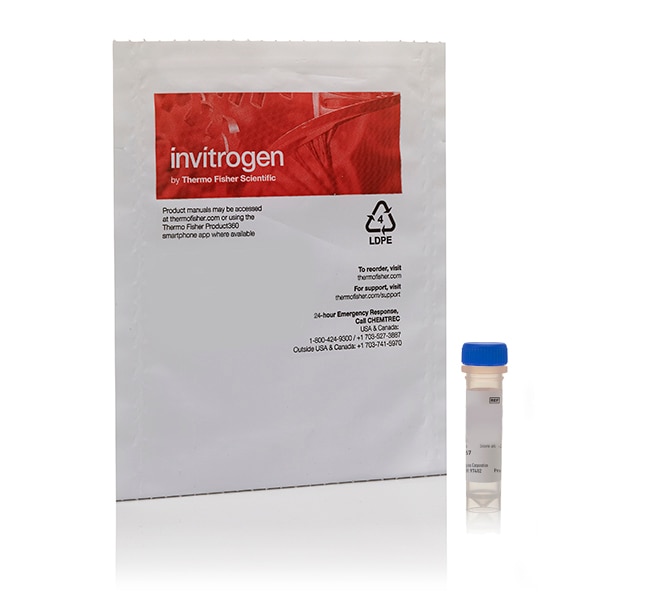
NeuroTrace™ Nissl 500/525绿色荧光染色剂 - DMSO 溶液
NeuroTrace Nissl 绿色荧光染色剂(仅可从 Molecular Probes 购买)可与仅存在于神经元细胞胞体中的 Nissl 物质结合了解更多信息
| 货号 | 数量 |
|---|---|
| N21480 | 1 mL |
货号 N21480
价格(CNY)
2,868.00
飞享价
Ends: 31-Dec-2026
3,982.00共减 1,114.00 (28%)
Each
数量:
1 mL
价格(CNY)
2,868.00
飞享价
Ends: 31-Dec-2026
3,982.00共减 1,114.00 (28%)
Each
NeuroTrace Nissl 绿色荧光染色剂(仅可从 Molecular Probes 购买)可与仅存在于神经元细胞胞体中的 Nissl 物质结合。NeuroTrace Nissl 染色剂呈现明亮的绿色荧光,可以用适合荧光素的滤光片观察,且比甲酚紫染色法的灵敏度高很多倍。NeuroTrace Nissl 绿色荧光染色剂是对经典的 FluoroNissl Green 染料的改进。
仅供科研使用。不可用于诊断程序。
规格
颜色绿色
检测方法荧光
适用于(设备)荧光显微镜
产品类型尼氏染色
数量1 mL
运输条件室温
子细胞定位尼氏体
激发/发射500/525 nm
产品线NEUROTRACE
Unit SizeEach
内容与储存
储存在冰箱(-5 至 -30°C)中并避光。
常见问题解答 (FAQ)
我可以使用NeuroTrace Nissl 染色剂染色胶质或其他类型细胞,该如何改善染色效果,使其对神经元的选择性更强?
NeuroTrace Nissl染色剂可染色石蜡切片吗?
NeuroTrace Nissl 染色剂是什么?
你们有哪些神经元示踪产品?
I am labeling brain cryosections with a NeuroTrace Nissl Stain. Is this compatible with antibody labeling?
引用和文献 (22)
引用和文献
Abstract
Beyond the olfactory bulb: an odotopic map in the forebrain.
Journal:Proc Natl Acad Sci U S A
PubMed ID:16339016
'We report electrophysiological evidence that a simple odotopy, the spatial mapping of different odorants, is maintained above the level of the olfactory bulb (OB). Three classes of biologically relevant odorants for fish are processed in distinct regions of the forebrain (FB) in the channel catfish. Feeding cues, mainly amino acids
JNK-mediated induction of cyclooxygenase 2 is required for neurodegeneration in a mouse model of Parkinson's disease.
Journal:Proc Natl Acad Sci U S A
PubMed ID:14704277
'Parkinson''s disease (PD) is a neurodegenerative disorder characterized by loss of dopamine-containing neurons, but the molecular pathways underlying its pathogenesis remain uncertain. Here, we show that by eliminating c-Jun N-terminal kinases (JNKs) we can prevent neurodegeneration and improve motor function in an animal model of PD. First, we found that
Defects in pancreatic development and glucose metabolism in SMN-depleted mice independent of canonical spinal muscular atrophy neuromuscular pathology.
Journal:
PubMed ID:24497575
Spinal muscular atrophy (SMA) is characterized by motor neuron loss, caused by mutations or deletions in the ubiquitously expressed survival motor neuron 1 (SMN1) gene. We recently identified a novel role for Smn protein in glucose metabolism and pancreatic development in both an intermediate SMA mouse model (Smn(2B/-)) and type
Cortical control of adaptation and sensory relay mode in the thalamus.
Journal:
PubMed ID:24748112
A major synaptic input to the thalamus originates from neurons in cortical layer 6 (L6); however, the function of this cortico-thalamic pathway during sensory processing is not well understood. In the mouse whisker system, we found that optogenetic stimulation of L6 in vivo results in a mixture of hyperpolarization and
High-throughput morphometric analysis of individual neurons.
Journal:Cereb Cortex
PubMed ID:15054070
To facilitate high-throughput quantitative analysis of neuronal structure, this study optimized the diOlistic method of whole neuron labeling to examine multiple neurons in fixed brain, and optimized image acquisition parameters to preserve signal for subsequent photoconversion. Fluorescent dye-coated gold particles were successively delivered by helium-powered ejection to 250 microm thick