Search


引用和文献 (22)
Invitrogen™
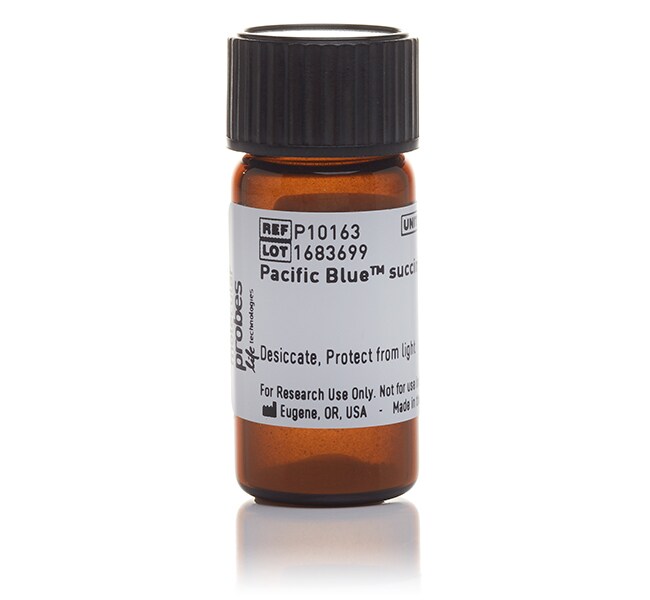
Pacific Blue™ 琥珀酰亚胺酯
Pacific Blue™ 琥珀酰亚胺酯
| 货号 | 数量 |
|---|---|
| P10163 | 5 mg |
货号 P10163
价格(CNY)
5,354.00
Each
数量:
5 mg
价格(CNY)
5,354.00
Each
The amine-reactive Pacific Blue™ succinimidyl ester can be used to can be used to create blue-fluorescent bioconjugates with excitation/emission maxima ∼410/455 nm that are excitable by the 405 nm spectral line of the blue diode (violet) laser.
Related Links:
- View all Pacific Blue™ dye products..
- View the Fluorophore Selection Guide.
胺反应性 Pacific Blue™ 琥珀酰亚胺酯可用于生成蓝色荧光生物偶联物,最大激发/发射波长 ∼410/455 nm,其由 405 nm 蓝色二极管(紫色)激光光谱线激发。
查看所有 Pacific Blue™ 染料产品。
查看荧光基团选择指南。
查看所有 Pacific Blue™ 染料产品。
查看荧光基团选择指南。
仅供科研使用。不可用于诊断程序。
规格
化学反应性胺
检测方法荧光
发射451
激发416
流式细胞仪激光线路405
产品规格实心
标签或染料Pacific Blue™
产品类型琥珀酰亚胺酯
数量5 mg
反应一部分活性酯、琥珀酰亚胺酯
运输条件室温
溶解度DMSO(二甲亚砜)
标签类型Pacific 染料
产品线Pacific Blue
Unit SizeEach
内容与储存
包含 1 小瓶 (1 mg)。 储存在冰箱中 (-5 - -30°C) 并避光。
引用和文献 (22)
引用和文献
Abstract
Tyramide signal amplification for analysis of kinase activity by intracellular flow cytometry.
Journal:Cytometry A
PubMed ID:20824632
'Intracellular flow cytometry permits quantitation of diverse molecular targets at the single-cell level. However, limitations in detection sensitivity inherently restrict the method, sometimes resulting in the inability to measure proteins of very low abundance or to differentiate cells expressing subtly different protein concentrations. To improve these measurements, an enzymatic amplification
Reduction in muscle fibre number during the adaptive radiation of notothenioid fishes: a phylogenetic perspective.
Journal:J Exp Biol
PubMed ID:12819266
'The fish fauna of the continental shelf of the Southern Ocean is dominated by a single sub-order of Perciformes, the Notothenioidei, which have unusually large diameter skeletal muscle fibres. We tested the hypothesis that in fast myotomal muscle a high maximum fibre diameter (FD(max)) was related to a reduction in
Cytoskeletal-assisted dynamics of the mitochondrial reticulum in living cells.
Journal:Proc Natl Acad Sci U S A
PubMed ID:12417764
'Subcellular organelle dynamics are strongly influenced by interactions with cytoskeletal filaments and their associated motor proteins, and lead to complex multiexponential relaxations that occur over a wide range of spatial and temporal scales. Here we report spatio-temporal measurements of the fluctuations of the mitochondrial reticulum in osteosarcoma cells by using
High-content single-cell drug screening with phosphospecific flow cytometry.
Journal:Nat Chem Biol
PubMed ID:18157122
'Drug screening is often limited to cell-free assays involving purified enzymes, but it is arguably best applied against systems that represent disease states or complex physiological cellular networks. Here, we describe a high-content, cell-based drug discovery platform based on phosphospecific flow cytometry, or phosphoflow, that enabled screening for inhibitors against
Fluorescent cell barcoding in flow cytometry allows high-throughput drug screening and signaling profiling.
Journal:Nat Methods
PubMed ID:16628206
'Flow cytometry allows high-content, multiparameter analysis of single cells, making it a promising tool for drug discovery and profiling of intracellular signaling. To add high-throughput capacity to flow cytometry, we developed a cell-based multiplexing technique called fluorescent cell barcoding (FCB). In FCB, each sample is labeled with a different signature,