Search


引用和文献 (1088)
Invitrogen™
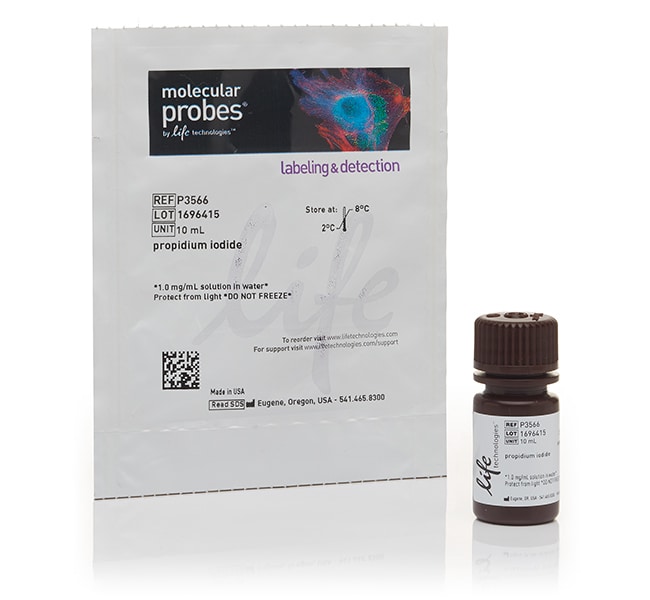
碘化丙啶 - 1.0 mg/mL 水溶液
碘化丙啶 (PI) 是一种常用的红色荧光细胞核和染色体复染剂。由于碘化丙啶不能渗透到活细胞中,也通常用于检测群体中的死细胞。PI 通过在碱基之间进行插入而与 DNA 结合,几乎没有序列偏好。在水溶液中,该染料的上限激发/发射波长为 493/636了解更多信息
| 货号 | 数量 |
|---|---|
| P3566 | 10 mL |
货号 P3566
价格(CNY)
982.00
飞享价
Ends: 31-Dec-2026
1,413.00共减 431.00 (31%)
Each
数量:
10 mL
价格(CNY)
982.00
飞享价
Ends: 31-Dec-2026
1,413.00共减 431.00 (31%)
Each
碘化丙啶 (PI) 是一种常用的红色荧光细胞核和染色体复染剂。由于碘化丙啶不能渗透到活细胞中,也通常用于检测群体中的死细胞。
PI 通过在碱基之间进行插入而与 DNA 结合,几乎没有序列偏好。在水溶液中,该染料的上限激发/发射波长为 493/636 nm。一旦染料被结合,其荧光增强20至30倍,荧光上限激发波长向红色偏移 ∼30–40 nm,荧光上限发射波长向蓝色偏移 ∼15 nm,使得上限激发波长为 535 nm,荧光上限发射波长为 617 nm。
PI 广泛用于荧光显微镜检查、共聚焦激光扫描显微镜、流式细胞分析和荧光测定法。
了解关于碘化丙啶和含碘化丙啶产品的更多信息
PI 通过在碱基之间进行插入而与 DNA 结合,几乎没有序列偏好。在水溶液中,该染料的上限激发/发射波长为 493/636 nm。一旦染料被结合,其荧光增强20至30倍,荧光上限激发波长向红色偏移 ∼30–40 nm,荧光上限发射波长向蓝色偏移 ∼15 nm,使得上限激发波长为 535 nm,荧光上限发射波长为 617 nm。
PI 广泛用于荧光显微镜检查、共聚焦激光扫描显微镜、流式细胞分析和荧光测定法。
了解关于碘化丙啶和含碘化丙啶产品的更多信息
仅供科研使用。不可用于诊断程序。
规格
检测方法荧光
染料类型碘化丙啶
形式溶液
数量10 mL
运输条件室温
子细胞定位细胞质&细胞溶质
发射波长范围533⁄617
适用于(应用)活力测定试剂盒
适用于(设备)荧光显微镜, 流式细胞仪
产品类型碘化丙啶
Unit SizeEach
内容与储存
含1瓶碘化丙啶(1.0 mg/mL 水溶液)。
避光储存在冷藏冰箱 (2–8°C) 中。
避光储存在冷藏冰箱 (2–8°C) 中。
常见问题解答 (FAQ)
I have a LIVE/DEAD BacLight Bacterial Viability kit that has SYTO 9 and propidium iodide in it. Will I be able to stain eukaryotic cells that have engulfed bacteria and determine if the bacteria are alive or dead using this kit?
Is propidium iodide (PI) fixable with glutaraldehyde or paraformaldehyde (PFA)?
引用和文献 (1088)
引用和文献
Abstract
Signaling through MHC class II molecules blocks CD95-induced apoptosis.
Journal:Journal of immunology (Baltimore, Md. : 1950)
PubMed ID:11342618
Glutamate and non-glutamate receptor mediated toxicity caused by oxygen and glucose deprivation in organotypic hippocampal cultures.
Journal:J Neurosci
PubMed ID:7472521
In vitro ischemia models have utilized oxygen, or oxygen and glucose deprivation to simulate ischemic neuronal injury. Combined oxygen and glucose deprivation can induce neuronal damage which is in part mediated through NMDA receptors. Severe oxygen deprivation alone however can cause neuronal injury which is not NMDA mediated. We tested
Identification and characterization of two subpopulations of Encephalitozoon intestinalis.
Journal:Appl Environ Microbiol
PubMed ID:12902292
Microsporidia are obligate intracellular protozoa that have been shown to be pathogenic to most living creatures. The development of in vitro cell culture propagation methods has provided researchers with large numbers of spores and facilitated the study of these organisms. Here, we describe heterogeneity within cell culture-propagated Encephalitozoon intestinalis suspensions.
Autoantigens targeted in systemic lupus erythematosus are clustered in two populations of surface structures on apoptotic keratinocytes.
Journal:J Exp Med
PubMed ID:7511686
'Systemic lupus erythematosus is a multisystem autoimmune disease in which the autoantibody response targets a variety of autoantigens of diverse subcellular location. We show here that these autoantigens are clustered in two distinct populations of blebs at the surface of apoptotic cells. The population of smaller blebs contains fragmented endoplasmic
Caspase activation contributes to delayed death of heat-stressed striatal neurons.
Journal:J Neurochem
PubMed ID:14622126
'Hyperthermia can contribute to brain damage both during development and post-natally. We used rat embryonic striatal neurons in culture to study mechanisms underlying hyperthermia-induced neuronal death. Heat stress at 43 degrees C for 2 h produced no obvious signs of damage during the first 12 h after the stress, but