Search


引用和文献 (4)
Invitrogen™
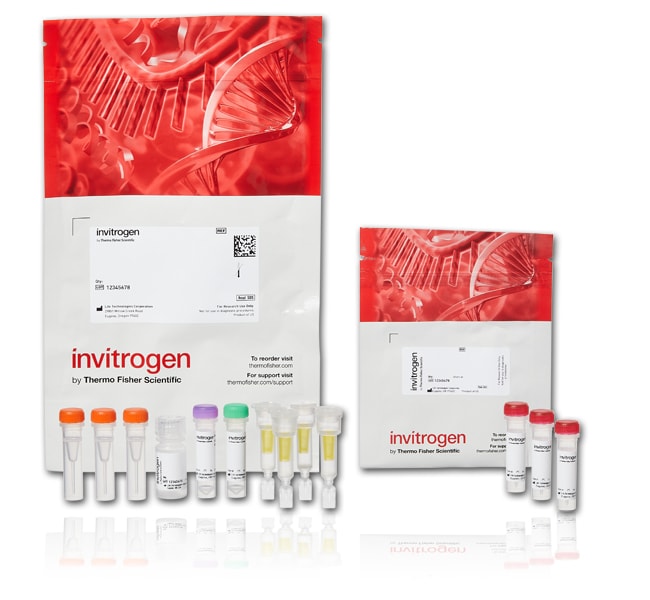
pHrodo™ Antibody Labeling Kits
pHrodo Deep Red 抗体标记试剂盒提供了轻松标记和纯化抗体以进行抗体内化研究所需的材料。胺反应性 pHrodo Deep Red 染料与抗体共价结合,产生仅在酸性环境中发荧光的明亮的可溶性偶联物。pHrodo了解更多信息
Have Questions?
更改视图

| 货号 | 数量 | 激发/发射 | 标签或染料 |
|---|---|---|---|
| P36014 | 1 个试剂盒 | 560/585 | pHrodo Red |
| P35355 | 3 x 100 μg 反应 | 640/655 | pHrodo 深红色 |
| P35356 | 3 x 1 mg 反应 | 640/655 | pHrodo 深红色 |
| P36020 | 3 x 100 μg 反应 | 560/585 nm | pHrodo Red |
| P36021 | 3 x 1 mg | 560/585 nm | pHrodo Red |
| P36022 | 3 x 100 μg 反应 | 505/525 nm | pHrodo Green |
| P36023 | 3 x 1 mg | 505/525 nm | pHrodo Green |
| P36015 | 1 个试剂盒 | 505/525 nm | pHrodo Green |
货号 P36014
价格(CNY)
8,498.00
Each
数量:
1 个试剂盒
激发/发射:
560/585
标签或染料:
pHrodo Red
价格(CNY)
8,498.00
Each
pHrodo Deep Red 抗体标记试剂盒提供了轻松标记和纯化抗体以进行抗体内化研究所需的材料。胺反应性 pHrodo Deep Red 染料与抗体共价结合,产生仅在酸性环境中发荧光的明亮的可溶性偶联物。pHrodo Deep Red 标记试剂盒使研究抗体内化比以往更容易,结果确定性更高且优化步骤更少,因为 pHrodo Deep Red 染料仅在晚期内体和溶酶体中发荧光。
pHrodo Deep Red 抗体标记试剂盒特点包括:
•出色的信号窗口—中性 pH 值条件下背景极低,能够实现较大信噪比以提高结果确定性
• 多重— Cy5 通道可进行多色实验
• 低 pKa—可消除来自非内化物质的非特异性信号,并且仅在晚期内体和溶酶体中发荧光
• 便利—标记通常需要 2 小时,手动操作时间少于 30 min
pHrodo Deep Red 是一种低背景 pH 传感器染料,其在中性条件下不显示信号,并且仅在酸性环境中发荧光。这种独特的特性有助于实现快速检测开发,并提高研究抗体内化和内吞/吞噬途径时结果的确定性。pHrodo Deep Red 染料有助于更好地鉴别细胞外内化物质,因为其约 5 pKa,在进入晚期内体和溶酶体之前不会发荧光。pHrodo Deep Red 染料可使用 Cy5 荧光过滤器组进行检测,并经过验证可用于多种应用,包括流式细胞分析、荧光显微镜检测和高内涵分析 (HCA)。
了解更多关于 pHrodo 染料和抗体内化的信息。
了解更多关于抗体标记的信息›
pHrodo Deep Red 抗体标记试剂盒特点包括:
•出色的信号窗口—中性 pH 值条件下背景极低,能够实现较大信噪比以提高结果确定性
• 多重— Cy5 通道可进行多色实验
• 低 pKa—可消除来自非内化物质的非特异性信号,并且仅在晚期内体和溶酶体中发荧光
• 便利—标记通常需要 2 小时,手动操作时间少于 30 min
pHrodo Deep Red 是一种低背景 pH 传感器染料,其在中性条件下不显示信号,并且仅在酸性环境中发荧光。这种独特的特性有助于实现快速检测开发,并提高研究抗体内化和内吞/吞噬途径时结果的确定性。pHrodo Deep Red 染料有助于更好地鉴别细胞外内化物质,因为其约 5 pKa,在进入晚期内体和溶酶体之前不会发荧光。pHrodo Deep Red 染料可使用 Cy5 荧光过滤器组进行检测,并经过验证可用于多种应用,包括流式细胞分析、荧光显微镜检测和高内涵分析 (HCA)。
了解更多关于 pHrodo 染料和抗体内化的信息。
了解更多关于抗体标记的信息›
For Research Use Only. Not for human or animal therapeutic or diagnostic use.
规格
颜色红色
激发/发射560/585
适用于(应用)细胞分析
适用于(设备)高内涵分析仪
产品线pHrodo
产品类型蛋白标记试剂盒
数量1 个试剂盒
运输条件室温
足够用于3 个标记
标签或染料pHrodo Red
Unit SizeEach
内容与储存
在冰箱 (2–8°C) 中干燥避光储存,切勿冷冻。
引用和文献 (4)
引用和文献
Abstract
LILRA2 selectively modulates LPS-mediated cytokine production and inhibits phagocytosis by monocytes.
Journal:PLoS One
PubMed ID:22479404
'The activating immunoglobulin-like receptor, subfamily A, member 2 (LILRA2) is primarily expressed on the surface of cells of the innate immunity including monocytes, macrophages, neutrophils, basophils and eosinophils but not on lymphocytes and NK cells. LILRA2 cross-linking on monocytes induces pro-inflammatory cytokines while inhibiting dendritic cell differentiation and antigen presentation.
A Common Genetic Variation in Langerin (CD207) Compromises Cellular Uptake of Staphylococcus aureus.
Journal:J Innate Immun
PubMed ID:31141812
'Langerhans cells are key sentinel cells of the skin and mucosal lining. They sense microorganisms through their repertoire of pattern-recognition receptors to mount and direct appropriate immune responses. We recently demonstrated that human Langerhans cells interact with the Gram-positive pathogen Staphylococcus aureus through the Langerhans cell-specific receptor langerin (CD207). It
High Affinity Promotes Internalization of Engineered Antibodies Targeting FGFR1.
Journal:Int J Mol Sci
PubMed ID:29748524
Fibroblast growth factor receptor 1 (FGFR1) is a plasma membrane protein that transmits signals from the extracellular environment, regulating cell homeostasis and function. Dysregulation of FGFR1 leads to the development of human cancers and noncancerous diseases. Numerous tumors overproduce FGFR1, making this receptor a perspective target for cancer therapies. Antibody-drug
Novel Silyl Ether-Based Acid-Cleavable Antibody-MMAE Conjugates with Appropriate Stability and Efficacy.
Journal:Cancers (Basel)
PubMed ID:31288450
Antibody-drug conjugate (ADC) is a novel efficient drug delivery system that has been successfully used in clinical practice, and it has become a research hotspot in the anti-tumor drug field. Acid-cleavable linkers were first used in clinical ADCs, but their structural variety (e.g., hydrazone and carbonate) is still limited, and