Search


引用和文献 (6)
Invitrogen™
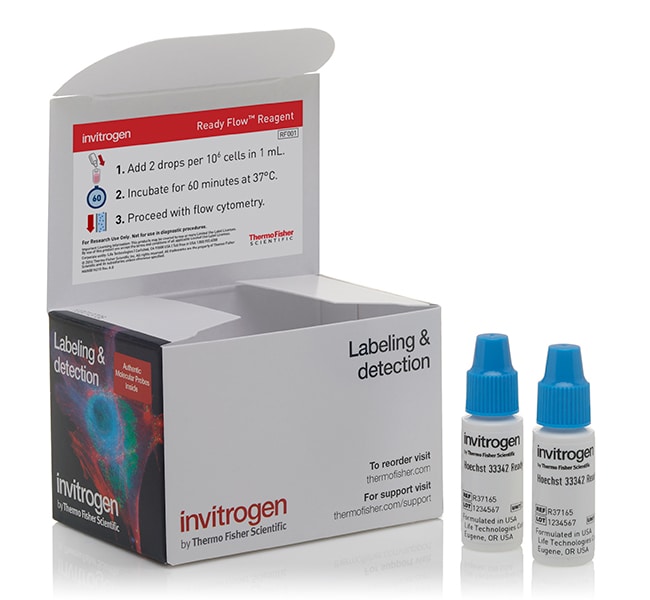
Hoechst 33342 Ready Flow™ 即用型染料
Hoechst 33342 Ready Flow™ 即用型染料是一种明亮且易于使用的细胞渗透性染料,适用于使用流式细胞仪分析细胞周期。当该染料与双链 DNA 结合时,会发出蓝色荧光,最大发射波长为 461 nm了解更多信息
| 货号 | 数量 |
|---|---|
| R37165 | 120 assays |
货号 R37165
价格(CNY)
1,944.00
飞享价
Ends: 31-Dec-2026
2,582.00共减 638.00 (25%)
Each
数量:
120 assays
价格(CNY)
1,944.00
飞享价
Ends: 31-Dec-2026
2,582.00共减 638.00 (25%)
Each
Hoechst 33342 Ready Flow™ 即用型染料是一种明亮且易于使用的细胞渗透性染料,适用于使用流式细胞仪分析细胞周期。当该染料与双链 DNA 结合时,会发出蓝色荧光,最大发射波长为 461 nm。
•在室温下稳定
•方便、即用型—无需稀释、称重或移液
•具有细胞渗透性,可对固定细胞或活细胞高效染色
Hoechst 33342 Ready Flow 即用型染料是一种细胞渗透性的蓝色荧光 DNA 染料,用于细胞周期分析。从滴瓶中直接向 1 x 10⁶ 细胞中滴加 2 滴染料,孵育并分析。
Hoechst 33342 即用型染料优先与双链 DNA 的腺嘌呤-胸腺嘧啶区域结合。染料结合到 DNA 的小凹槽后,发射出明显的荧光光谱,荧光强度取决于染料:碱基对比例。Hoechst 33342 Ready Flow 即用型染料由紫外光激发,在 460 nm 处有发射峰。
•在室温下稳定
•方便、即用型—无需稀释、称重或移液
•具有细胞渗透性,可对固定细胞或活细胞高效染色
Hoechst 33342 Ready Flow 即用型染料是一种细胞渗透性的蓝色荧光 DNA 染料,用于细胞周期分析。从滴瓶中直接向 1 x 10⁶ 细胞中滴加 2 滴染料,孵育并分析。
Hoechst 33342 即用型染料优先与双链 DNA 的腺嘌呤-胸腺嘧啶区域结合。染料结合到 DNA 的小凹槽后,发射出明显的荧光光谱,荧光强度取决于染料:碱基对比例。Hoechst 33342 Ready Flow 即用型染料由紫外光激发,在 460 nm 处有发射峰。
规格
颜色蓝色
染料类型细胞通透性
激发波长范围361/497
产品线Ready Flow
数量120 assays
产品类型核酸染色剂
亚细胞定位细胞核/核仁
Unit SizeEach
内容与储存
2 个滴瓶,在室温下储存
常见问题解答 (FAQ)
Is DAPI a good live-cell nuclear label?
I want to label the nuclei of live cells and track them over time. Can I use DAPI for this?
I would like to label only 100 µL of sample of the same cell density using a Ready Flow product. The manual notes 2 drops per 1 mL (1 X 10E6 cells/mL). May I scale down for smaller volumes?
What is the concentration of dye/reagent in the Ready Flow products?
Can I use the ReadyProbes reagents for flow cytometry?
引用和文献 (6)
引用和文献
Abstract
Sphingosine-1-phosphate mediates the therapeutic effects of bone marrow mesenchymal stem cell-derived microvesicles on articular cartilage defect.
Journal:Transl Res
PubMed ID:29324234
'Microvesicles (MVs) are emerging as a new mechanism of intercellular communication by transferring cellular components to target cells, yet their function in disease is just being explored. However, the therapeutic effects of MVs in cartilage injury and degeneration remain unknown. We found MVs contained high levels of sphingosine-1-phosphate (S1P) compared
The Importance of Multifrequency Impedance Sensing of Endothelial Barrier Formation Using ECIS Technology for the Generation of a Strong and Durable Paracellular Barrier.
Journal:Biosensors (Basel)
PubMed ID:29973526
'In this paper, we demonstrate the application of electrical cell-substrate impedance sensing (ECIS) technology for measuring differences in the formation of a strong and durable endothelial barrier model. In addition, we highlight the capacity of ECIS technology to model the parameters of the physical barrier associated with (I) the paracellular
Diverse Signaling by TGFß Isoforms in Response to Focal Injury is Associated with Either Retinal Regeneration or Reactive Gliosis.
Journal:Cell Mol Neurobiol
PubMed ID:32219603
'Müller cells may have stem cell-like capability as they regenerate photoreceptor loss upon injury in some vertebrates, but not in mammals. Indeed, mammalian Müller cells undergo major cellular and molecular changes summarized as reactive gliosis. Transforming growth factor beta (TGFß) isoforms are multifunctional cytokines that play a central role, both
ECIS technology reveals that monocytes isolated by CD14+ve selection mediate greater loss of BBB integrity than untouched monocytes, which occurs to a greater extent with IL-1ß activated endothelium in comparison to TNFa.
Journal:PLoS One
PubMed ID:28732059
We have previously shown that TNFa and IL-1ß differentially regulate the inflammatory phenotype of human brain endothelial cells (hCMVECs). In this regard, IL-1ß treatment was considerably more potent than TNFa at increasing expression of inflammatory chemokines and leukocyte adhesion molecules. We therefore hypothesised that interaction of the hCMVECs with human
Colloid chemistry pitfall for flow cytometric enumeration of viruses in water.
Journal:Water Res X
PubMed ID:31194069
Flow cytomtery (FCM) has become a standard approach to enumerate viruses in water research. However, the nature of the fluorescent signal in flow cytometric analysis of water samples and the mechanism of its formation, have not been addressed for bacteriophages expected in wastewaters. Here we assess the behaviour of fluorescent