Search


引用和文献 (4)
Invitrogen™
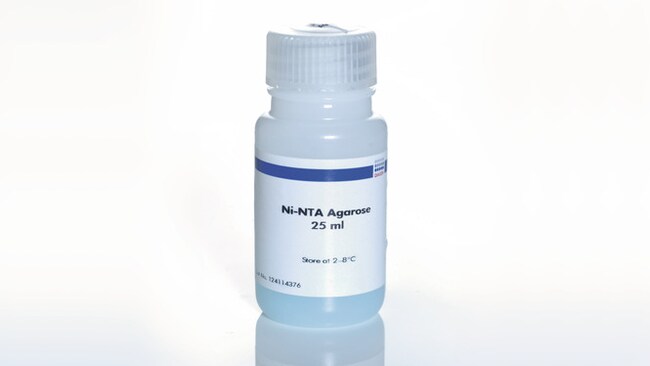
Ni-NTA 琼脂糖
Ni-NTA 琼脂糖是含镍的亲和树脂,可用于纯化含有多组氨酸 (6xHis) 序列的重组蛋白质。 用低 pH 缓冲液或者通过咪唑或组氨酸的竞争洗脱树脂上结合的蛋白质。 可在天然和变性条件下进行一步法纯化了解更多信息
Have Questions?
更改视图

| 货号 | 数量 |
|---|---|
| R90101 | 10 mL |
| R90115 | 25 mL |
| R90110 | 100 mL |
货号 R90101
价格(CNY)
3,247.00
Each
数量:
10 mL
价格(CNY)
3,247.00
Each
Ni-NTA 琼脂糖是含镍的亲和树脂,可用于纯化含有多组氨酸 (6xHis) 序列的重组蛋白质。 用低 pH 缓冲液或者通过咪唑或组氨酸的竞争洗脱树脂上结合的蛋白质。 可在天然和变性条件下进行一步法纯化。 Ni-NTA 使用与高度交联的 6% 琼脂糖树脂偶联的螯合配体氮川三乙酸 (NTA),这种琼脂糖树脂适用于批量和重力流应用。
仅供科研使用。不可用于诊断程序。
规格
数量10 mL
固定相Ni-NTA
色谱柱类型亲和柱
形式悬浮
类型琼脂糖
Unit SizeEach
内容与储存
预先装入 Ni-NTA 树脂,每 1 mL 树脂能够结合多达 50 mg 重组蛋白。以 30% 乙醇中的 50% 浆液提供。带有双价镍电荷 (Ni2+) 时,树脂将呈蓝色。储存在 +4°C 下。妥善储存时,保证 Ni-NTA 树脂稳定储存 6 个月。
常见问题解答 (FAQ)
Are there other sequences that can bind to nickel more tightly than 6xHis-tagged proteins and how can they be eluted.
Can ProBond or Ni-NTA beads be used for large-scale preparations?
What should the typical protein recovery be when using the Probond Purification System or Ni-NTA Purification system?
引用和文献 (4)
引用和文献
Abstract
A protein kinase encoded by the t complex responder gene causes non-mendelian inheritance
Journal:Nature
PubMed ID:10647005
'Males heterozygous for the t-haplotype form of mouse chromosome 17 preferentially transmit the t-chromosome to their progeny. Several distorter/sterility loci carried on the t-haplotype together impair flagellar function in all spermatozoa whereas the responder, Tcr, rescues t-sperm but not wild-type sperm. Thus, t-sperm have anadvantage over wild-type sperm in fertilizing
DNA Polymerase lambda, a Novel DNA Repair Enzyme in Human Cells.
Journal:J Biol Chem
PubMed ID:11821417
'DNA polymerase lambda (pol lambda) is a novel family X DNA polymerase that has been suggested to play a role in meiotic recombination and DNA repair. The recent demonstration of an intrinsic 5''-deoxyribose-5-phosphate lyase activity in pol lambda supports a function of this enzyme in base excision repair. However, the
A ribozyme that ligates RNA to protein.
Journal:Proc Natl Acad Sci U S A
PubMed ID:12077317
'We have used a combination of in vitro selection and rational design to generate ribozymes that form a stable phosphoamide bond between the 5'' terminus of an RNA and a specific polypeptide. This reaction differs from that of previously identified ribozymes, although the product is analogous to the enzyme-nucleotidyl intermediates
Transduction of MIN6 beta Cells with TAT-Syntaxin SNARE Motif Inhibits Insulin Exocytosis in Biphasic Insulin Release in a Distinct Mechanism Analyzed by Evanescent Wave Microscopy.
Journal:J Biol Chem
PubMed ID:12393909
To investigate the in vivo interaction of syntaxin-mediated soluble N-ethylmaleimide-sensitive fusion protein attachment protein receptor (SNARE) assembly and insulin exocytosis in biphasic release, we examined the dynamics of insulin granule motion such as docking and fusion with the plasma membrane when the syntaxin SNARE motif (H3 domain) was transduced into