Search


引用和文献 (4)
Invitrogen™
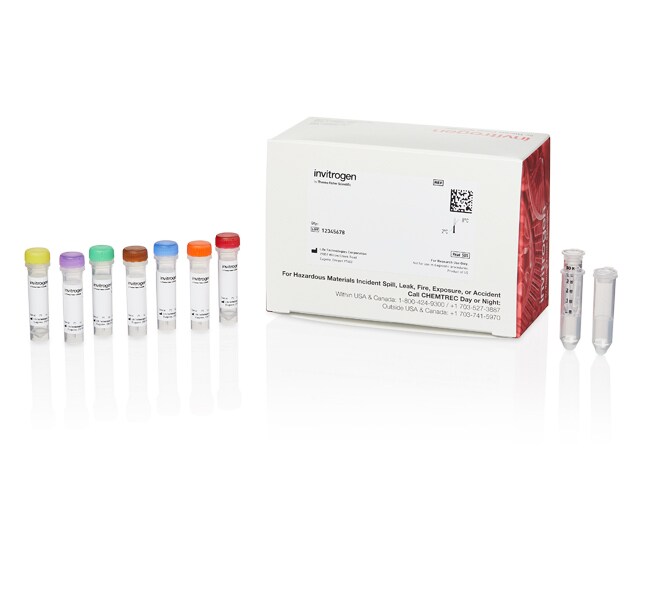
SiteClick™ R-PE 抗体标记试剂盒
使用 SiteClick™ R-PE 抗体标记试剂盒创建一个完全标记抗体。与传统的抗体标记试剂盒不同,SiteClick™ 标记可以特异性地将标记连接至 IgG 抗体的重链上,确保抗原结合结构域仍可与抗原靶标结合。该位点选择性是通过靶向基本上所有 IgG了解更多信息
| 货号 | 数量 |
|---|---|
| S10467 | 1 kit |
货号 S10467
价格(CNY)
7,164.00
Each
数量:
1 kit
价格(CNY)
7,164.00
Each
使用 SiteClick™ R-PE 抗体标记试剂盒创建一个完全标记抗体。与传统的抗体标记试剂盒不同,SiteClick™ 标记可以特异性地将标记连接至 IgG 抗体的重链上,确保抗原结合结构域仍可与抗原靶标结合。该位点选择性是通过靶向基本上所有 IgG 抗体(不考虑同种型和宿主种类)上存在的碳水化合物结构域而实现的。根据标记,得到的 SiteClick™ 标记抗体可用于流式细胞分析或任何其他应用。
SiteClick™ R-PE 抗体标记试剂盒的重要特点:
•包含标记 100 μg IgG 抗体所需的一切成分
•易于遵循逐步方案
•高效、位点特异性、可重现的标记化学产生高质量抗体偶联物。
R-PE(R-藻红蛋白)为明亮标记
R-藻红蛋白 (R-PE) 是一种从红藻中提取的明亮藻胆蛋白。其一级吸收(激发)峰在 565 nm 处,二级峰在 496 和 545 nm 处。宽激发光谱和极明亮的荧光(最大发射波长 = 约 578 nm)使其成为免疫细胞化学(尤其是流式细胞分析和细胞分选 (FACS))应用中多通路技术的有用标记。
了解更多关于蛋白和抗体标记的信息
我们可提供多种可供选择的 Molecular Probes® 抗体和蛋白标记试剂盒(参见 A 至 Z 的抗体标记)。要了解更多关于不同试剂盒的信息,请阅读 Molecular Probes® 手册中标记蛋白和核酸的试剂盒—第 1.2 节。
定制 SiteClick™ 抗体标记服务
如果您有一种被视为“难以标记”或在使用传统方法标记后失去活性的抗体,请联系我们的定制服务代表,以确定 SiteClick™ 抗体标记服务是否适用于您的抗体。我们提供完整的定制 SiteClick™ 抗体标记服务,有多种检测分子可供选择,包括生物素、Alexa Fluor® 染料、Qdot® 荧光基团、R-PE 和许多其他选择。
SiteClick™ R-PE 抗体标记试剂盒的重要特点:
•包含标记 100 μg IgG 抗体所需的一切成分
•易于遵循逐步方案
•高效、位点特异性、可重现的标记化学产生高质量抗体偶联物。
R-PE(R-藻红蛋白)为明亮标记
R-藻红蛋白 (R-PE) 是一种从红藻中提取的明亮藻胆蛋白。其一级吸收(激发)峰在 565 nm 处,二级峰在 496 和 545 nm 处。宽激发光谱和极明亮的荧光(最大发射波长 = 约 578 nm)使其成为免疫细胞化学(尤其是流式细胞分析和细胞分选 (FACS))应用中多通路技术的有用标记。
了解更多关于蛋白和抗体标记的信息
我们可提供多种可供选择的 Molecular Probes® 抗体和蛋白标记试剂盒(参见 A 至 Z 的抗体标记)。要了解更多关于不同试剂盒的信息,请阅读 Molecular Probes® 手册中标记蛋白和核酸的试剂盒—第 1.2 节。
定制 SiteClick™ 抗体标记服务
如果您有一种被视为“难以标记”或在使用传统方法标记后失去活性的抗体,请联系我们的定制服务代表,以确定 SiteClick™ 抗体标记服务是否适用于您的抗体。我们提供完整的定制 SiteClick™ 抗体标记服务,有多种检测分子可供选择,包括生物素、Alexa Fluor® 染料、Qdot® 荧光基团、R-PE 和许多其他选择。
仅供科研使用。不可用于诊断程序。
规格
颜色橙红色
激发/发射496、546、565/578
流式细胞仪激光线路蓝色、绿色、黄色
标记方法SiteClick 标记系统
标记规模100 μg
产品线SiteClick
产品类型Labeling Kit
数量1 kit
运输条件湿冰
标记目标IgG
标签或染料R-PE(R-藻红蛋白)
Unit SizeEach
内容与储存
包含叠氮基修饰和标记 100 µg 抗体所需的一切组分。 接收后将整个试剂盒储存于 2 至 6°C 下。
常见问题解答 (FAQ)
I need to label my tissue section with two mouse primary antibodies. Do I have to make direct conjugates of the antibodies to use them?
引用和文献 (4)
引用和文献
Abstract
Enzyme-mediated methodology for the site-specific radiolabeling of antibodies based on catalyst-free click chemistry.
Journal:
PubMed ID:23688208
'An enzyme- and click chemistry-mediated methodology for the site-selective radiolabeling of antibodies on the heavy chain glycans has been developed and validated. To this end, a model system based on the prostate specific membrane antigen-targeting antibody J591, the positron-emitting radiometal (89)Zr, and the chelator desferrioxamine has been employed. The methodology
Targeting the CXCR4 pathway using a novel anti-CXCR4 IgG1 antibody (PF-06747143) in chronic lymphocytic leukemia.
Journal:J Hematol Oncol
PubMed ID:28526063
'The CXCR4-CXCL12 axis plays an important role in the chronic lymphocytic leukemia (CLL)-microenvironment interaction. Overexpression of CXCR4 has been reported in different hematological malignancies including CLL. Binding of the pro-survival chemokine CXCL12 with its cognate receptor CXCR4 induces cell migration. CXCL12/CXCR4 signaling axis promotes cell survival and proliferation and may
Actin-Related Protein 2 (ARP2) and Virus-Induced Filopodia Facilitate Human Respiratory Syncytial Virus Spread.
Journal:PLoS Pathog
PubMed ID:27926942
Human respiratory syncytial virus (RSV) is an enveloped RNA virus that is the most important viral cause of acute pediatric lower respiratory tract illness worldwide, and lacks a vaccine or effective antiviral drug. The involvement of host factors in the RSV replicative cycle remains poorly characterized. A genome-wide siRNA screen
Donor-derived cell-free DNA detects kidney transplant rejection during nivolumab treatment.
Journal:J Immunother Cancer
PubMed ID:31300068
In solid organ transplant (SOT) recipients, transplant rejection during immune checkpoint inhibitor (ICI) treatment for cancer is a clinical problem. Donor-derived cell-free DNA (dd-cfDNA) can be detected in blood and is a sensitive biomarker for diagnosis of acute rejection in SOT recipients. To our best knowledge, this is the first