Search


引用和文献 (2)
Invitrogen™
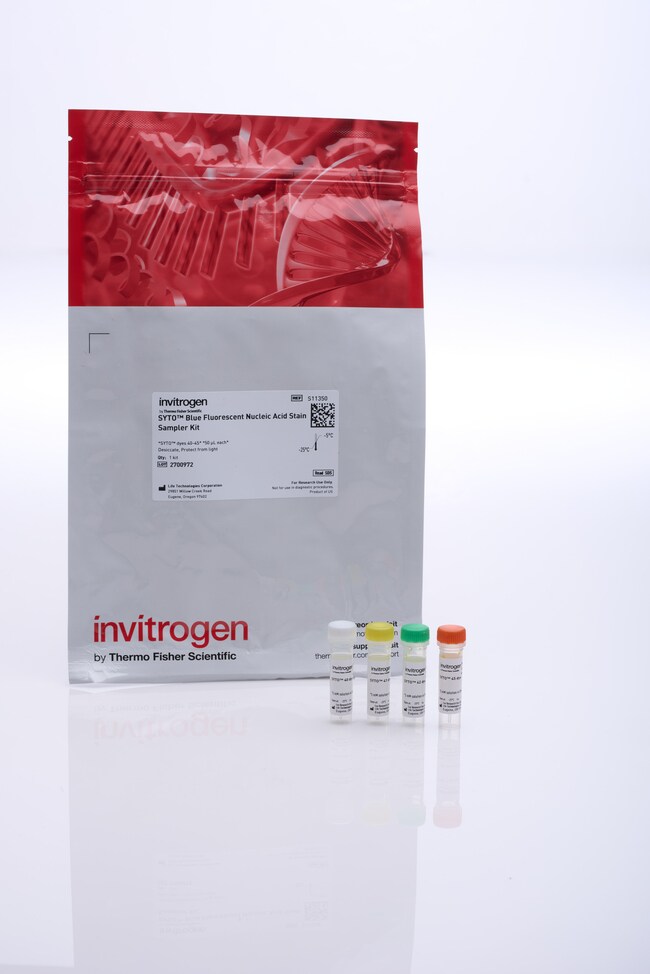
SYTO™ 蓝色荧光核酸染色剂采样试剂盒(SYTO™ 染料40、41、42、45)
包括细胞通透性蓝色荧光 SYTO 染料
| 货号 | 数量 |
|---|---|
| S11350 | 1 kit |
货号 S11350
价格(CNY)
4,971.00
飞享价
Ends: 31-Dec-2026
6,904.00共减 1,933.00 (28%)
Each
数量:
1 kit
价格(CNY)
4,971.00
飞享价
Ends: 31-Dec-2026
6,904.00共减 1,933.00 (28%)
Each
The SYTO Blue Fluorescent Nucleic Acid Stain Sampler Kit contains a collection of cell-permeant, blue-fluorescent SYTO nucleic acid stains (SYTO dyes 40, 41, 42, 45). Because the dyes may demonstrate different staining behaviors with various tissues and cells, it may be necessary to test the dyes to find the optimal dye for a specific application. The kit contains 50 μL of each SYTO dye.
Any physiological buffer between pH 7.0–8.0, including PBS, can be used to dilute the SYTO dyes for the staining solution.
SYTO 蓝色荧光核酸染色剂采样试剂盒包含一系列细胞通透性蓝色荧光 SYTO 核酸染色剂(SYTO® 染料40、41、42、45)。由于这些染料针对不同组织和细胞可能表现出不同染色行为,因此有必要对这类染料进行检测,以确定最适于特定应用的染料。该试剂盒每种 SYTO 染料含50μL。
仅供科研使用。不可用于诊断程序。
规格
颜色蓝色
检测方法荧光
染料类型细胞通透性
激发波长范围多种
适用于(设备)荧光显微镜
产品线SYTO
数量1 kit
运输条件室温
标签类型Fluorescent Dye
产品类型核酸染色剂
亚细胞定位核酸
Unit SizeEach
内容与储存
该试剂盒包含每种 SYTO 染料 50 μL。在冷冻冰箱(-5°C 至 -30°C)中避光储存。
常见问题解答 (FAQ)
这些染料如何与DNA结合?
How do SYTO dyes bind to DNA?
引用和文献 (2)
引用和文献
Abstract
Assessment of fluorochromes for two-photon laser scanning microscopy of biofilms.
Journal:Appl Environ Microbiol
PubMed ID:11823234
A major limitation for the use of two-proton laser scanning microscopy (2P-LSM) in biofilm and other studies is the lack of a thorough understanding of the excitation-emission responses of potential fluorochromes. In order to use 2P-LSM, the utility of various fluorochromes and probes specific for a range of biofilm constituents
Novel model for multispecies biofilms that uses rigid gas-permeable lenses.
Journal:Appl Environ Microbiol
PubMed ID:21421785
Oral biofilms comprise complex multispecies consortia aided by specific inter- and intraspecies interactions occurring among commensals and pathogenic bacterial species. Oral biofilms are primary initiating factors of periodontal disease, although complex multifactorial biological influences, including host cell responses, contribute to the individual outcome of the disease. To provide a system