Search


引用和文献 (4)
Invitrogen™
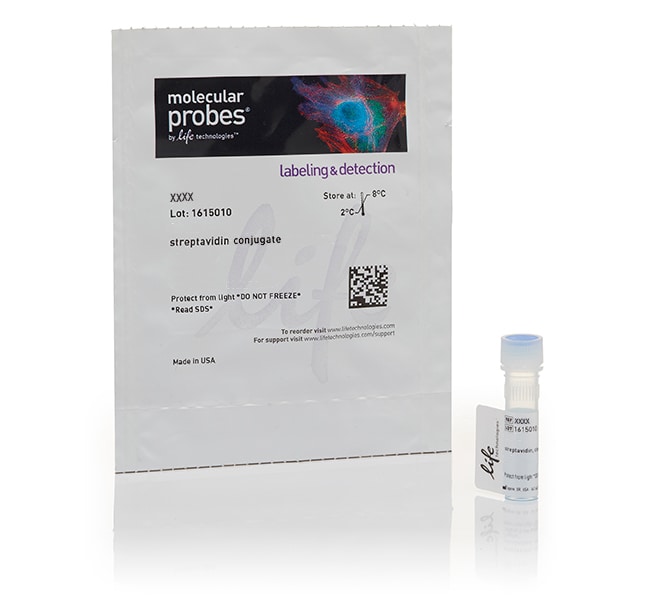
链霉素亲和素,Alexa Fluor™ 405 偶联物
我们的链霉素亲和素 Alexa Fluor 405 偶联物是一种明亮、光稳定的探针,最大激发/发射波长分别为 402 nm 和 421了解更多信息
| 货号 | 数量 |
|---|---|
| S32351 | 1 mg |
货号 S32351
价格(CNY)
4,770.00
Each
数量:
1 mg
价格(CNY)
4,770.00
Each
我们的链霉素亲和素 Alexa Fluor 405 偶联物是一种明亮、光稳定的探针,最大激发/发射波长分别为 402 nm 和 421 nm。链霉亲和素是一种非糖基化生物素结合蛋白,从细菌中分离所得,具有近中性等电点。由于经报道其非特异性结合比例比糖基化生物素结合蛋白(亲和素)更低,故广泛用于检测生物素化探针。
查看所有 Alexa Fluor™ 链霉亲和素-亲和素偶联物选择指南。
查看所有 Alexa Fluor™ 链霉亲和素-亲和素偶联物选择指南。
仅供科研使用。不可用于诊断程序。
规格
检测方法荧光
激发/发射402/421
流式细胞仪激光线路405
适用于(设备)流式细胞分析、免疫检测、组化应用、印迹分析
标签或染料Alexa Fluor 405
产品类型链霉素亲和素偶联物(荧光)
数量1 mg
运输条件室温
偶联物Alexa Fluor 405
形式实心
产品线Alexa Fluor
Unit SizeEach
内容与储存
包含 1 瓶链霉亲和素 Alexa Fluor™ 405 偶联物。
在冷冻冰箱(-5 至 -30°C)中避光储存。
在冷冻冰箱(-5 至 -30°C)中避光储存。
常见问题解答 (FAQ)
I am planning to use a fluorescent streptavidin labeled conjugate. What are the storage conditions and shelf life for the lyophilized powder and reconstituted solution?
I am planning to use a fluorescent streptavidin labeled conjugate. How should I prepare the working solution of the conjugate?
引用和文献 (4)
引用和文献
Abstract
Violet laser diodes in flow cytometry: an update.
Journal:Cytometry A
PubMed ID:17051581
INTRODUCTION: In previous studies we and others have demonstrated the usefulness of violet laser diodes (VLDs) as replacement laser sources for krypton-ion lasers on stream-in-air cytometers. Previously available VLDs had a maximum available power of less than 25 mW; this was sufficient for excitation of densely labeled cell surface antigens
Novel strategy to selectively label excitatory and inhibitory neurons in the cerebral cortex of mice.
Journal:J Neurosci Methods
PubMed ID:18321591
Revealing the connections of neuronal systems is critical for understanding how they function. The vast majority of neurons in all cortical areas consist of excitatory cells whose activity is controlled by inhibitory cells. Distribution and projection patterns of inhibitory and excitatory cells are key information to understand the organization of
Endosomal trafficking of the ligated FcvarepsilonRI receptor.
Journal:Mol Immunol
PubMed ID:18945491
In addition to initiating signaling cascades leading to mast cell mediator release, aggregation of the high affinity IgE receptor (FcvarepsilonRI) leads to rapid internalization of the cross-linked receptor. However, little is known about the trafficking of the internalized FcvarepsilonRI. Here we demonstrate that in RBL-2H3 cells, aggregated FcvarepsilonRI appears in
Inducible gene targeting in the neonatal vasculature and analysis of retinal angiogenesis in mice.
Journal:Nat Protoc
PubMed ID:20725067
The retina is a powerful experimental system for the analysis of angiogenic blood vessel growth in the postnatal organisms. The three-dimensional architecture of the vessel network and processes as diverse as endothelial cell (EC) proliferation, sprouting, perivascular cell recruitment, vessel remodeling or maturation can be investigated at high resolution. The