Search


引用和文献 (11)
Invitrogen™
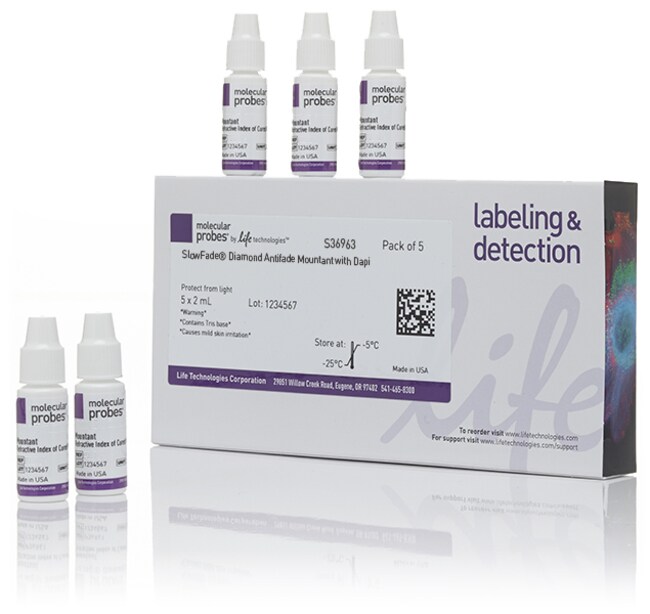
SlowFade™ Diamond 抗淬灭封片剂(含 DAPI)
SlowFade Diamond 抗淬灭封片剂是一种基于甘油的液体封片剂,直接应用于显微镜载玻片上的荧光标记细胞或组织样品。这种封片剂在整个可视光谱和红外光谱内提供优越的抗淬灭保护。SlowFade Diamond 封片剂可以用于几乎所有的荧光染料或荧光蛋白(如 GFP、RFP了解更多信息
Have Questions?
更改视图

| 货号 | 容积(公制) |
|---|---|
| S36964 | 5 x 2 mL |
| S36968 | 2 mL |
| S36973 | 10 mL |
货号 S36964
价格(CNY)
1,942.00
飞享价
Ends: 31-Dec-2026
2,696.00共减 754.00 (28%)
Each
容积(公制):
5 x 2 mL
价格(CNY)
1,942.00
飞享价
Ends: 31-Dec-2026
2,696.00共减 754.00 (28%)
Each
SlowFade Diamond 抗淬灭封片剂是一种基于甘油的液体封片剂,直接应用于显微镜载玻片上的荧光标记细胞或组织样品。这种封片剂在整个可视光谱和红外光谱内提供优越的抗淬灭保护。SlowFade Diamond 封片剂可以用于几乎所有的荧光染料或荧光蛋白(如 GFP、RFP、mCherry),以获得明亮、高清晰的荧光图像。
SlowFade Diamond 抗淬灭封片剂的特点如下:
•在整个可见光谱和 IR 光谱内保护荧光染料和荧光蛋白,防止荧光信号淬灭
• 无需固化即用型液体;可立即观察样品
• 适用于 Alexa Fluor 和传统染料(如 FITC 和 Cy3)以及荧光蛋白(如 GFP、RFP 和 mCherry)
• 保持荧光信号—几乎无淬灭
选择符合您荧光成像需求的抗淬灭封片剂或光学透明剂 ›
对于高分辨率或为具有 0–500 µm 焦点深度的较厚组织或 3D 细胞培养物成像,可尝试使用 SlowFade Glass 抗淬灭封片剂。其为 RIMS 封片剂,折射率为 1.52。
可根据您的实验需要,选择最佳的 SlowFade 抗淬灭封片剂›
SlowFade Diamond 抗淬灭封片剂以滴瓶形式提供,是一种即用型混合液,含有或未含有 DAPI。只需在样品上滴上一滴,加入盖玻片,然后成像。当盖玻片边缘用适当的密封剂密封时,样品可保存数天至数周。如果需要长期储存且折射率类似于玻璃或油浸,则推荐使用 ProLong 玻璃抗淬灭封闭剂。若使用无需固化的 SlowFade Diamond 封片剂,可在标记后立即对样品进行评估和成像。
在整个可见光和红外光谱内提供光漂白保护
无论您使用的是哪种荧光染料或荧光蛋白,SlowFade Diamond 封片剂均可提供最佳的光漂白保护作用。经证实其在一系列荧光染料(包括 Alexa Fluor 染料、FITC、TRTC、Texas Red、Cy3 和 Cy5)中具有较佳的性能。SlowFade Diamond 封片剂不会淬灭荧光基团,可以使荧光染料在无背景信号的情况下发出更明亮的信号,有助于您获得高质量、高分辨率的图像,可供发表使用。
成像期间信号稳定,可即时观察
SlowFade Diamond 封片剂是标记后立即分析样品的理想选择。其对荧光染料和荧光蛋白的抗淬灭特性可使其在长时间成像期间保持信号强度,例如在共聚焦激光扫描照明下重复扫描,或使用超分辨率显微镜成像时。易于使用—只需从染色样品中去除多余的水,然后固化。可使用玻片密封剂保存玻片数天或数周。如果需要存档更长时间,可以用 PBS 洗去 SlowFade Diamond 封片剂,然后用 ProLong Diamond 抗淬灭封片剂重新封装样品。
具有 Crisp 图像的最佳折射率
折射率 (RI) 匹配对现代高分辨率成像至关重要。SlowFade™ Diamond 封片剂的折射率为 1.42,推荐用于培养细胞或组织薄切片(厚度低于 10 µm)。
SlowFade Diamond 抗淬灭封片剂的特点如下:
•在整个可见光谱和 IR 光谱内保护荧光染料和荧光蛋白,防止荧光信号淬灭
• 无需固化即用型液体;可立即观察样品
• 适用于 Alexa Fluor 和传统染料(如 FITC 和 Cy3)以及荧光蛋白(如 GFP、RFP 和 mCherry)
• 保持荧光信号—几乎无淬灭
选择符合您荧光成像需求的抗淬灭封片剂或光学透明剂 ›
对于高分辨率或为具有 0–500 µm 焦点深度的较厚组织或 3D 细胞培养物成像,可尝试使用 SlowFade Glass 抗淬灭封片剂。其为 RIMS 封片剂,折射率为 1.52。
可根据您的实验需要,选择最佳的 SlowFade 抗淬灭封片剂›
SlowFade Diamond 抗淬灭封片剂以滴瓶形式提供,是一种即用型混合液,含有或未含有 DAPI。只需在样品上滴上一滴,加入盖玻片,然后成像。当盖玻片边缘用适当的密封剂密封时,样品可保存数天至数周。如果需要长期储存且折射率类似于玻璃或油浸,则推荐使用 ProLong 玻璃抗淬灭封闭剂。若使用无需固化的 SlowFade Diamond 封片剂,可在标记后立即对样品进行评估和成像。
在整个可见光和红外光谱内提供光漂白保护
无论您使用的是哪种荧光染料或荧光蛋白,SlowFade Diamond 封片剂均可提供最佳的光漂白保护作用。经证实其在一系列荧光染料(包括 Alexa Fluor 染料、FITC、TRTC、Texas Red、Cy3 和 Cy5)中具有较佳的性能。SlowFade Diamond 封片剂不会淬灭荧光基团,可以使荧光染料在无背景信号的情况下发出更明亮的信号,有助于您获得高质量、高分辨率的图像,可供发表使用。
成像期间信号稳定,可即时观察
SlowFade Diamond 封片剂是标记后立即分析样品的理想选择。其对荧光染料和荧光蛋白的抗淬灭特性可使其在长时间成像期间保持信号强度,例如在共聚焦激光扫描照明下重复扫描,或使用超分辨率显微镜成像时。易于使用—只需从染色样品中去除多余的水,然后固化。可使用玻片密封剂保存玻片数天或数周。如果需要存档更长时间,可以用 PBS 洗去 SlowFade Diamond 封片剂,然后用 ProLong Diamond 抗淬灭封片剂重新封装样品。
具有 Crisp 图像的最佳折射率
折射率 (RI) 匹配对现代高分辨率成像至关重要。SlowFade™ Diamond 封片剂的折射率为 1.42,推荐用于培养细胞或组织薄切片(厚度低于 10 µm)。
仅供科研使用。不可用于诊断程序。
规格
数量5 x 2 mL
产品线SlowFade
产品类型抗淬灭固定剂
试剂类型封片剂,抗淬灭剂
容积(公制)5 x 2 mL
Unit SizeEach
内容与储存
5 滴瓶装,每瓶含 2 mL 试剂。
•储存于 2-8°C 或在 -5 至 -30°C 冷冻储存。
•避光。
•接收后至少可稳定保存 6 个月。
•储存于 2-8°C 或在 -5 至 -30°C 冷冻储存。
•避光。
•接收后至少可稳定保存 6 个月。
常见问题解答 (FAQ)
我希望采用抗淬灭封固剂来封固自己的染料标记细胞,防止染料发生光漂白。你们推荐采用哪种封固剂?
当我拍照时我发现荧光染料的信号淬灭了,我该如何终止这一现象?
DAPI和Hoechst 染料非常相似,该如何选用?
What is the difference between ProLong and SlowFade antifade reagents?
Some antifade mounting media stay as liquid whereas others harden. What is the benefit of having one that hardens?
引用和文献 (11)
引用和文献
Abstract
Human Primordial Germ Cells Are Specified from Lineage-Primed Progenitors.
Journal:Cell Rep
PubMed ID:31875561
'In vitro gametogenesis is the process of making germline cells from human pluripotent stem cells. The foundation of this model is the quality of the first progenitors called primordial germ cells (PGCs), which in vivo are specified during the peri-implantation window of human development. Here, we show that human PGC (hPGC) specification
SosA inhibits cell division in Staphylococcus aureus in response to DNA damage.
Journal:Mol Microbiol
PubMed ID:31290194
'Inhibition of cell division is critical for viability under DNA-damaging conditions. DNA damage induces the SOS response that in bacteria inhibits cell division while repairs are being made. In coccoids, such as the human pathogen, Staphylococcus aureus, this process remains poorly studied. Here, we identify SosA as the staphylococcal SOS-induced
Light needle microscopy with spatially transposed detection for axially resolved volumetric imaging.
Journal:Sci Rep
PubMed ID:31406209
'The demand for rapid three-dimensional volumetric imaging is increasing in various fields, including life science. Laser scanning fluorescence microscopy has been widely employed for this purpose; however, a volumetric image is constructed by two-dimensional image stacking with a varying observation plane, ultimately limiting the acquisition speed. Here we propose a
Nanoscale Surveillance of the Brain by Microglia via cAMP-Regulated Filopodia.
Journal:Cell Rep
PubMed ID:31167136
'Microglia, the brain''s immune cells, maintain homeostasis and sense pathological changes by continuously surveying the parenchyma with highly motile large processes. Here, we demonstrate that microglia also use thin actin-dependent filopodia that allow fast nanoscale sensing within discrete regions. Filopodia are distinct from large processes by their size, speed, and
Spatial organization of the somatosensory cortex revealed by osmFISH.
Journal:Nat Methods
PubMed ID:30377364
Global efforts to create a molecular census of the brain using single-cell transcriptomics are producing a large catalog of molecularly defined cell types. However, spatial information is lacking and new methods are needed to map a large number of cell type-specific markers simultaneously on large tissue areas. Here, we describe